OSV owners explain how they will invest in their fleets during buoyant markets (source: Riviera Maritime Media)
It is the “best of times” for offshore support vessels (OSVs), owners from North America and Europe agreed, as the market has rebounded after seven years in the doldrums
Vessel owners are in a bullish mood and feel buoyant about the sector, although investments will still be cautious.
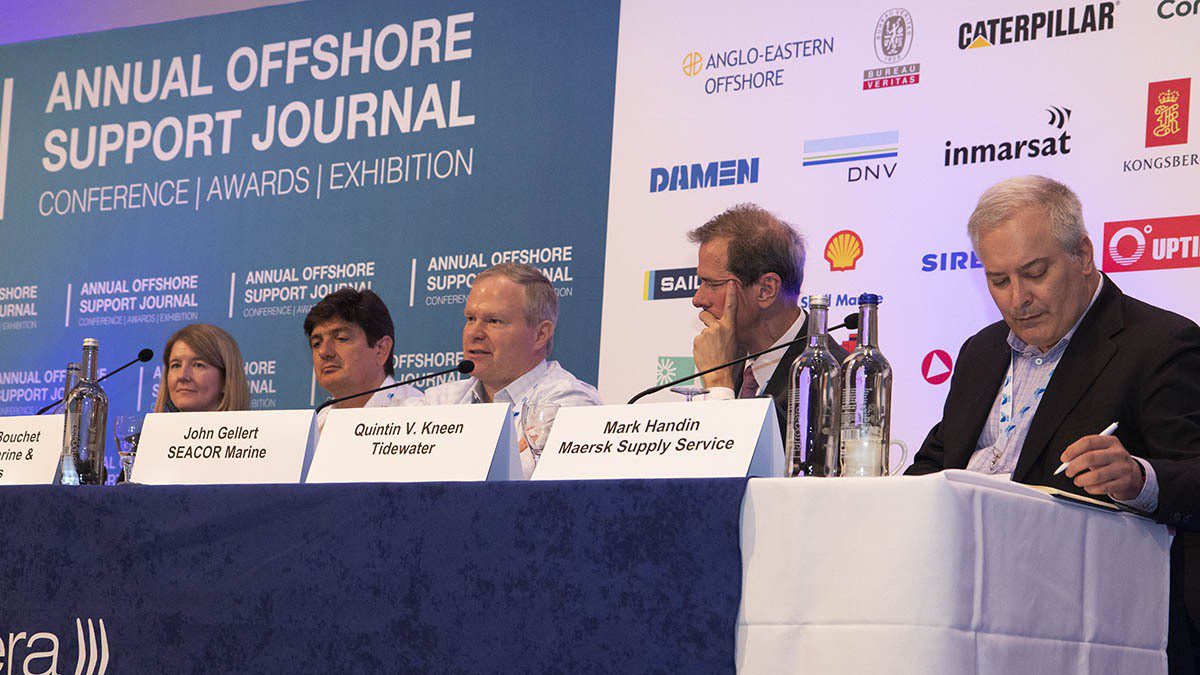
Tidewater chief executive and president Quintin Kneen told delegates at Riviera Maritime Media’s Annual Offshore Support Journal Conference, Awards and Exhibition, held in London, UK, 16 June 2022, how OSV markets will remain strong for three to five years because “fundamentals have jumped up and will not be changing for a while. The market will be positive into 2023 and 2024.”
During the owners debate, he said, “Around the world, all markets are up and better than 12 months ago.”
Some markets were already healthy, such as the Middle East and southern Caribbean.
Other regional markets, such as the US Gulf of Mexico and North Sea, have accelerated. “Brazil is getting better and Africa is accelerating quickly,” said Mr Kneen.
On the supply side, there are fewer vessels in layup or idle as owners have reactivated many for term charters and spot markets.
“Markets are getting tighter and this cannot be rectified in three to five years,” he added. This is how long it will take to build new OSVs with energy-efficient technologies to bring more tonnage into the market.
Maersk Supply Service chief operating officer Mark Handin was also upbeat, although the owner still has idle anchor handing tug, supply (AHTS) vessels to find work for.
“It is positive. US$120 per barrel oil is good for us. But we need to be conscious we do not go too far.”
He said owners should remain cautious before investing in new vessels just because the market is buoyant.
Mr Handin thinks PSV markets have improved, but AHTS demand needs to improve. “Large AHTS will have a good run. Some will be needed for floating wind and a lot of AHTS will be needed for towing and mooring floating production systems,” he said.
Seacor Marine Holdings president, chief executive and director John Gellert agreed markets have improved and owners could start generating profits.
But it is not all easy sailing for owners, as he summarised challenges they face. “The /Ukraine conflict means it is difficult crewing some vessels,” Mr Gellert said. “Decarbonisation does not make us money and there is little financing” for investments.
One of the technologies Seacor is investing in is digitalisation, which he said was “great for gains in efficiency.”
But, there are challenges. “Digitalisation needs to be safe and secure for transferring data between ships and shore. This is increasingly important. We need the data to know what fuel we are burning.”
Bourbon Marine & Logistics chief executive Rodolphe Bouchet said the market was returning, but are were still many idle vessels in the company’s fleet and dayrates had not improved enough.
“We have rationalised the fleet but it is still not enough. Bourbon had a fleet of 211 vessels in 2018, and this was down to 131 vessels Q1 2022. “We want to have an active fleet of around 120,” said Mr Bouchet.
“We are at the beginning of a new growth cycle, but dayrates need to go higher for fair margins.”
He said Bourbon would not order newbuild vessels. “We will look at the fleet we have to meet market requirements,” he said. “We will have to retrofit vessels to make them greener and more efficient.”
This will be significant investment for owners “but much cheaper than newbuildings” said Mr Bouchet. “We need to think about reuse and recycling with greener propulsion to meet different client requirements. We will need to adopt solutions that make more economic sense.”