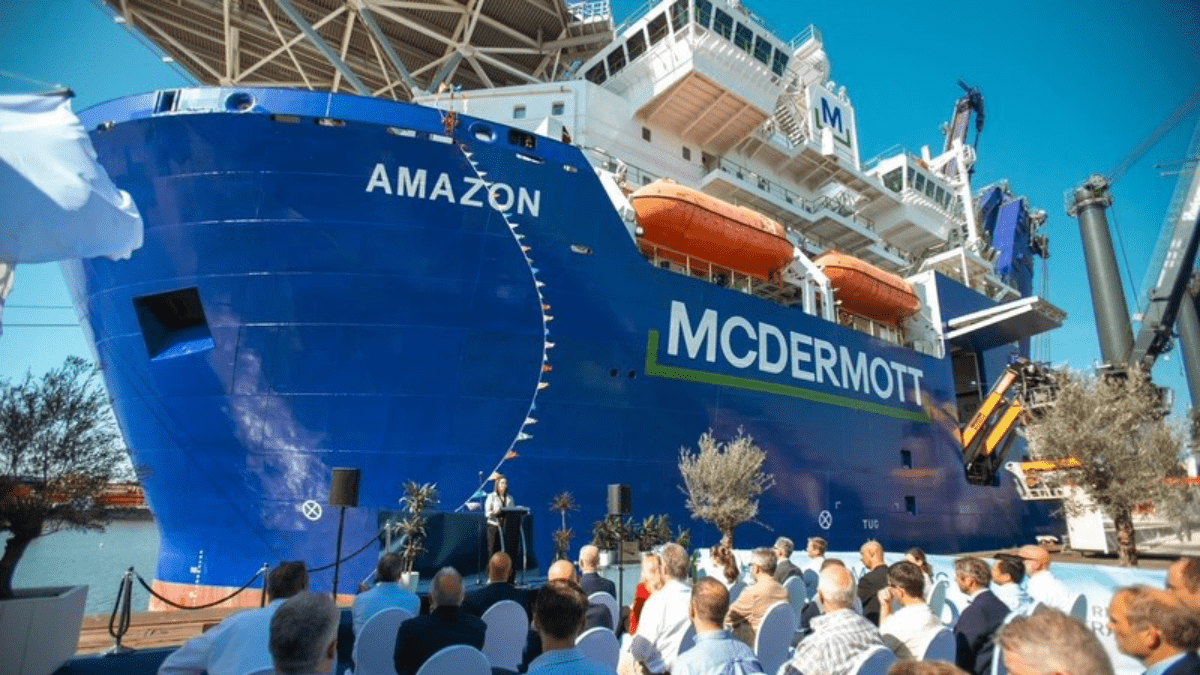
McDermott International unveiled its newly converted offshore construction support and pipelay vessel Amazon at a ceremony in the Port of Rotterdam, the Netherlands
As part of the US-based marine construction and engineering firm’s global deepwater subsea strategy, Amazon underwent conversion to enable highly automated operations, the production of hex joints from single or double joints using an onboard multi-joint facility and an upgrade to its pipe hold capacity of 10,000 tonnes. Its increased level of automation also enables a significant reduction in the crew numbers required to safely perform pipelay operations.
Additional features of the 199-m vessel are its two 400-tonne offshore mast cranes for single fall operations, rated at 200 tonnes at 5,000 m, and dual-fall operations of 400 tonnes at 2,500 m. Some 8,000 tonnes of cargo can be handled on its massive deck area of 4,600 m2.
McDermott International subsea and floating facilities senior vice president Mahesh Swaminathan called Amazon, a “game-changing vessel” to deliver ultra-deepwater projects. “The world-class pipeline system, installation versatility and advanced technology behind the upgrade significantly elevates its ability to efficiently deliver safe, quality-driven results,” said Mr Swaminathan.
One of the highlights in the conversion is the instalment of a high-capacity J-lay tower at Dutch shipyard Royal IHC. This involved the removal of the existing pipelay system and installation of the new J-lay system, including the tower and loading arm. Rated for water depths of 3,500 m, the J-lay system, with a top dynamic capacity of 1,500 tonnes, can handle a variety of pipe including normal flowlines, export lines and various pipe-in-pipe configurations.
Built to DNV class in 2014, Amazon is designed to be self-sufficient, allowing an easy transition from project to project and providing pull-through opportunities for the rest of the McDermott subsea fleet.