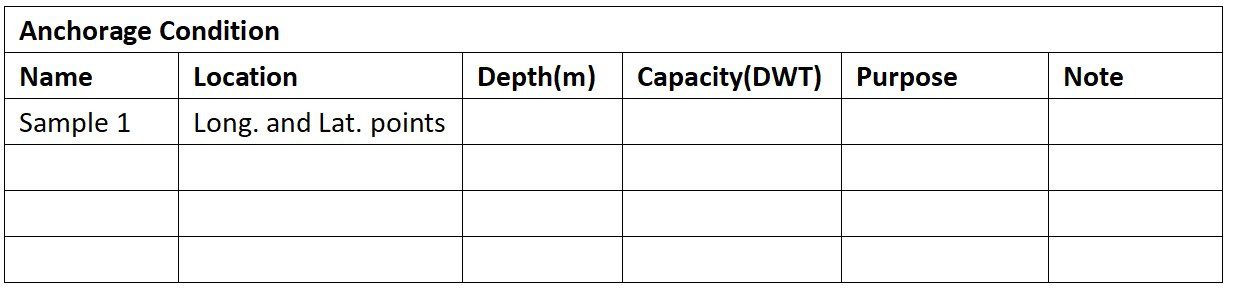
| Anchorage Name | Location (Coordinates) | Area (km²) | Depth (m) | Bottom Type | Max Vessel DWT | Capacity | Primary Use | Restrictions & Safety Notes | Commercial Notes |
|---|---|---|---|---|---|---|---|---|---|
| Funabashi Anchorage No. 1 | 35°41’30″N, 139°59’15″E (JGD2011 Datum) |
0.8 | 10-12 (Chart Datum) |
Mud/Sand (JHD Seabed Survey 2022) |
20,000 | 4 vessels (min 200m spacing) |
General cargo Pre-port waiting |
1. Limited swing room (1.5xLOA required) 2. Prohibited during currents >3 knots 3. Mandatory anchor watch maintained 4. Typhoon evacuation zone: NW quadrant |
1. Priority to scheduled vessels 2. Max stay 24h without extension 3. Bunkering requires separate permit 4. Fresh water available on request |
| Funabashi Anchorage No. 2 | 35°40’45″N, 140°00’30″E (JGD2011 Datum) |
1.2 | 12-15 (Chart Datum) |
Clay/Mud (JHD Seabed Survey 2022) |
30,000 | 6 vessels (min 250m spacing) |
Bulk carriers Temporary storage |
1. Daylight ops only for >20,000 DWT 2. Prohibited for LOA >250m 3. Special caution for cement carriers 4. Tug standby required for >25,000 DWT |
1. Dedicated cement carrier area (NE section) 2. Bunkering permitted with 12h notice 3. Slops reception available 4. Night surcharge applies |
| Funabashi Emergency Anchorage | 35°42’10″N, 139°58’40″E (JGD2011 Datum) |
0.5 | 8-10 (Chart Datum) |
Sand (JHD Seabed Survey 2022) |
10,000 | 2 vessels (min 300m spacing) |
Emergency repairs Storm refuge |
1. 24h prior permission required 2. Continuous VTS monitoring 3. Immediate evacuation if blocking fairway 4. Medical emergency priority |
1. No commercial operations 2. Charges: ¥25,000 first 12h 3. Damage assessment required post-use 4. No cargo operations permitted |
| Funabashi Temporary Anchorage | 35°41’05″N, 140°01’15″E (JGD2011 Datum) |
0.3 | 9-11 (Chart Datum) |
Sandy clay (JHD Seabed Survey 2023) |
15,000 | 3 vessels (min 150m spacing) |
Short-term waiting Tide-dependent ops |
1. Max 6h stay without extension 2. No night operations (sunset-sunrise) 3. Prohibited during neap tides 4. No anchoring in SW quadrant |
1. First-come-first-served basis 2. No commercial activities 3. Pilot transfer area designated 4. No fresh water supply |
Hydrographic & Environmental Data:
- Tidal range: 1.5m (max) – JHD Tidal Predictions 2024
- Currents: 2-3 knots spring tides (NE-SW flow) – Tokyo Bay Current Atlas
- Water temperature: 8°C (winter) to 26°C (summer) – MLIT Monitoring Data
- Visibility: Typically 5-10nm, reduced to 1nm during kosa (Mar-May)
- Seabed holding power: Grade B (1.5x normal scope recommended) – JHD Report JH-2023-1542
Navigation & Safety Requirements:
- Mandatory AIS transmission (continuous) – Tokyo Bay VTS Regulation Art.14
- Day shapes/lights per COLREGs Rules 30 & 35
- Engine on standby (warm) during entire anchorage period
- Pollution prevention: 100m boom for tankers, double containment for bunkering
- Anchoring watch: 1 officer + 1 lookout at all times
Operational Procedures:
- Permission requests: Via Tokyo MARTIS (VHF Ch.16/74) min 2h advance
- Reporting: Position, draught, cargo, ETA/ETD to Chiba Port Control
- Anchoring plan: Must include swing circle calculation (1.5xLOA + 50m)
- Emergency contact: Tokyo MARTIS +81-45-211-7234 (official number)
- Salvage coordination: Japan Coast Guard Sector Chiba
Commercial Regulations:
- Anchorage fees: ¥15,000/day (>5,000 GT), ¥8,000/day (<5,000 GT) – Chiba Port Tariff 2024
- Overtime charges: 150% (2000-0600), 200% (public holidays)
- Bunkering surcharge: ¥5,000/operation (plus environmental fee)
- Damage deposits: ¥500,000 required for vessels >20,000 DWT
- Cargo declaration: Required 24h before arrival (Customs Form C-1020)
Important Notes:
- All coordinates in JGD2011 datum (matches ENC systems)
- Depths referenced to Chart Datum (LAT)
- VTS monitoring includes radar, AIS and visual tracking
- Annual seabed surveys conducted each November
- Port regulations updated every April 1st