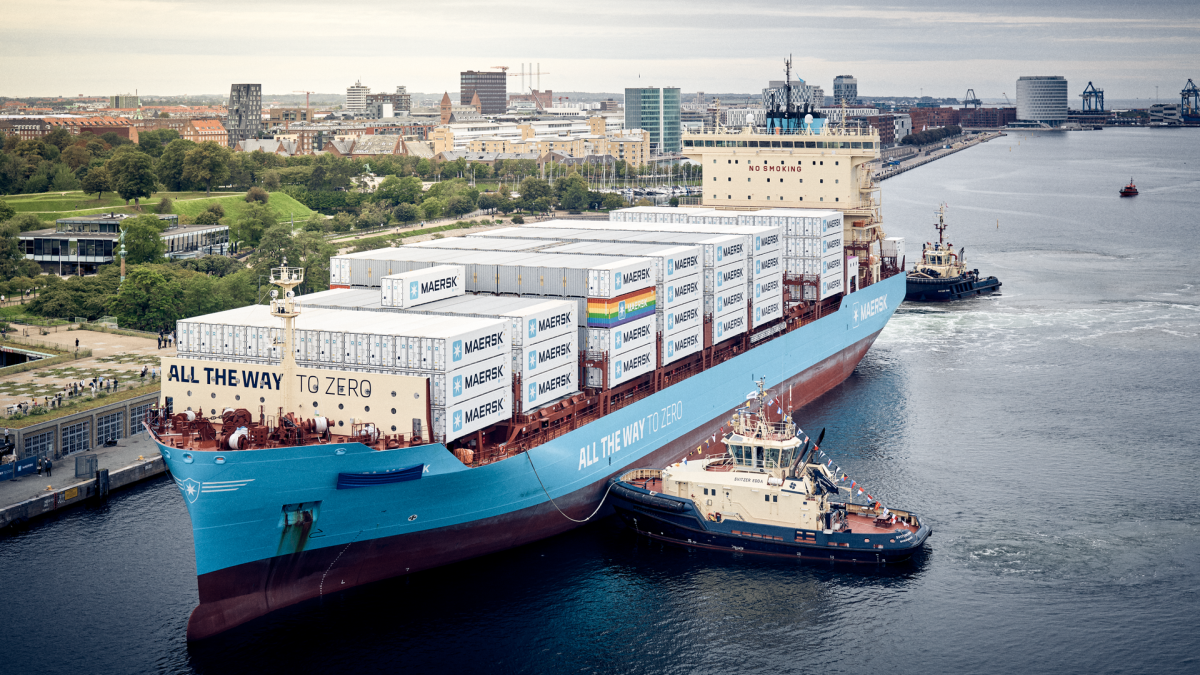
Maersk celebrated the naming of its newest dual-fuel methanol container vessel, Albert Maersk, in Mumbai today. This event marked the vessel’s maiden voyage to India and is a significant milestone as it is the eleventh vessel in Maersk’s fleet capable of operating on methanol.
The ceremony was led by Vincent Clerc, CEO of A.P. Moller – Maersk, and attended by distinguished guests, including the Honourable Minister of Ports, Shipping and Waterways, Sarbananda Sonowal, and the Honourable Minister of State for Youth Affairs and Sports, Raksha Khadse, along with government officials, diplomats, customers, and Maersk employees.
Honourable Minister Sarbananda Sonowal emphasized the significance of the event, stating, “It is a privilege for India to host the naming of this advanced dual-fuel vessel, marking a historic first for a foreign shipping company in our country. With the growing global demand for green vessels, India has immense potential to become a major producer and supplier of green methanol, ammonia, and hydrogen-based fuels. Maersk’s decision to explore green fuel production in India aligns well with our nation’s ambitions to lead in sustainable maritime practices. This vessel naming is more than tradition it represents trust, collaboration, and a shared vision for the future.”
Speaking at the event, Vincent Clerc announced Maersk’s commitment to decarbonizing shipping with the addition of the dual-fuel vessel to its fleet. He noted India’s rapid economic growth and the importance of shipping and logistics in supporting this expansion. Clerc expressed Maersk’s eagerness to partner with India in sourcing alternative fuels for low-emissions shipping and exploring opportunities in ship repairs and shipbuilding.
Maersk plays a crucial role in India’s economy by facilitating the movement of one in every six containers imported or exported from the country and enabling global trade through its integrated logistics solutions. The company’s operations in India include two APM Terminals in Mumbai and Pipavav that facilitate the import and export of over three million containers every year, 26 warehouses spread across 350,000 sq. m., and a distribution network covering over 80% of India’s pin codes.
During the ceremony, Maersk announced an investment opportunity pipeline of approximately USD 5 billion in ports, terminals, and landside infrastructure development in India.
Keith Svendsen, CEO of APM Terminals, highlighted “We aim to lower logistics costs by providing seamless, integrated supply chain solutions from port handling to warehousing and distribution. We are prepared to invest in efficient, low-emission port facilities that will enable businesses to grow and enhance India’s connectivity to global markets.
The Albert Maersk is part of a series of 18 large dual-fuel methanol vessels scheduled for delivery in 2024 and 2025. Built at Hyundai Heavy Industries in Ulsan, South Korea, the vessel can carry 16,592 standard containers (TEU). These dual-fuel vessels are integral to Maersk’s transition towards cleaner shipping, with bio- and e-methanol capable of reducing GHG emissions by at least 65% compared to conventional fossil fuels. Maersk has been actively advocating for strong International Maritime Organisation (IMO) regulations that support a multi-fuel future and help bridge the cost gap between fossil and alternative fuels.