Lloyd’s Register Foundation wanted to understand how safety is currently valued across different industries and sectors. For this reason, it commissioned Delft University of Technology (TU Delft) to undertake assess the status and effectiveness of current methods to value safety and explored opportunities to make improvements where needed.
According to the report, the work confirmed that safety has multiple values attached to it, that these vary between different organisations, sectors and countries, and that they can change over time.
It specifically found that health values have gained the most attention to date followed by economic and environmental values. The figure below shows the relative attention the different values have received in the literature and questionnaire.
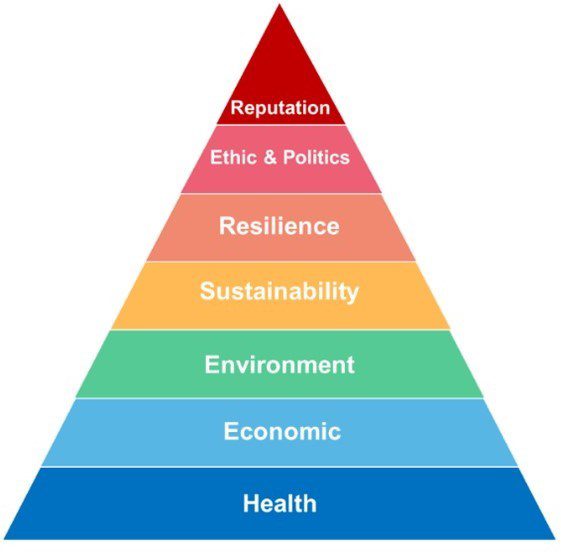 Furthermore, the authors found that there are gaps in the existing research on how safety is valued and in addition, that the methods available to measure values are limited.
#1 Health issues
The health value refers to the physical health and mental health of employees and the public. Consequently, occupational health is the primary concern for the health value. Importantly, in 2018 the ISO published ISO 45001 for management systems of occupational health and safety (OH&S), substituting OHSAS 18001. The objective of ISO 45001 is to reduce occupational injuries and diseases, promoting and protecting physical and mental health. In terms of mental health, the work mainly focuses on the mental health of frontline workers, healthcare workers, government leaders, and the public after an accident.
#2 Environmental issues
Environmental issues in the safety domain are typically related to pollutants caused by accidents, such as the release of hazardous materials into the local environment. For example, Duarte et al. (2012) studied the ecological risk caused by oil spills occurring during maritime transportation in the coastal tropical area of North-eastern Brazil.
In addition, Mrozowska (2021) conducted a risk assessment for major accidents offshore during drilling and production operations based on the provisions of Directive /EU, considering the impacts on the marine ecosystem. Moreover, emergency response actions to mitigate damage may themselves cause further harm if not implemented correctly, as such they also need to be addressed as part of this value.
#3 Economic issues
Economic value mainly concerns the costs of accidents, the costs of safety interventions, and the expected benefits from safety intervention. Namely, Ahn et al. (2021) developed a cost assessment model for sustainable health and safety management of high-rise residential buildings.
Moreover, Yang and Maresova (2020) investigated the impact of occupational health and safety management standards on the financial performance of pharmaceutical firms in China. Importantly, Elvik (2019) demonstrated that the monetary valuation of road safety is very imprecise, which may lead to difficulties in applying cost-benefit analysis to decision-making on road safety measures.
#4 Sustainability issues
Safety is a precondition for sustainable development, as such frequent or high impact accidents limit the sustainability of an industry. For instance, several chemical manufacturers in China were forced to close by the government in response to frequent safety breaches. Another well-known example is the planned shutdown of all nuclear power plants in Germany by 2023, a process started in response to the Fukushima nuclear disaster in 2011. Alongside industry, safety risks are also related to the sustainability of cities.
#5 Resilience issues
Resilience may refer to the ability of a system to anticipate, prepare for, and adapt to changing conditions and withstand, respond to, and recover rapidly from disruption. Improving the safety of a system can enhance its resilience of the system. Ewertowski and Butlewski (2021) developed a pandemic residual risk assessment tool for enhancing organisational resilience within Polish companies. Bragatto et al. (2021) studied the major accident management in Italian Seveso industries under the impact of the COVID-19 pandemic to improve organisational resilience.
The annual World Day for Safety and Health at Work on 28 April promotes the prevention of occupational accidents and diseases globally. The international day focuses on enhancing social dialogue towards a culture of safety and health.