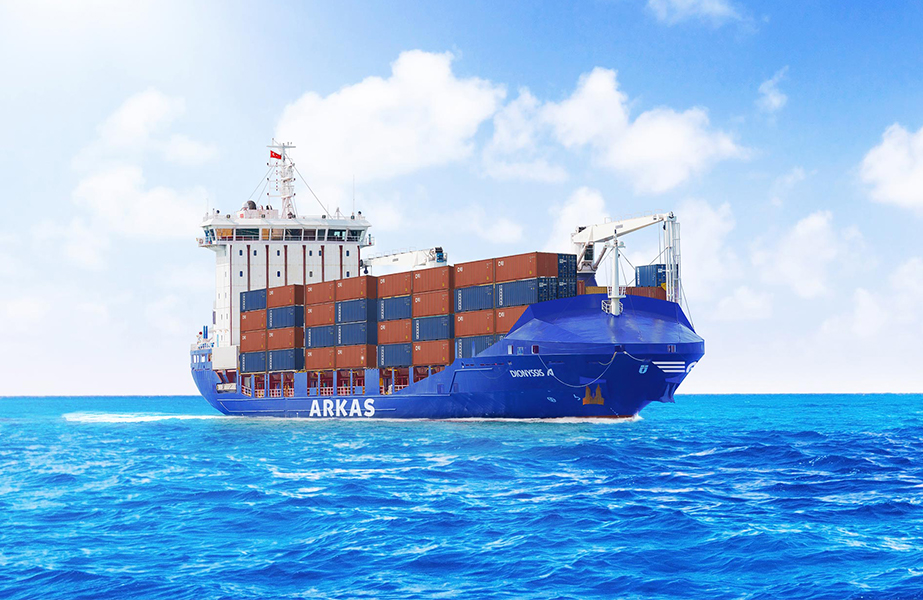
The suction sail is an innovative design that uses a small amount of energy to redirect a large flow of crosswind to assist ship propulsion, reducing the amount of thrust required from ship propellers. Spin-offs from the suction sail concept can be applied to other maritime transportation applications.
Introduction
The concept of the suction sail begins with conventional boat sails that convert the kinetic energy of crosswinds into vessel propulsion, applying Newton’s law of motion—that there is a kinetic reaction for every kinetic action. Designers of early sails, kite makers, and builders of early airplane wings focused on the interaction between wind on the upwind side of the sail, not the shadow side. The early aviation sector discovered the important role of the upper shadow side of a wing in sustaining ‘lift’ compared to the wing underside.
Developers of yachts experimented with adapting an aeronautical wing or airfoil sail for vessel propulsion by redirecting crosswind kinetic energy. Airfoil construction and ‘angle-of-attack’ in relation to crosswind direction made greater use of the shadow side of the airfoil to provide propulsive force, as long as air flowed over the shadow side like water flows down the side of a tilted mug. Airfoil design produced a low-pressure zone near the forward edge, diverting a large amount of crosswind rearward around the airfoil shadow side to generate greater propulsive force.
Suction Sail
The suction sail is a deck-mounted airfoil with an extractor fan installed at the upper end, pulling air in through slits in the airfoil to create a low-pressure zone across the airfoil shadow side. This modification significantly increases the amount of crosswind diverted rearward around the shadow side of the airfoil, greatly enhancing propulsive force by several orders of magnitude. The concept has potential applications in other areas of maritime propulsion, including below the waterline with hydrofoils and even Flettner Rotors.
Suction Hydrofoils
The ability of suction sail technology to greatly amplify the equivalent of ‘lift’ along the shadow side of an airfoil-sail provides the basis for adapting the concept to underwater operation in the form of suction hydrofoils. When submerged, a small propeller would draw a small volume flow rate of water through narrow slit-type inlets built into the hydrofoil upper surface. Water would flow through the hydrofoil interior and exit through an outlet below the hydrofoil or at its far end, potentially increasing the low-speed ‘lift’ of the hydrofoil.
Using suction technology to enhance ‘lift’ along the top surface of a hydrofoil increases the potential to raise a vessel hull above water at lower sailing speeds, also allowing the vessel to carry more weight on its hydrofoils. Raising the hull at lower speeds reduces drag when sailing through choppy water, enabling the vessel to travel at low speeds over extended distances with the hull above water. While most hydrofoil vessels are designed for high-speed sailing, there may be a market for low-speed hydrofoil vessels capable of smooth sailing through rough water.
Suction Rotor
The success of suction sail technology during real-world operation provides a basis to combine it with a competing technology, the vertical-axis spinning cylindrical Flettner Rotor. A hollow rotor with inlet slits and an extraction fan installed at its upper end offers the concept of a suction rotor. Reversible blades would allow the rotor and extraction fan to spin in either clockwise or counter-clockwise directions while pulling air through the rotor. A planetary overdrive gear would spin the extractor fan at extreme rotational speeds, sustaining a low-pressure zone inside the cylinder while diverting air inward through the inlets.
The moving boundary layer of a conventional spinning Flettner rotor develops a low-pressure zone in the crosswind shadow, diverting crosswind energy toward the low-pressure zone and changing its direction to produce propulsive thrust. Air flowing into the inlets at sonic speed would restrict air mass flow rate when wind blows directly at the inlets, allowing air to flow into inlets on the downwind shadow side. A rotary valve that momentarily closes inlets on the upwind side while keeping shadow-side inlets operational would theoretically divert a greater volume of crosswind kinetic energy rearward, producing greater propulsive force.
Conclusions
The suction sail is the ultimate development of airfoil-sail technology, harnessing propulsive force from crosswind kinetic energy. In wind-assisted ship propulsion, it outperforms all previous airfoil-sail designs. It is a proven concept based on flow dynamics that has potential applications below water, in hydrofoils intended to raise a vessel’s hull above water at low sailing speeds and carry greater weight at higher speeds. There is also scope to adapt suction sail airflow dynamics to a competing wind-assisted ship propulsion technology, the vertical-axis spinning rotor.
In both suction sail applications and potentially with spinning rotor applications, the airflow dynamics offer the ability to divert a greater proportion of crosswind kinetic energy to vessel propulsion, using minimal energy input. The concept can achieve the same result as an extremely tall wind technology while using less height and maintaining a lower center of gravity. Adapting suction rotor dynamics to a cylindrical rotor spinning on a vertical axis will need to be the focus of future research, to develop greater propulsive thrust from a larger proportion of crosswind kinetic energy.