In September, the operational efficiency of China’s major ports experienced fluctuations, while the operational efficiency of major ports in Europe, America, and along the routes also saw respective rises and falls.
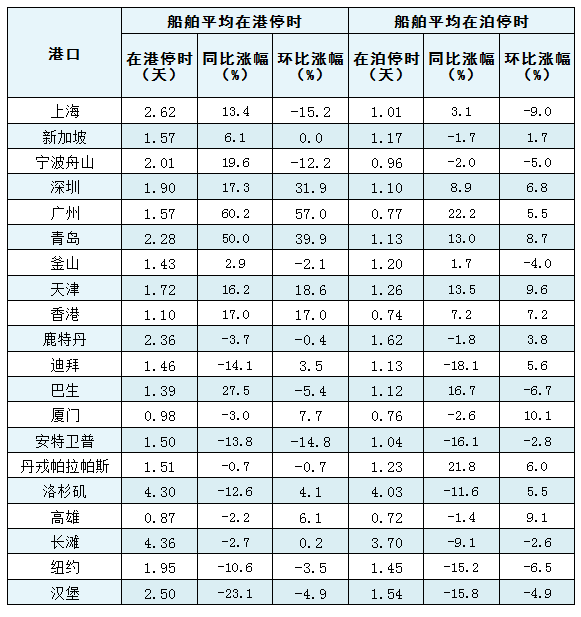
In September, affected by typhoons, the operational efficiency of China’s major ports experienced some fluctuations. The average time in port and at berth for international container ships at China’s major ports were 1.67 days and 0.94 days respectively, up by 10.6% and 4.4% month-on-month. This was better than the average time in port and at berth for container ships at the other 11 major foreign ports (2.21 days, 1.75 days).
The operational efficiency of major ports in Europe and America fluctuated. Among them, the average time in port for ships at the Port of Rotterdam in Europe was 2.36 days, down 0.4% month-on-month; the average time in port for ships at the Port of Hamburg was 2.50 days, down 4.9% month-on-month. The average time in port for ships at the Port of Los Angeles, a major US West Coast port, was 4.30 days, up 4.1% month-on-month; the average time in port for ships at the Port of Long Beach was 4.36 days, up 0.2% month-on-month.
Average Time in Port and at Berth for International Ocean-Going Container Ships at Global Major Ports in September 2025
Remarks:
Time in port refers to the total duration from when a ship arrives at the port’s anchorage waiting for a berth until it completes /unloading operations at the berth and departs. This indicator centrally reflects the comprehensive efficiency of port facilities and equipment, pilotage, scheduling, /unloading, collection and distribution, and customs clearance.
Time at berth refers to the total duration from when a ship docks at the berth for /unloading operations until it completes the operations and departs the berth. This indicator mainly reflects the /unloading operation efficiency during the ship’s time at berth.