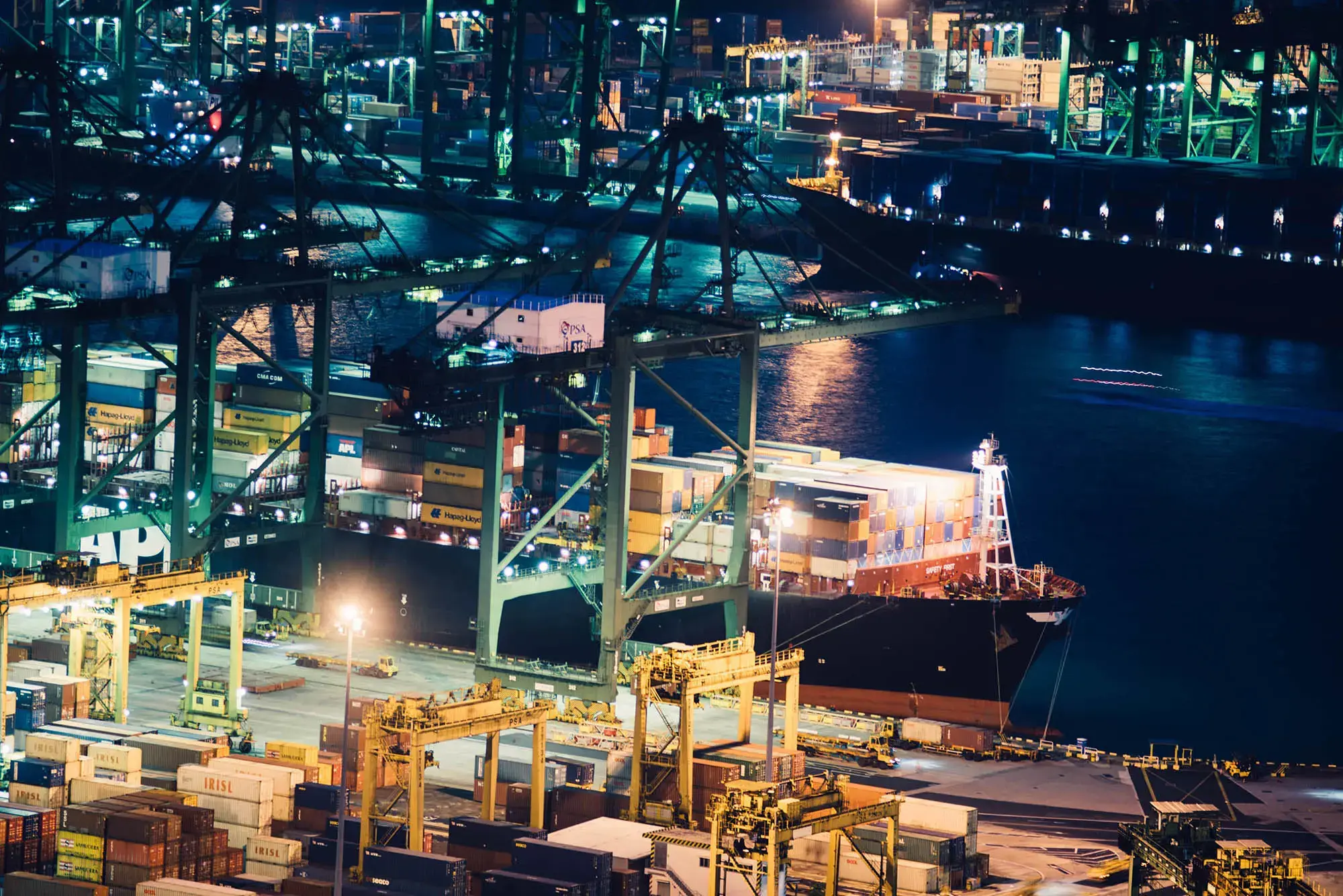
In America, talking about automation generates more noise than the diesel machines operating in the ports. The first to be discontent and, evidently, worried are the port workers who see in this possibility the specter of unemployment. At some point, the academic from the Valenciaport Foundation, Miguel Garín, coined that “there is no smart port without smart people” and, indeed, this largely corresponds to the training that the port worker -regardless of their function or specialty- must require to operate in the maritime exchange stations of the future.
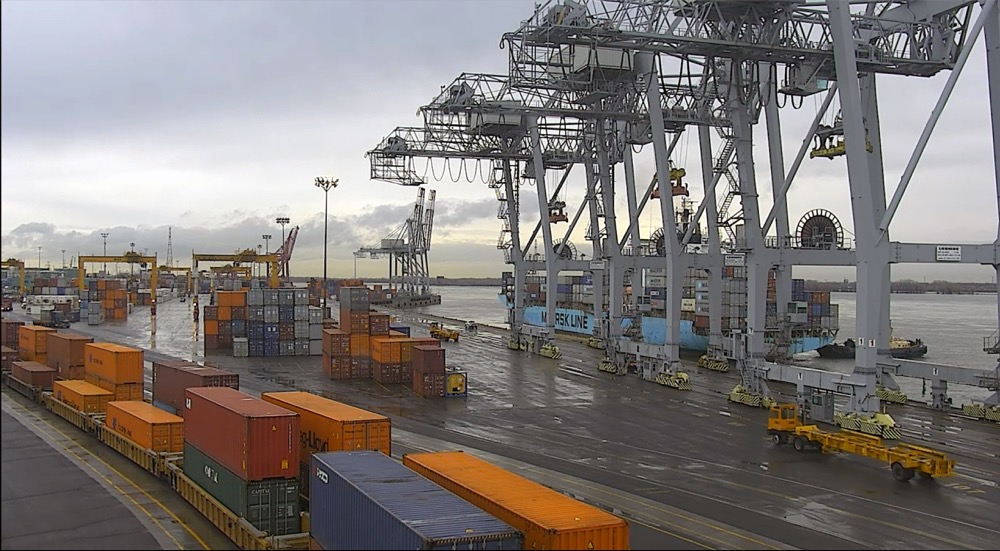
Until now, the region has the semi-automated terminal of APM Terminals in Lázaro Cárdenas, Mexico, and the fully automated one in Chancay, signs that this future, which sometimes seems distant, is already becoming part of the present, of the now. However, while this manages to become established, which will also depend on the rules of the upcoming concessions or addenda, at DP World they are thinking of a different path through teleoperation, which will allow increasing the performance of equipment like their STS cranes, doing it -moreover- safely.
“There is the alternative of remote control of the equipment, where the crane operator does not necessarily have to be sitting 50 meters above the ship, but can be in the operations center with screens. Nowadays, you have screens, cameras and you can control the same as from the crane, you can control it from an operations center with air conditioning, communication equipment, many cameras and monitors. In Callao, a pilot plan is already being implemented so that our crane operators train in this new technology of operating remotely,” commented Otto Bottger, commercial director of DP World for the Americas Region.
“I believe that Latin America still has a long way to go before thinking about automation. Furthermore, our port operators are good and what one sees as automation in other parts of the world is not necessarily much better, despite the gigantic investment.
The remote control is another thing, because it is the same human factor, just surrounded by new technology,” he added.
On a countdown is the new Colombian port of Antioquia which is waiting to be inaugurated and begin operating its first import and export loads, becoming another point in the Caribbean enabled for the movement of containers and other cargo formats.
It is estimated that the first official operation will come from CMA CGM with its /WSCSA service, which should occur on December 20 with the call of the CMA CGM Imagination of 6,874 TEU.
This first service will be weekly and will connect ports on the west coast of South America from Paita to Buenaventura to, then, call at several points in the Caribbean before departing to the Mediterranean.
Waterway
In Argentina, the Federal Government, through the Ministry of Security, launched the Paraná Plan aimed at the prevention, detection, neutralization and investigation of illicit activities in the Paraná-Paraguay Waterway.
The initiative aims to dismantle smuggling networks and organized crime on the northern river border, located in the provinces of Chaco, Formosa, Corrientes and Misiones.
Likewise, the idea seeks to increase controls in public and private ports of the lower section of the Waterway with special attention to the prevention, detection and prosecution of federal crimes.
It is worth remembering that, in recent weeks, alarms were raised about the waterway after pirate actions were detected in the San Nicolás area.
Drugs
For its part, in Peru, within the framework of the Container Control Program in Latin America and the Caribbean of the United Nations Office on Drugs and Crime (UNODC), the new Joint Control Unit (UCC) was put into operation in the Port of Chancay, a key space to strengthen supervision and combat illicit activities in the port logistics chain.
The UCC is made up of the National Port Authority (APN), the National Superintendence of Customs and Tax Administration (Sunat), the Anti-Drug Directorate of the National Police of Peru (Dirandro), the Navy of Peru (MGP) and the Public Ministry (MP), who work together to analyze risks and prevent the use of containers for illicit purposes.
As the end of the year approaches, statistics begin to appear and outline who and with how much will enter the so-called “millionaires’ club of the Americas.”
This week, the Port of Los Angeles, in the United States, announced that by the end of October, it had achieved a transfer of 8.6 million TEU, which is 2% higher than 2024. In Brazil, on the other hand, Santos has already added 4.9 million 20-foot containers transferred.
Slightly behind, the Port of Cartagena, in Colombia, could consolidate a flow slightly above 4 million TEU, according to a source from PortalPortuario.
Likewise, in Peru, the Port of Callao, through its DP World terminal, will exceed 2 million TEU, as Marco Hernández, general manager of that concessionaire, advanced to PortalPortuario. To this performance, the figures of its neighbor APM Terminals, which would be around 1.15 million TEU, must be added.
In Mexico, in turn, APM Terminals Lázaro Cárdenas reported this week that it surpassed the mark of 1 million TEU.
Something that San Antonio Terminal Internacional achieved at the beginning of the month and which, added to DP World San Antonio, could bring the main Chilean port to approximately 2 million TEU.
The port operator APM Terminals will invest 550 million dollars to carry out expansions in the Port of Callao, Peru, starting in January 2026, according to Fernando Fauche, commercial director of the company’s Peruvian unit.
The project will last two years and aims to increase the terminal’s capacity and enable its facilities to receive 24,000 TEU vessels, as Fauche explained to journalists during an event celebrating the start of direct arrivals from Asia to the facility located on the central coast of Peru.
The tariff measures of the Donald Trump Administration in the United States are beginning to recede. On November 15, the President removed a total of 200 food products from the list of goods subject to tariffs, including staples such as coffee, meat, bananas, and orange juice, in response to growing concern from American consumers about the high cost of food.
The new provisions have freed 100 products from the Peruvian agro-export basket from these tariffs. The same happened with a series of Chilean agricultural exports, now freed from those surcharges.
For the first time in its history, the Port of Quebec received cruises from the middle of winter until the height of autumn, which marked an exceptionally long and varied 2025 season. Between late January and early November, the terminal received international ships almost every month, consolidating the city as a true year-round destination on the St. Lawrence River.
The terminal welcomed almost 140 thousand cruise passengers during 103 calls made by 35 ships from 22 different companies. Furthermore, it was the first or last port of call for 21 cruises, demonstrating the continued confidence of cruise companies in the port and the experience it offers their passengers.
Although in the 19th century several of the port cities had a good connection to the railway, today the reality is very different. Therefore, whenever announcements about the return of trains arise, expectations are high. In this sense, this week the tracks resonated with news in different parts of the continent.
In Peru, the Minister of Transport and Communications (MTC), Aldo Prieto, detailed that the sector is promoting a portfolio of seven railway projects in different regions with an investment exceeding USD 40 billion. One of them is the Lima-Barranca Railway, which will facilitate commercial exchange with the ports of Callao and Chancay.
In Brazil, the Ministry of Transport formalized the concession contract for the southeastern railway network. The agreement contemplates investments worth 3.8 billion reais (702,117,640 dollars) aimed at improving operational efficiency and freight transport.
In Uruguay, the National Port Administration of Uruguay (ANP) reported the unloading at the Port of Montevideo of three locomotives built in Brazil for Grupo RAS.
These are the first units of a total of seven, which will be used to mobilize cargo to the port facility starting in March or April 2026.
Finally, in Chile, the Antofagasta Railway (FCAB) took a decisive step towards the decarbonization of railway transport in the country.
The company, with 137 years of history in the north of the country, carried out the inaugural journey of its locomotive powered by green hydrogen, the first to operate in Latin America.
The journey, which extended from Patio Norte to the Port of Antofagasta, specifically to the concession holder Antofagasta Terminal Internacional (ATI), brought together national and regional authorities, representatives from the mining and railway sectors, along with the local community.
From the networks, the most viral
Previous editions: