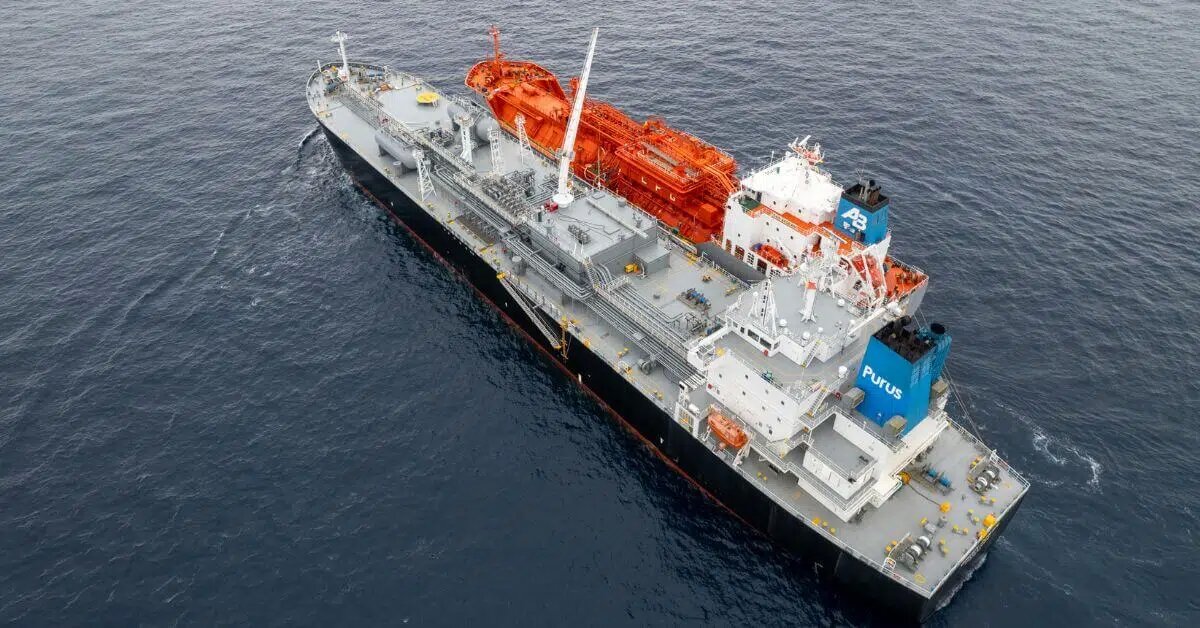
Image source: Frontline
Shipping Network news, tanker owner Frontline released its third quarter 2025 financial report on November 21. During the reporting period, Frontline’s overall performance in the third quarter was weaker than market expectations. In fact, the market is getting increasingly excited as VLCC spot rates rebounded to $100,000 per day.
Frontline CEO Lars Barstad said, “The third quarter started in line with seasonal trends, with the summer typically being softer. However, as the quarter progressed, the freight market strengthened, particularly for VLCCs. Global oil demand remains resilient, and the gradual reversal of OPEC+ production cuts is starting to be reflected in increased export volumes. After a moderate third quarter, we are excited to face strong fundamentals and Frontline’s efficient, spot-oriented fleet as rates reach multi-year highs entering the winter market.”
Specifically, in the third quarter of 2025, Frontline achieved operating revenue of $440 million, a year-on-year decrease of 10.5%; operating profit reached $95.967 million, a year-on-year decrease of 33.7%; and net profit was $40.319 million, a year-on-year decrease of 33.3%.
In the third quarter, the average daily time charter equivalents (TCEs) for Frontline’s VLCCs, Suezmax tankers, and LR2 tankers operating in the spot market were $34,300, $35,100, and $31,400, respectively, representing year-on-year decreases of 13.4%, 12.0%, and 12.8%.
For the first three quarters of 2025, Frontline achieved operating revenue of $1.35 billion, a year-on-year decrease of 21.7%; operating profit reached $320 million, a year-on-year decrease of 50.8%; and net profit was $150 million, a year-on-year decrease of 64.8%.
For the fourth quarter of this year, Frontline has secured 75% of its VLCC fleet’s spot market operating days at an average daily rate of $83,300; 75% of its Suezmax tanker fleet’s spot market operating days at an average daily rate of $60,600; and 51% of its LR2 fleet’s spot market operating days at an average daily rate of $42,200.
Fleet Update
The report disclosed that Frontline sold one 2011-built Suezmax tanker at a net price of $36.4 million, delivering it to the new owner in September. After repaying existing debt, this transaction generated approximately $23.7 million in net cash in the third quarter and resulted in a gain of approximately $5.9 million.
Following the completion of this transaction, Frontline owns and operates 80 tankers, consisting of 41 VLCCs, 21 Suezmax tankers, and 18 /Aframax tankers. The daily break-even points for its VLCC, Suezmax, and LR2 tankers over the next 12 months are $26,000, $23,300, and $23,600, respectively.
Tanker Market Analysis
According to the Energy Information Administration (EIA), global oil consumption averaged 104.8 million barrels per day in the third quarter of 2025, an increase of 1.4 million barrels per day compared to the same period last year.
Global oil supply accelerated in the third quarter, averaging 107.4 million barrels per day, an increase of 2.4 million barrels per day from the previous quarter and 4.3 million barrels per day higher than the same period last year. In the third quarter of 2025, inventories increased by an average of 2.6 million barrels per day. Global supply is expected to continue exceeding demand by an average of 2.6 million barrels per day in the fourth quarter.
Geopolitical uncertainty, shifting trade patterns, and OPEC+ production policies remain key drivers for fleet utilization and earnings.
In short, expanding supply, longer sailing distances, and stricter compliance continue to support strong fundamentals in the crude tanker market heading into the year-end.
As of now, the VLCC orderbook stands at 135 vessels, the Suezmax orderbook at 111 vessels, and in the LR2 segment, the orderbook is 162 vessels. Industry analysts state that only 3 VLCCs are expected to be delivered in 2025, with capacity growth primarily dependent on deliveries in 2026 and 2027. Due to the overall age profile of the existing fleet, this is not expected to impact the overall tanker fleet outlook in the near term.
As newbuilding deliveries slow and scrapping remains subdued, the tanker fleet will continue to age. Industry analysts point out that 17.4% of the global VLCC fleet, 20.3% of the Suezmax fleet, and 20.5% of the LR2 fleet are over 20 years old.