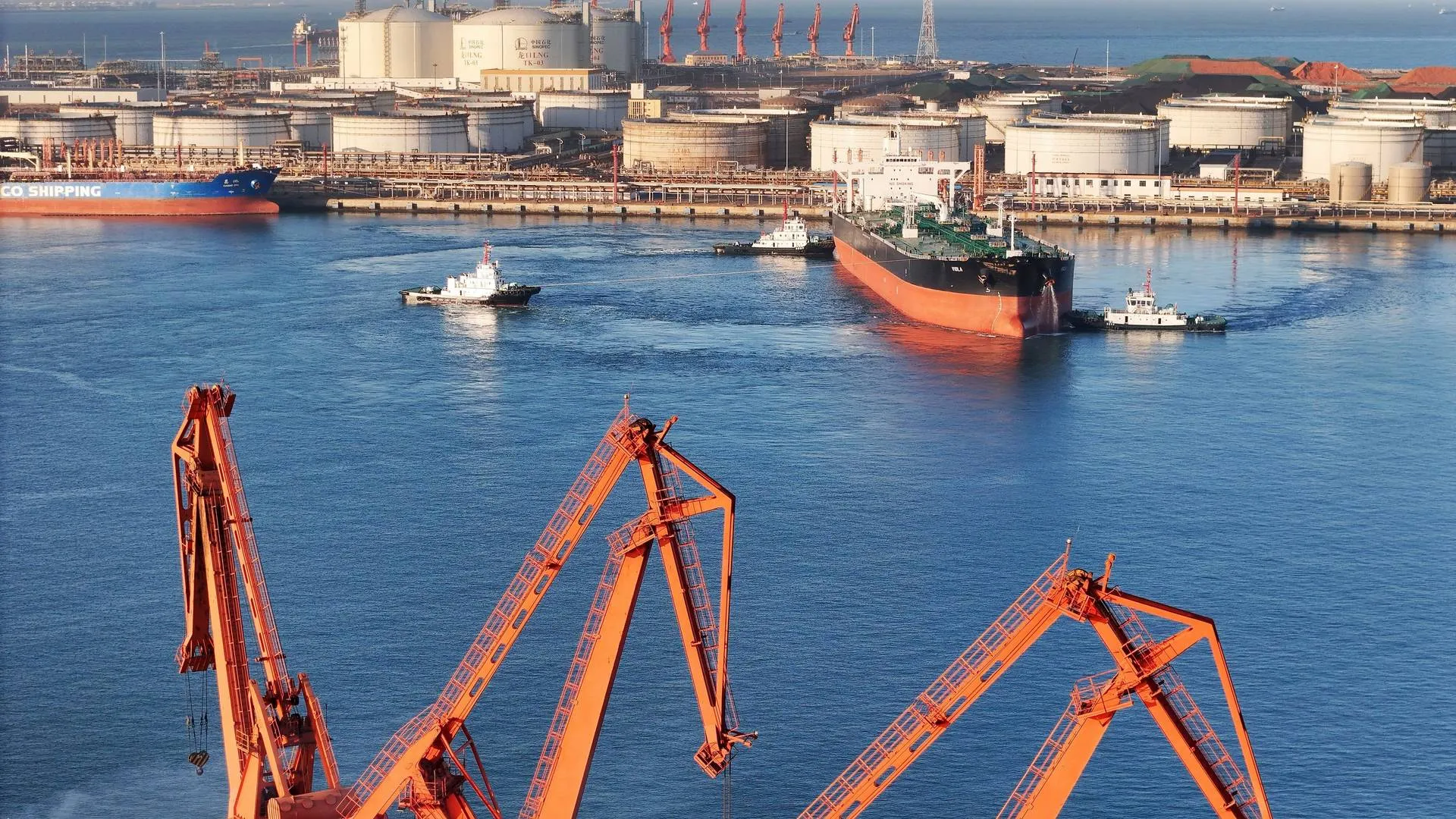
In the depths of winter, with cold winds howling, the Beisan Grain Terminal at Dongjiakou Port Area of Shandong Port Qingdao Port was a scene of bustling activity. At 12:00 on November 26, as the fully automated grain ship unloader smoothly completed its work, a grain ship fully loaded with 68,250 tons of wheat finished all unloading operations in just 21 hours, setting a new industry record for grain terminal unloading. This marks the second time Qingdao Port has broken this record this year, fully demonstrating its professional standards and benchmark strength in the field of grain unloading, and providing robust support for ensuring the grain supply this winter and next spring, thereby strengthening the national food security defense line.
Food security is crucial for national governance and the well-being of the people. As the largest grain unloading base along the Yellow River basin and an important grain transfer hub in the north, Qingdao Port has always deeply implemented the national food security strategic deployment, actively integrated into the national grain industry chain layout, and built a comprehensive, all-chain guarantee for grain cargo through specialized grain berths, ultra-large intelligent silo clusters, and a fully intelligent operational system. This not only stabilizes the supply in the domestic grain, oil, and feed markets but also serves as an important engine driving the coordinated economic upgrade of hinterland areas such as Shandong and Henan.
Behind this record-breaking achievement is the dual empowerment of “Chinese Intelligent Manufacturing” and precise management. Qingdao Port innovatively implemented a single-vessel production line responsibility mechanism, fully unleashing the potential of equipment such as fully automatic hopper-equipped gantry cranes and ship unloaders. Through the integration of digital intelligence and automatic control technology, as well as an integrated intelligent management platform, it achieved automated operation of five major categories of equipment: “quayside equipment, urban truck loading, container loading operations, grain process transportation, and hold cleaning operations.” Simultaneously, relying on the “Zhi Sun” safety management and control system, a closed-loop management mechanism was established to monitor the safety status of each operation link in real-time, ensuring high efficiency and smoothness throughout the entire process with intelligent optimization and precise decision-making.
Facing critical grain unloading tasks, departments such as Dongjiakou Port Customs, Maritime Safety, and Border Control provided proactive services, opening a “green channel” for grain customs clearance; the pilot station accurately assessed strong wind conditions and efficiently scheduled pilotage; the Qingdao Port Production Dispatch and Command Center fully coordinated efforts, with all parties working together to lay a solid foundation for breaking the record. During the operation, Qingdao Port’s Dongjiakou Branch Company promptly assessed the ship schedule dynamics in advance, achieving precise and timely berthing through scientific planning. It also organized specialized personnel to conduct silo cleaning operations, clearing eight silos in advance to reserve sufficient space for wheat unloading. Meanwhile, equipment inspections were carried out beforehand, and phased operation plans were formulated for each hold to ensure safe and steady progress.
As a key node in the national grain supply chain, Shandong Port Qingdao Port’s latest record-breaking achievement not only showcases the comprehensive advantages of “large terminals, large storage yards, high efficiency, and superior service” but also confirms the strong resilience of China’s grain collection and distribution system. In the future, Qingdao Port will continue to strengthen the construction of its grain collection and distribution system, enhance the quality and efficiency of its comprehensive port services, polish the “golden brand” of grain unloading, shoulder the political responsibility of ensuring national food security with concrete actions, and make new contributions to serving the high-quality development of the economy and society.