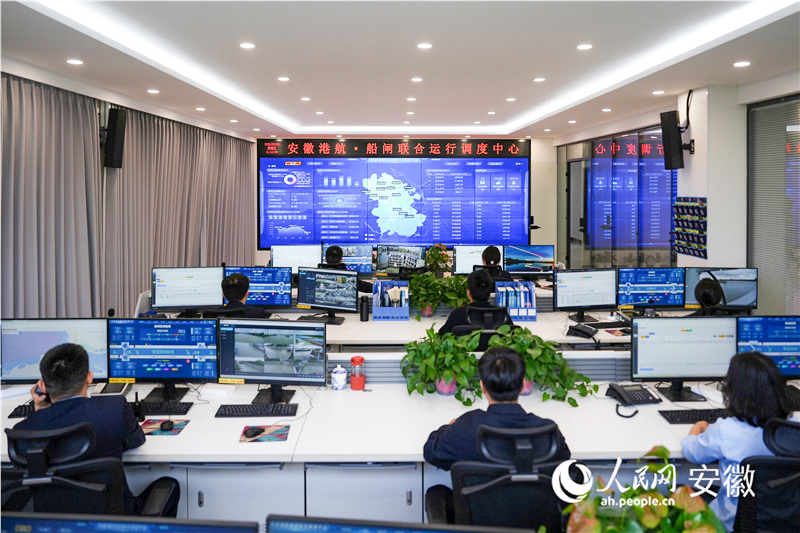
People’s Daily Online Hefei, November 27 (Reporter Miao Zijian) Inside the Anhui Port and Shipping Lock Joint Operation Dispatch Center, staff can remotely schedule locks located on different waterways across various river basins hundreds of kilometers away with just a click of the mouse. Crew members no longer need to go ashore to pay fees, and vessels can pass through smoothly, significantly improving transit efficiency.
The Lock Joint Operation Dispatch Center. Photo by Miao Zijian, People’s Daily Online reporter
“This is the most powerful ‘smart brain’ for lock operation management in the province, and also the nation’s first provincial-level cross-basin, multi-waterway lock joint operation dispatch center,” Zhang Wei, the director of the dispatch center, told the reporter. By integrating the resources of 22 locks at 17 locations owned by the group, it achieves unified reporting and review, unified dispatch control, unified information services, and unified centralized management, comprehensively enhancing the public service capacity and level of the waterways.
Relying on the platform’s “four unifications” function, the average vessel dispatch time per lock cycle is reduced by about 15 minutes, transit time is shortened by about 8 minutes, and lock operation dispatch efficiency is improved by about 6%.
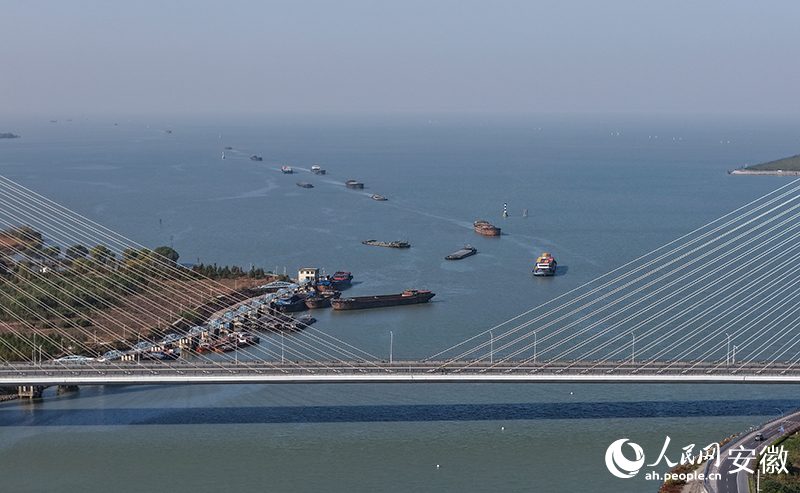
The busy Heyu Waterway. Photo by Miao Zijian, People’s Daily Online reporter
On August 9, 2024, the Anhui Port and Shipping Lock Joint Operation Dispatch Center was officially established. As of November 20, 2025, it has cumulatively opened for lock cycles 38,765 times, handled 129,365 vessel transits, with a total lock transit tonnage of 235 million tons.
As the “smart brain” for Anhui’s lock operations, the dispatch center has broken down the geographical and management barriers between the locks in the Yangtze River and Huai River basins. It has effectively solved problems such as poor scheduling coordination and inefficient information exchange between locks on different waterways. This has realized a “single diagram” for lock operation dispatch management and “one-stop” service for vessel lock transits, significantly enhancing the specialization, standardization, informatization, and coordination level of lock operation dispatch within the province’s trunk waterway network.
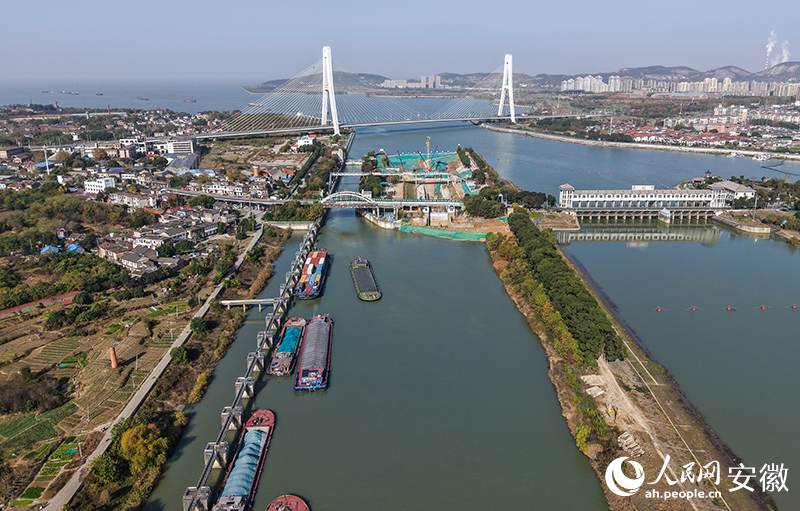
Chaohu Lock. Photo by Miao Zijian, People’s Daily Online reporter
To date, the number of registered boatmen within the system exceeds 21,000, with approximately 20,000 active vessels on record. Boatmen only need to use mobile terminals like smartphones to obtain full waterway navigation information with one click and grasp vessel dynamics in real-time, truly realizing “smart navigation at their fingertips.”
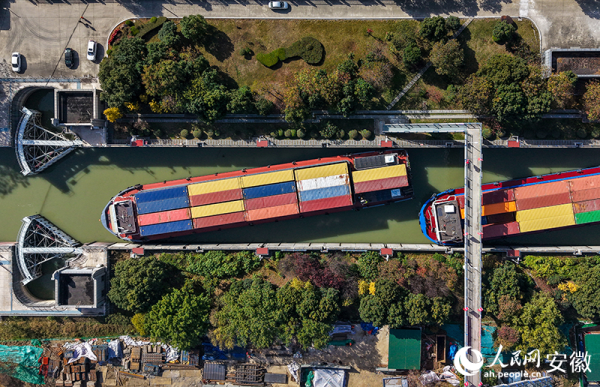
A vessel passing through the Chaohu Lock. Photo by Miao Zijian, People’s Daily Online reporter
“Staff are selected and transferred from various local lock sites to work together in a centralized office, where one person can simultaneously dispatch multiple locks,” according to Zhang Wei. Adopting this joint dispatch operation model can reduce the land required for local management buildings at the group’s locks under construction, such as those in Yuxi, Guoyang, and Linhuan, saving over 30 million yuan in one-time construction costs. For the group’s existing 22 locks, approximately 100 operational staff can be reduced, saving 20 million yuan in annual labor operational costs. Simultaneously, vessel lock transit efficiency is significantly improved. Based on an average of 12,000 vessels operating annually in Anhui, this can save costs and increase revenue for shipping companies by about 2.64 billion yuan per year.