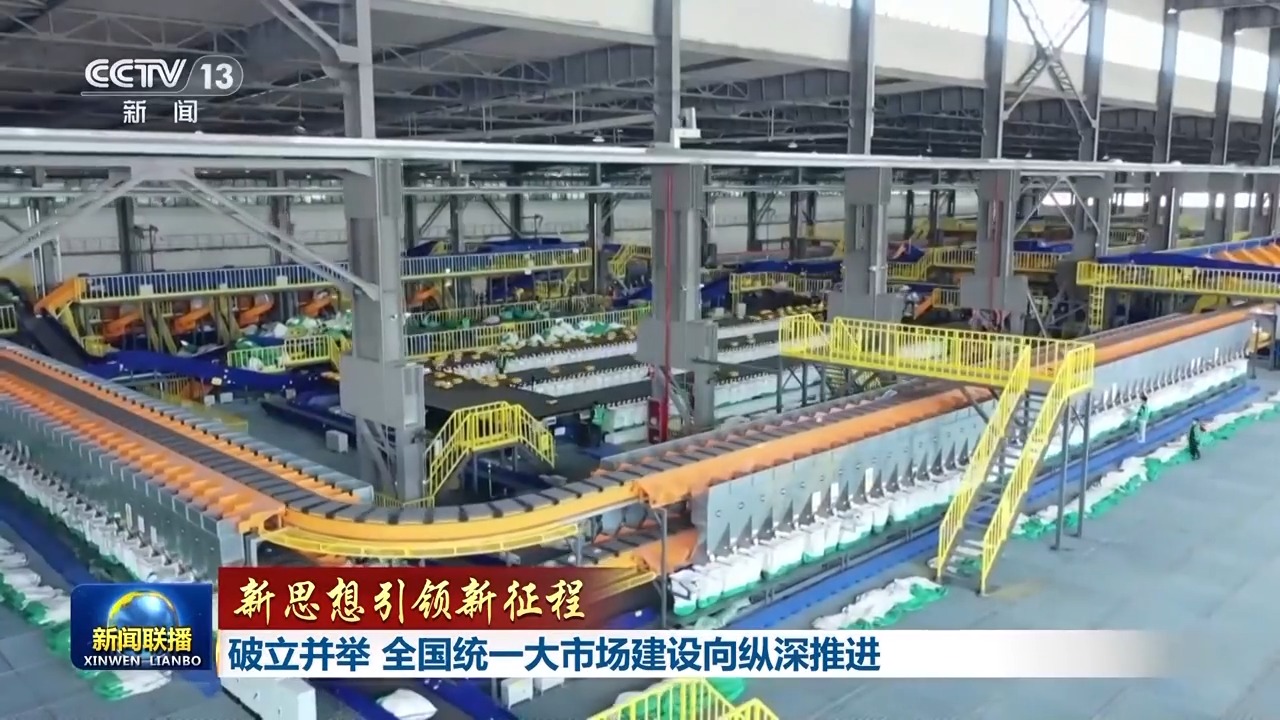
President Xi Jinping emphasized that building a unified national market is not only necessary for constructing a new development pattern and promoting high-quality development, but also essential for gaining the initiative in international competition. Currently, many regions are focusing on key and difficult tasks, intensifying efforts to eliminate local protectionism and market fragmentation, and continuously improving the fundamental systems of the market structure. Through the dual approach of dismantling and establishing, the construction of the unified national market is accelerating and deepening, constantly injecting strong momentum into promoting high-quality economic development.
Since the beginning of this year, the construction of the unified national market has gained “acceleration.”
Not long ago, China released its first public logistics data sharing and opening list, promoting the opening and interconnection of 10 types of data including highway, railway, waterway, aviation, and postal services, accelerating the removal of data barriers in the logistics industry.
Advancing the construction of the unified national market in depth is inherent in building a new development pattern and promoting high-quality development. When deploying economic work for this year, President Xi Jinping emphasized the need to focus on correcting market failures, standardizing competition order, and making the unified national market a grand stage for fair competition among all types of business entities. He proposed that the basic requirement for deepening the construction of the unified national market is “Five Unifications and One Opening.” All regions should actively integrate into the construction of the unified national market, resolutely eliminate local protectionism, market fragmentation, and “involution-style” competition, and build a fairer and more dynamic market environment.
Li Yuju, Deputy Director of the Xi Jinping Thought on Economic Studies Research Center: President Xi Jinping profoundly elucidated the strategic considerations for building a unified national market, scientifically answered how to balance the relationship between an effective market and a proactive government, the relationship between the unified national market and local competitive development, and the relationship between relying on the domestic market and deepening opening up. He clarified the long-term goals and directions and the tasks and measures to be continuously advanced, providing fundamental guidance for more systematic, in-depth, and comprehensive promotion of the unified national market construction.
During the “14th Five-Year Plan” period, the construction of the unified national market continuously advanced in depth. The items on the market access negative list were reduced to the current 106 items; a centralized cleanup of 4,218 regulations and practices that hindered the unified national market and fair competition was conducted; and consistency assessments of newly introduced policies with macro policy orientations were carried out. The “four beams and eight pillars” of the unified national market have been basically established.
Currently, focusing on bottlenecks and blockages, all regions and departments are taking real and practical measures to solve the deep-seated problems in the construction of the unified national market.
Actions to reduce costs, improve quality, and increase efficiency in transportation and logistics are being deeply implemented. The 404-kilometer-long Northern Jiangsu Canal is one of the busiest waterways in the country, with 28 large ship locks in the basin. In the past, ships had to report information each time they passed a lock, often leading to long queues before the locks. The newly launched smart shipping system has broken down the data barriers between various links. Once a ship enters the canal, a single declaration allows it to pass all locks along the way.
Captain Liu Qiang: It used to take over half a month at the longest to pass through; now, at the fastest, it can be done in one day.
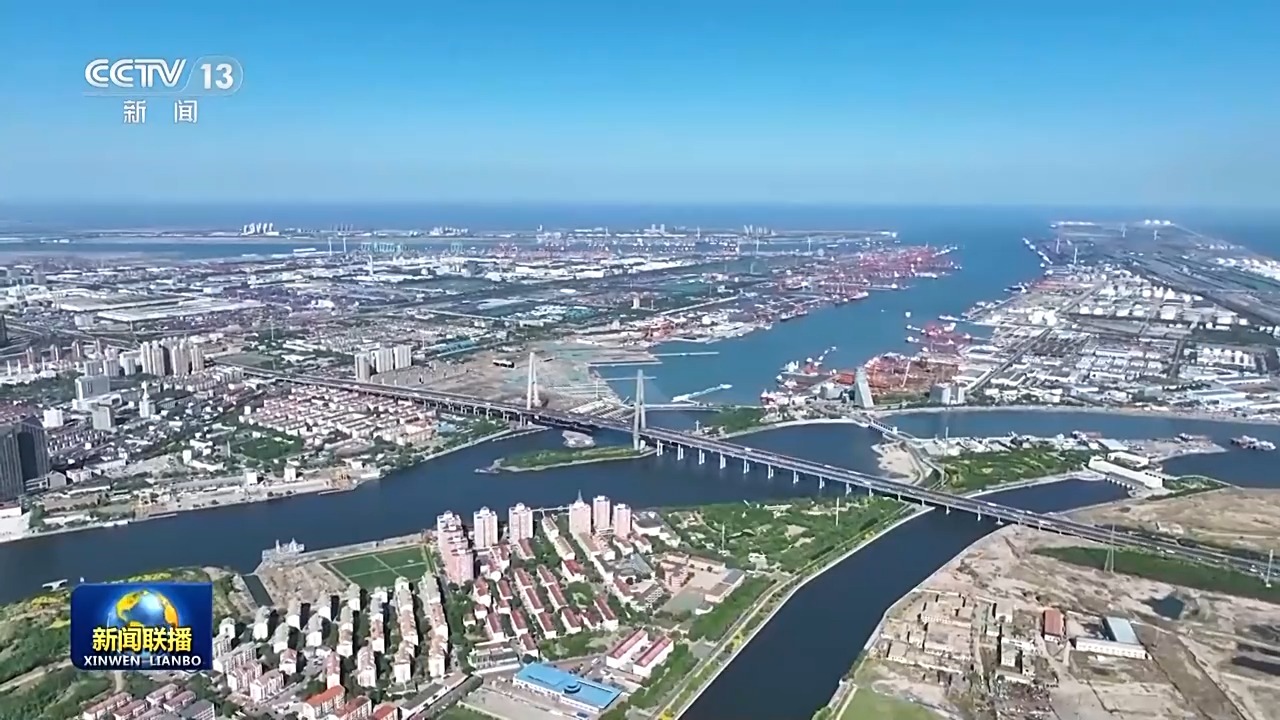
To address the poor connectivity in the “middle mile” of multimodal transport, 13 national railway dedicated lines that can directly enter ports are accelerating construction, enabling seamless transfer and efficient flow of goods between land and water transport. Innovative models like the single-system and single-container system are being rapidly promoted, and the backbone channel network for cold chain logistics has basically taken shape. In the first three quarters of this year, China’s total social logistics costs as a ratio of GDP was 14.0%, a decrease of 0.1 percentage points from the same period last year, further reducing overall social logistics costs.
Initial results have been seen in the governance of low-price, disorderly competition among enterprises. The capacity utilization rate of industrial enterprises above the designated size has stabilized and rebounded, and industrial enterprise profits are recovering faster. The Producer Price Index (PPI) for October turned from flat to a month-on-month increase.
Many regions are intensifying efforts to eliminate local protectionism and market fragmentation. Addressing the difficulty of enterprises moving out compared to moving in, provinces like Henan, Hebei, and Jilin have compressed the complex process of cross-regional “back-and-forth trips” into a one-time settlement, facilitating the free movement of enterprises. Local investment promotion has also shifted from the past “competition in tax incentives” to “competition in industrial ecology.” In Zhuji, Zhejiang, at the newly established investment project command center, an industrial chain investment map ranging from core technologies to application scenarios has just been updated. Locally, nearly ten细分领域 have been deeply explored around the intelligent visual industry chain, attracting the aggregation and landing of projects with an output value of上百亿 this year.
Lü Zhaoyang, Director of the Zhuji City Investment Promotion Center in Zhejiang Province: We no longer blindly “roll” in hot sectors but proceed from our own industrial base, establishing a “full life cycle” service chain for major projects, attracting enterprises with solid industrial support and high-quality business services.
The “15th Five-Year Plan” “Proposal” proposes to resolutely eliminate the bottlenecks and blockages hindering the construction of the unified national market, unify the basic market system rules, remove barriers in areas like bidding and government procurement, standardize local government economic promotion behaviors, and improve statistical, fiscal, tax, and assessment systems conducive to the construction of the unified market. Looking to the future, the continuously deepening construction of the unified national market will surely provide a more solid and powerful support for China’s high-quality economic development.