After experiencing the impact of sanctions, contract cancellations, and prolonged detention, a batch of ice-class LNG carriers ordered by Russian energy giant Novatek for its flagship Arctic LNG project has finally seen a turning point in delivery.
After six years of detention, a turning point has emerged. Are 10 ice-class LNG carriers to be sold as a package?
According to TradeWinds, Novatek is planning to acquire 10 ice-class LNG carriers controlled by Japan’s Mitsui O.S.K. Lines (MOL) and South Korea’s Hanwha Ocean (formerly Daewoo Shipbuilding & Marine Engineering). These include six Arc7 icebreaking LNG carriers originally ordered by Novatek in 2020 that have yet to be delivered, and four Arc4 ice-class LNG carriers that are already in operation.
Sources say Novatek’s Singapore subsidiary, Novatek Gas & Power Asia, has recently been holding talks with representatives from MOL and Hanwha Ocean. Alex Pilkington, head of shipping and chartering at Novatek Gas & Power Asia, will lead the negotiations on behalf of the Russian side. He previously worked at companies such as Petredec, Shell, and Avenir LNG.
The negotiations involve six 172,600-cubic-meter Arc7 icebreaking LNG carriers ordered by Novatek in 2020 from Hanwha Ocean’s predecessor, Daewoo Shipbuilding. Of these, three are owned by Novatek, while ownership of the other three was transferred to MOL, with plans for Novatek to operate them under long-term leases after delivery.
The construction cost of each icebreaking LNG carrier is as high as $290 million (approximately RMB 1.96 billion), with original delivery planned for 2023. However, after the outbreak of the Russia-Ukraine war in early 2022, Western sanctions against Russia prevented Hanwha Ocean from receiving payments for the three LNG carriers ordered by Novatek. In 2022, Hanwha Ocean announced the termination of construction contracts for the three LNG carriers: “Zhores Alferov,” “Pyotr Kapitsa,” and “Lev Landau.”
In 2023, Hanwha Ocean disclosed that the Russian side had filed for arbitration with the Singapore International Arbitration Centre (SIAC), claiming damages exceeding $877 million, on the grounds that the shipyard had canceled the construction contracts for the above three vessels. The relevant arbitration proceedings are still ongoing.
Meanwhile, MOL has also been affected by the sanctions. In early 2024, MOL announced that the project for three Arc7-class icebreaking LNG carriers originally planned to serve Russia’s Arctic LNG 2 project was forced to be suspended.
Last year, MOL stated it was renegotiating charter contracts for these three LNG carriers, “Ilya Mechnikov,” “Nikolay Semenov,” and “Nikolay Basov,” as well as one condensate tanker. The company admitted at the time that if negotiations failed to reach an agreement, it did not rule out selling the relevant vessels to third parties.
As of now, the six Arc7 icebreaking LNG carriers remain moored at the shipyard dock in Geoje, South Korea. To maintain the vessels’ seaworthiness, Hanwha Ocean continues to bear high maintenance costs. Compared to conventional LNG carriers, the hull derusting and maintenance requirements for various specialized systems of Arc7 icebreaking LNG carriers are higher, and the associated costs far exceed those of ordinary vessels. Additionally, due to tight berth resources at the shipyard, Hanwha Ocean has had to move these vessels to berths outside the Geoje shipyard, incurring additional site rental fees.
Over the past few years, Hanwha Ocean and MOL have repeatedly attempted to resell these vessels to other buyers. However, because these ships were specifically designed for the development and transportation needs of oil and gas resources in Russia’s Arctic region, equipped with numerous specialized devices suitable for polar navigation, their market applicability is relatively limited, and a suitable buyer has yet to be found.
It is worth noting that international newbuilding contracts typically adopt a milestone payment model, with approximately 50% of the contract amount payable upon final delivery. This means that, based on a construction cost of about $290 million per vessel, Hanwha Ocean’s outstanding receivables for the above six vessels still amount to approximately $870 million (about RMB 5.899 billion).
Capacity gap hard to fill, Russia’s flagship Arctic LNG project faces transportation bottleneck
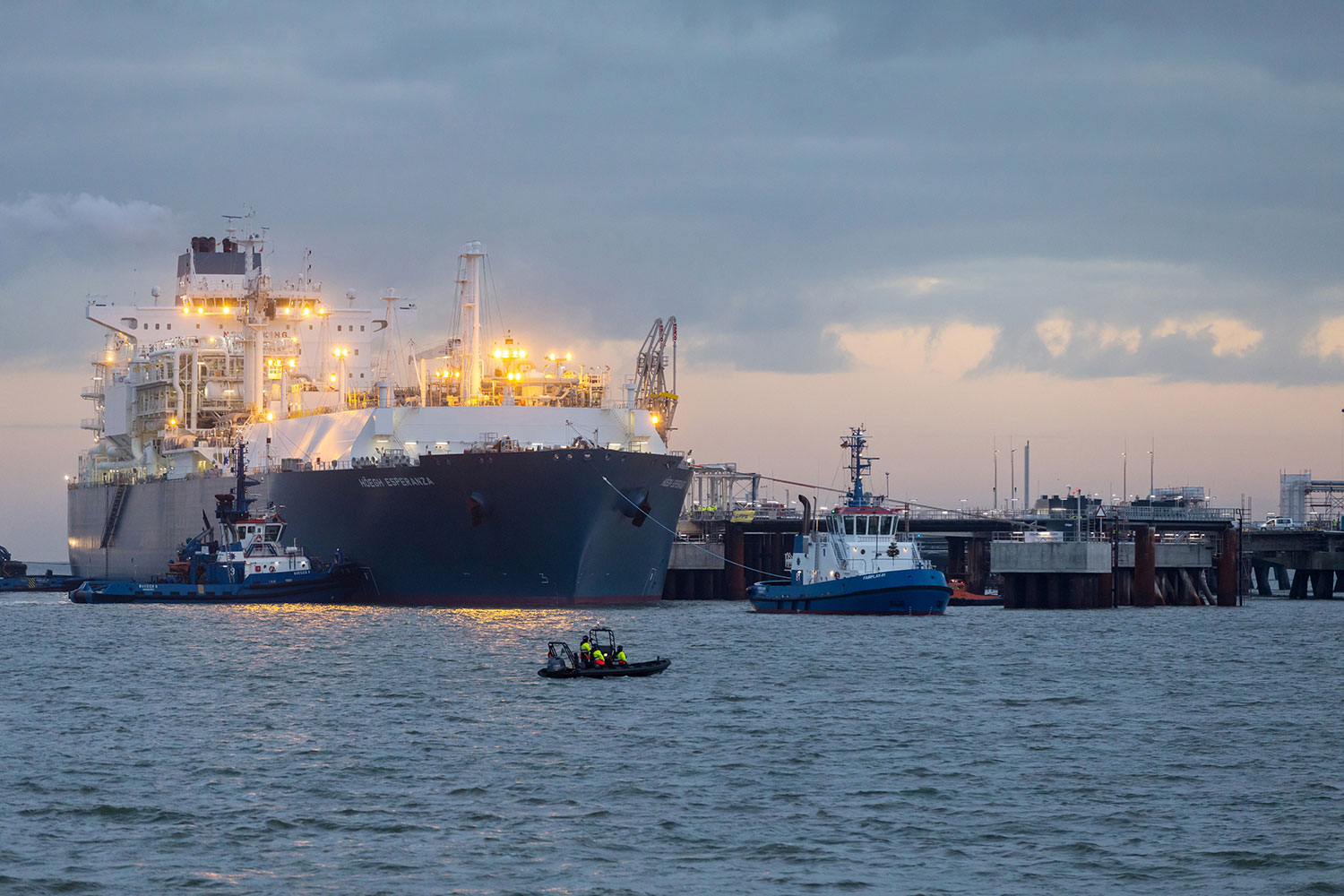
In addition to the icebreaking LNG carriers stranded at the shipyard, Novatek is also reportedly interested in acquiring four 174,000-cubic-meter Arc4 ice-class LNG carriers from MOL: “North Moon” (built 2024), “North Light” (built 2024), “North Ocean” (built 2024), and “North Valley” (built 2025).
These four vessels were ordered by MOL from Daewoo Shipbuilding in 2021 and were signed under time charter contracts with Novatek Gas & Power Asia. According to initial plans, these ships were to serve the Arctic LNG 2 project. However, after the project faced Western sanctions, both parties agreed to adjust their deployment to serve the non-sanctioned Yamal LNG project.
In May last year, the EU imposed sanctions on the first three vessels, but after active mediation by the Japanese government and MOL, the sanctions were lifted two months later. MOL argued at the time that these four vessels were only used to transport cargo for the Yamal LNG project and therefore should not be considered members of Russia’s “shadow fleet.”
In fact, Novatek’s flagship Arctic LNG project, Arctic LNG 2, is facing a severe shortage of ice-class vessels. The Arctic LNG 2 project originally planned to build up to 21 172,600-cubic-meter Arc7-class icebreaking LNG carriers. In addition to the six from Hanwha Ocean, the other 15 were to be built in cooperation between South Korea’s Samsung Heavy Industries and Russia’s Zvezda Shipbuilding Complex. However, to date, only one of the 21 vessels has entered operation.
Affected by sanctions, Samsung Heavy Industries only delivered the hull blocks and equipment for the first five LNG carriers and officially announced the termination of construction for the subsequent ten LNG carriers for Zvezda at the end of 2023. This means the Russian side must complete the construction of these LNG carriers on its own. Furthermore, with key technology suppliers such as France’s GTT withdrawing from the Russian market, these vessels face significant challenges in the supply of core equipment.
At the end of last year, a delivery ceremony was held for the first Arc7-class LNG carrier built by Zvezda, the “Aleksey Kosygin.” This is the first large LNG carrier built and delivered by Russia and the largest vessel ever built by a Russian shipyard. The vessel was originally scheduled for delivery in 2024 but was severely delayed.
The capacity shortage became further exposed last winter. In December 2024, due to ice conditions deteriorating earlier than expected, some Arc4-class LNG carriers were unable to reach the Arctic LNG 2 project terminal, and one vessel was even forced to turn back mid-voyage, abandoning its transport mission.
According to plans, the Arctic LNG 2 project is scheduled to receive two more icebreaking LNG carriers built by Zvezda this year. However, Laura Page, an analyst at research firm Kpler, stated that due to the impact of sanctions, the sources of key equipment, engineering support, and specialized technology required for the project have been cut off, making it difficult to achieve the goal of completing the construction of two Arc7-class vessels this year.
Against this backdrop, re-acquiring and integrating ice-class LNG carrier assets scattered overseas is becoming an important option for Novatek to alleviate capacity bottlenecks and maintain the operation of its Arctic LNG projects.