The week produced the war’s strangest artifact yet: a peace process with a price list. Iran and Oman agreed a temporary shipping corridor through Hormuz, explicitly not a full reopening, while US officials said a nuclear agreement was within reach. Tehran’s parliament took up a draft transit bill barring US and Israeli vessels, requiring hostile states to pay compensation before passage, imposing penalties of 20% of cargo value for violations, and making full reopening conditional on Washington lifting its naval blockade. Washington floated a 20% Hormuz transit fee in July and abandoned it. Tehran has now drafted its own, payable in the other direction. In this war, even the bad ideas change flags. By Friday, Iran said it had struck hostile targets in the strait, explosions were reported near Qeshm Island, the UK Navy reported blasts near a transiting tanker, and Houthi forces claimed fresh attacks on Saudi targets. The corridor exists. So does everything it was meant to avoid.
Oil deflated into the diplomacy and rebounded into the fine print. Brent fell for three sessions, helped by Saudi Aramco cutting Asian prices and US crude inventories rising from their lowest levels since 2018, before bouncing 3% on Thursday as the transit bill circulated. Brent closed near USD 82.84 and WTI at USD 77.67, down roughly 5% on the week and 15% from the July peak. Urals is up more than 50% on the month. The clearest beneficiary of a Gulf war remains, as ever, a country nowhere near it.
Freight has made up its mind emphatically. The Baltic Dry Index rose four sessions to 3,063, crossing 3,000 for the first time since early June, while Capesizes surged 6.6% in a day to 5,094 before both paused Thursday. Panamaxes reached 2,275, their best since June 15, while Supramax sat out the party at 1,608. Capesize earnings are up more than 20% in a week, and the recycling implication is familiar: the beach’s stiffest competition is not another beach, but a freight market paying old ladies to keep working.
The data drought broke. Pakistan’s July CPI eased to 9.2% from 11.1%, back in single digits, though monthly prices rose 1.2% and the improvement owes more to arithmetic than relief. The SBP held at 11.5%. Turkey’s official July CPI eased to 31.75%, against an independent estimate of 50.49%. Both cooled. The gap did not. Bangladesh’s print had not landed by publication, leaving June’s 9.16% operative, with US and India CPI due Wednesday. Currencies moved first. /INR strengthened to near 95.20, its best since spring; the Taka held near 123.55; the Lira set fresh records near 47.71; and the Pakistani Rupee closed near 278.20, again inside a quarter-rupee range, now less a pattern than a covenant.
At the beaches, Chattogram’s July 29 to August 1 window cleared the flood-era backlog and closed on schedule, with anchorage rebuilding toward the August 12 to 15 tides. Bangladesh retained the basin’s best prices and firmest buyer confidence, while recovery from a month that killed at least 57 people is now measured in reopened yards rather than shelters. Alang buyers actively hunted tonnage after losing recent candidates to Chattogram and Gadani, the clearest sign in months that appetite is basin-wide, while the two-yard EU List proposal remains pending. Gadani’s firm bidding finally secured deals, with deliveries to follow, as the absence of Iranian steel imports keeps local mills leaning on recyclers. Turkey remained Turkey.
The strait now has a corridor, the corridor has conditions, and the conditions have a price list.
The beaches deal in simpler terms: a tide, a berth and a number. The market is moving, and for the first time since February, the paperwork is the only chokepoint left.
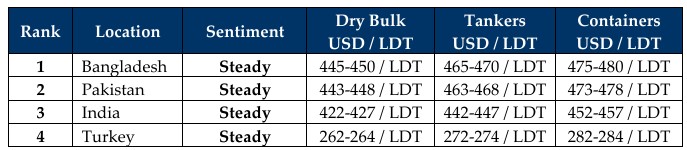
For Week 32 of 2026, GMS Market Rankings / Vessel indications are as below.
Source: GMS,Inc.