Asset divestments for billions of dollars. Office shutdowns. Canceled agreements. Rerouted voyages. WPO provides an overview of how 100 days of war in Ukraine have upended the global shipping industry.
Besides the fact that the effect of Russia’s invasion of Ukraine can already be measured in thousands of lost human lives, the war has also had consequences for the global shipping industry, which go far beyond what a war between two neighboring states usually entail for an industry which deems itself resilient toward most incidents and conflicts.
The consequences apply to those shipping companies that have opted to sell their assets in Russia at great losses, and to the carriers that have had ships lying at Ukrainian ports. And those which do not wish to sail to Russia or cannot sail in the Black Sea because the ports are mined.
A successful corn shipment to Spain fuels Ukraine’s fighting spirit
They also apply to those who are getting additional business out of the crisis because sanctions from the EU and US are making business with Russia illegal or because they, of their own accord, have opted to shut down their activities on moral grounds. And then there are the thousands of Ukrainian and Russian seafarers who must keep the global fleet sailing, knowing that the two nations they represent are at war and that it may prove difficult to go home.
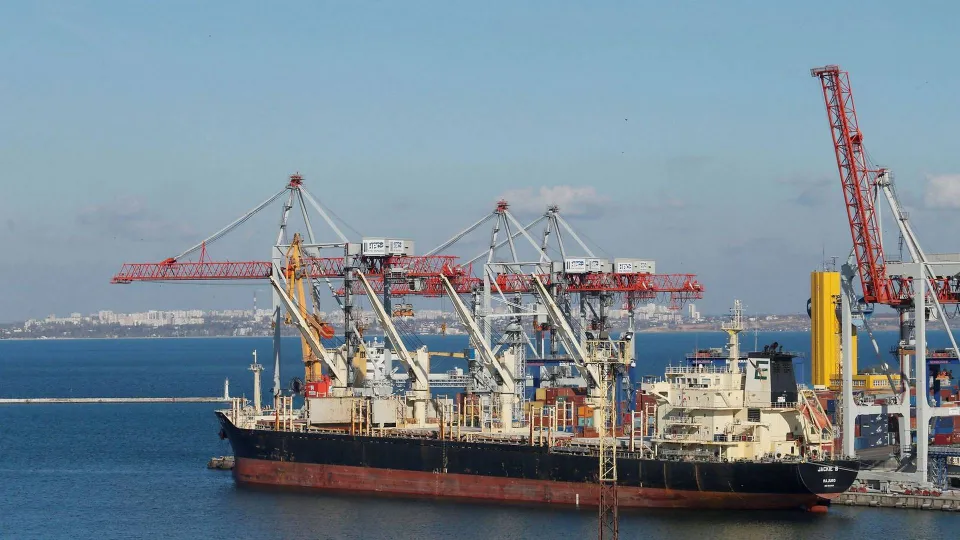
Photo: Valentyn /Ritzau Scanpix
Just to mention a few of the severe and hitherto entirely unheard of consequences that the war, which will have gone on for 100 days tomorrow, has had for the global shipping industry.
Shipping before and after Feb. 24
WPO has gone back to the start of the invasion and now provides – via interviews with key persons, for example – an overview of the changes the war has brought to the industry. If not forever, doubtlessly for several years or perhaps decades in the future.
One place to start could be the shipping cluster in Hamburg and the German container industry. One of the world’s largest container lines, Hapag-Lloyd, like its major European competitors, has already faced the consequences and shut down its offices in Russia and closed its connections to Russia and Ukraine.
These are Novorossiysk, Kaliningrad and St. Petersburg in Russia as well as Ukrainian port city Odesa. At the same time, like other European box carriers, the company has suspended bookings to and from not only Russia and Ukraine, but also Belarus, Hapag-Lloyd tells WPO. This is due to sanctions, but also about employees’ safety, the carrier states.
Maersk in several negotiations regarding Global Ports sale
”We have closed our Office in Odessa and offered all our 20 colleagues to work from home or at other Hapag-Lloyd locations. From a commercial side, the Russian business accounts for less than two percent of our total transport volume. That is, of course, relatively small in the overall context. We had three services (BMX, PEX, NBS) related to Russia and Ukraine […], however, none of these are in operation now,” writes Hapag-Lloyd in a comment.
Maersk wrote off USD 718m
Competitor Maersk is among the carriers which had stated an exact amount as to the cost of the war. With an ownership stake of around one third in Russian port company Global Ports, the Danish company found itself in the odd situation, like other major brands, of having to decide whether it should keep its share of the container port or sell. And Maersk opted for the latter.
In total, Russia’s invasion of Ukraine has impacted the operating result negatively by USD 718m in the first quarter of 2022. In particular, a write-down on the company’s terminal business has proven costly, entailing a negative regulation of USD 485m.
Within the sea freight business, the war has entailed a negative regulation of USD 162m.
”The invasion and the ensuing sanctions on Russia are clearly having a very significant negative impact on Ukraine and Russia. The invasion has also added to inflationary pressures elsewhere via higher energy and commodity prices. At this stage, not much data is available for the post-invasion period,” explained the company, which declines to provide additional comment on the situation.
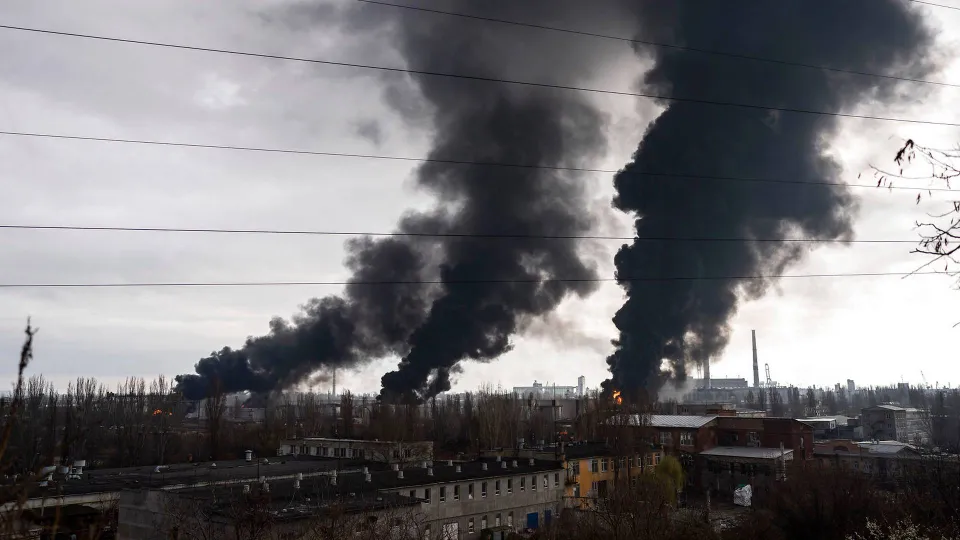
Photo: Petros /Ritzau Scanpix
Inflation and rising energy prices
Galloping inflation, gas shortage in Europe, swelling oil prices and costlier bunker are also consequences that the global shipping industry must handle. Political unrest, geopolitical tensions and uncertainty on global prices usually make up a toxic cocktail that the industry would rather avoid. But it isn’t bad for everyone this time.
The tanker industry became subject to US sanctions in April, and the EU has just passed a set of sanctions slated to enter force in eight months. For moral reasons, some carriers opted to terminate their business with Russia immediately and self-sanction.
Others have waited for a statement by policymakers. Regardless, it has been to the overall benefit of tanker shipping companies that Europe must get its oil from the US and no longer Russia, as this extends travel distances, thereby requiring additional tankers and boosting tonne-mile demand.
It benefits product tanker carriers such as Torm, which in the first three months of the year turned a deficit into a profit of USD 10.4m against a loss of USD 21.3m in the same period last year.
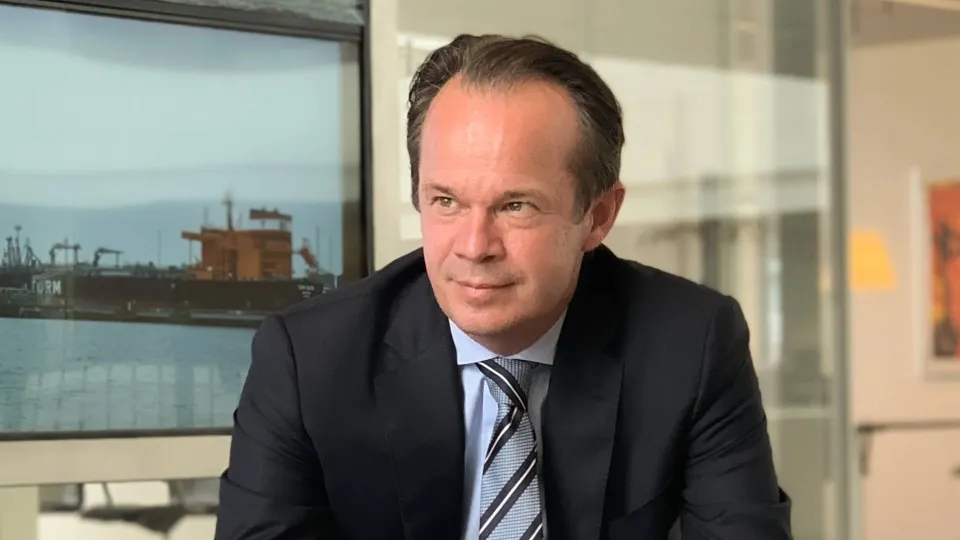
Photo: PR/Torm
Torm Chief Executive Jacob Meldgaard is looking at an actual upswing on the strained market resulting from the conflict and the political decisions made in the wake of the war’s beginning. One of them has been to blacklist Russian state carrier Sovcomflot, which naturally provides more business to other entities.
Trade pattern will change
And this benefits carriers transporting crude oil such as /London-based Frontline and Antwerp-based Euronav. As Frontline CEO Lars Barstad says in a comment to WPO:
”The trade pattern for oil will change. There are large volumes of oil which will now sail longer distances. This will in general increase the utilization rate in the tanker fleet, particularly on aframax and suezmax. There will be increased competition on the oil exported from the Atlantic Ocean as Europe now has to import from other regions.”
Going forward, Barstad expects a pattern in which oil from the US, Middle East, West Africa and Asia will replace Russia’s share of the European oil imports. The Russian oil will be carried to Asian countries instead. For instance, Frontline expects a lifting of the years-long sanctions against Venezuela, whose oil can then be sailed to the US and Europe.
Difficult to handle sanctions
Danish company Norden is an example of a carrier that feels the changes within both dry bulk and tanker. One of the main challenges is to navigate the many sanctions packages that have been introduced, says the carrier.
The most recent package passed by the EU was the sixth one so far, and according to maritime lawyers and lawyers representing the carriers, one has to be very careful not to get caught up in the wrong place.
Celsius ship has recently loaded oil at Russian port
And for tonnage owners, which have chartered their vessels to customers, it can be very difficult to prevent these customers from sailing to Russia as has recently been the case for Celsius.
Norden immediately announced that the carrier would no longer be active in Russia following the invasion. This was also the case at Lauritzen Bulkers, where CEO Niels Josefsen – in line with the assessment within the tanker sector – sees increased freight as a consequence of the war because longer voyages are needed, for example to South America, in order to pick up grain. Which is a good thing for the sector.
Ships in Ukrainian ports
No matter the segment in question, most have experienced the war close-hand – such as the ships that have been stranded in Ukraine, unable to leave the Black Sea due to the ring of mines. For instance, Maersk Tankers had vessel Harald Maersk positioned in Mykolaiv when the war broke out.
The war furthermore affects many seafarers and officers sailing on ships around the world. No less than 1.9 million, or 14% of the global crew force, come from Ukraine or Russia. Most of them had already been strained by two years of Covid lockdowns, which meant that crew members in some cases were not allowed to leave their ships for several months.
Anglo-Eastern is one of the large ship management companies which has to deal with their Ukrainian crew declining leave of absence, maybe because their village or home have been bombed. And they have to deal with the fact that all Ukrainian men in the age of 18 to 60 have been called up for military service, thus unable to leave the country.
According to Anglo-Eastern COO Carsten Ostenfeldt, this puts pressure on the entire supply chain of seafarers, because it’s difficult to find sufficient replacement among Indian or Philippine crew suppliers.
Prefer to stay onboard
”Most of the crew on board want to remain on board as long as they possibly can. But now we are receiving requests for relief from some of them and we are trying to relieve them with Ukrainians who can or with other nationalities,” states Ostenfeldt from Hong Kong.
Hamburg-based MPC Container Ships may be summarizing what many within the industry think in the carrier’s commercial assessment of what the last 100 days of war have meant for the global shipping industry, highlighting the uncertainty as the primary opponent.
“Whenever there is uncertainty regarding the global economy or geopolitical matters, it is particularly relevant for container shipping because it is so global. Uncertainty always has an effect on sentiment and the willingness to commit certain things,” says CEO Constantin Baack with reference to the trade war in 2019.
”I think it was really more the impact of the shift in sentiment than an actual drop in demand back then. And, at least to some extent, it is a similar picture now that people are a more hesitant to make decisions.”