The UK Marine Accident Investigation Branch has published its report into three Wight Sky engine failures and the history of engine failures on its sister ships.
One failure occurred on 26 August 2018 as the Wight Sky prepared to enter the Lymington River on its regular crossing from Yarmouth, Isle of Wight. This was the ferry’s second catastrophic main engine failure in less than a year, the failed engine being the replacement for the previous failure that had resulted in a fire and serious injuries to an engineer officer. On 14 December 2018, Wight Sky suffered a third catastrophic engine failure at Lymington Pier. On this occasion, the failed engine was a newbuild and had been in operation for just 389 hours.
Wight Sky was one of three Wight Class sister ferries and following the third engine failure Wightlink withdrew its Wight Class ferries from service. Following discussions between the ferry owner, the Maritime and Coastguard Agency, Lloyd’s Register, and the engine manufacturer Volvo Penta, a mitigation plan was put in place to enable the ferries to return to service.
The MAIB investigation found a history of engine failures across the Wight Class fleet dating back to 2010 and expanded the scope of the investigation to include all known failures. This led to a long and detailed technical investigation that comprised forensic examination and testing of five of the failed engines and their components, a full review of the vessels’ system design and operation, and the safety management, planned maintenance and condition monitoring procedures, together with manning and technical oversight.
Four of the five catastrophic engine failures discussed in detail in the report failed suddenly because of a loss of lubrication supply to the engines’ crankshaft journal bearings and crankpins.
For example, Wight Sky’s ME2 failed catastrophically due to a sudden loss of lubricating oil supply to its number five main journal bearing and number four crankpin. The oilway to the main journal and crankpin was blocked of when the bearing shells turned in their housing. Poor fuel combustion, the presence of silica sand and other abrasive particles embedded in the main bearing shells, engine misalignment, high levels of vibration, and contaminated lubricating oil might all have contributed to the event failure.
Wight Sky’s ME4 failed catastrophically because of an assembly error during build at Volvo Penta’s factory in Sweden. Two of the engine’s matched connecting rod big end bearing caps had been transposed during the engine assembly process. The transposition of the bearing caps reduced the metal-to-metal contact between surfaces of the connecting rods and their bearing caps. This would have caused fretting wear between the mating faces, which would have led to loosening and rapid failure of the end cap securing bolts.
The MAIB investigation highlighted a range of issues, including stating that:
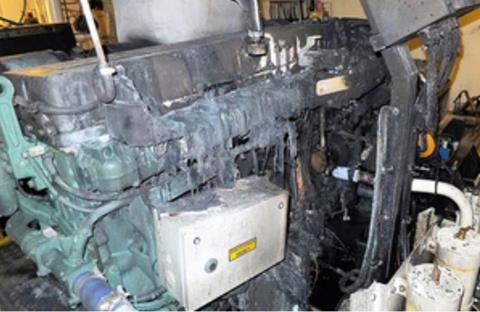
The catastrophic failure of a main engine aboard passenger ferry Wight Sky in 2017 was one of a series of incidents covered in the MAIB report.
The operation and maintenance of engines was not being managed effectively, and many of the engineering crew were not recording tasks they had performed or engine fluid test results on the company’s electronic integrated management system. The ability to interrogate the alarm history of an engine and the level of protections against abnormal changes in running temperatures and pressures was reduced because engine control units were moved from engine to engine and were not subject to manufacturer’s software upgrades.
Opportunities to identify and diagnose engine problems early, and therefore avoid catastrophic failures, were missed because the condition of the engine lubricating oil and coolant was not closely monitored.
Some aspects of the maintenance work carried out by RK Marine did not meet the standards set by Volvo Penta and those expected by Wightlink. Assembly errors had been made during overhauls, basic levels of workshop cleanliness were not always met, engines had not been properly aligned, unapproved repairs were carried out and used components were regularly switched from engine to engine.
Lloyd’s Register was not made aware of all engine failures. The society also accepted repairs that had not been approved by the engine manufacturer and did not identify the engine shutdown and protection system problems discovered following Wight Sky’s ME2 and ME4 catastrophic failures.
MAIB has worked closely with Wightlink, Volvo Penta, Lloyd’s Register and the Maritime and Coastguard Agency over the past three years to help ensure that most of the technical issues identified in the investigation report have been addressed.
The report is available here.