With the support of South Korea’s newly elected President Lee Jae-myung, whether the Gunsan Shipyard—once one of the world’s largest single shipyards under HD Hyundai Group—can achieve a “full restart” after years of dormancy has become a major focus in the country’s shipbuilding industry.
New President Takes Office: Is a Full Restart of Gunsan Shipyard on the Horizon?
South Korea’s new President Lee Jae-myung officially took office on June 4. Whether he can fulfill his campaign promise that “the Gunsan shipbuilding industry will surely recover if the government plays its role” and truly push for the complete restart and operational normalization of HD Hyundai Heavy Industries’ Gunsan Shipyard is drawing widespread attention across the country.
This is because, despite the global shipbuilding industry entering a “super cycle,” the Gunsan Shipyard, which has been idle for eight years, has yet to resume full ship assembly operations, remaining a “silent player” in the industry. Local stakeholders in Gunsan point out that HD Hyundai Group has been passive in advancing the full restart of the shipyard, while the previous Yoon Suk-yeol administration did little to support the effort. Now, high hopes are pinned on the new Lee Jae-myung government.
Currently, South Korea’s shipbuilding industry is enjoying a long-awaited boom due to increased orders for eco-friendly, high-value vessels like LNG carriers and VLACs (very large ammonia carriers). According to HD Korea Shipbuilding & Offshore Engineering’s order details, HD Hyundai Heavy Industries’ commercial ship orders in Q1 this year grew by about 30% year-on-year. Other major South Korean shipbuilders have order backlogs stretching to 2028, marking what is widely regarded as a true “super boom” for the industry.
However, the Gunsan Shipyard is an exception. Since its shutdown in 2017, the shipyard only partially resumed operations in October 2022 for block manufacturing and has yet to restart full ship construction. The once-bustling production lines, which employed thousands, have effectively ground to a halt.
Despite this, HD Hyundai Group continues to state that it will “monitor market trends before deciding on a full restart of the Gunsan Shipyard,” maintaining a cautious stance on resuming full shipbuilding operations.
Local stakeholders view this as “a clear strategic avoidance”—that is, despite strong market demand, avoiding Gunsan goes beyond “a simple business decision.” Additionally, former President Yoon Suk-yeol’s administration failed to present a clear roadmap or budget plan for restarting the shipyard, relying solely on corporate decisions with insufficient government involvement.
Critics argue that substantive policy support—such as training shipbuilding labor and restoring the ecosystem of subcontractors—was neglected under the Yoon administration.
However, the new Lee Jae-myung government is met with greater expectations from Gunsan’s stakeholders. During his campaign, Lee explicitly mentioned “rebuilding South Korea’s shipbuilding industry” and emphasized the “government’s role.” On May 16, while campaigning in Gunsan, Lee stated, “If the government plays its role, the Gunsan shipbuilding industry will surely recover,” demonstrating strong resolve to revitalize the sector.
Local stakeholders believe the change in administration could mark a turning point for the full restart of the Gunsan Shipyard. The region’s political and industrial circles hope the new government will implement concrete measures, such as prioritizing public ship orders for Gunsan, providing mid- to long-term order support, and establishing a dedicated “shipbuilding industry control tower.”
A local shipbuilding industry representative said, “The government can no longer stand idly by while leaving everything to corporations. The new administration views the Gunsan Shipyard as a core axis for regional balanced development and has a responsibility to lead its restart from an industrial strategy perspective.”
Ji Hae-choon, head of the Gunsan City Council’s Economic Construction Committee, noted, “While the shipbuilding boom benefits regions like South Gyeongsang and South Jeolla, North Jeolla’s Gunsan is becoming an industrial dead zone. The delay in resuming full shipbuilding at Gunsan Shipyard isn’t due to a lack of technical capability or demand but rather the absence of strong will from the Yoon administration and large corporations. The stance of the Lee Jae-myung government on regional industrial allocation and strategic redeployment will determine the shipyard’s fate.”
“Labor + Subcontractors + Orders”: Three Key Challenges for Gunsan Shipyard’s Restart
Industry experts highlight that amid the global shipbuilding boom, restoring full shipbuilding operations at the Gunsan Shipyard to achieve a complete revival has become central to local industrial reconstruction.
This is because the “revival” of the Gunsan Shipyard isn’t just about restarting the facility—it could also serve as a breakthrough for job creation, population inflow, and regional economic recovery.
However, achieving this requires meeting comprehensive, systematic preconditions and strategic planning.
The first prerequisite for a full restart is securing an adequate skilled workforce.
Industry analysis suggests that, given the labor-intensive nature of shipbuilding, a concentrated influx of skilled workers is unavoidable. To stably build 10 or more ships at the Gunsan Shipyard, around 3,000 frontline workers would be needed—a realistic figure considering the shipyard employed about 4,000 at its peak.
Since its partial restart in October 2022, the Gunsan Shipyard has struggled with labor shortages, failing to meet the target of “producing 100,000 tons of ship blocks in the first year” as outlined in the restart agreement signed by HD Hyundai Group, North Jeolla Province, Gunsan City, and the Ministry of Trade, Industry and Energy. Over a year after restarting, the shipyard has only hired 827 workers and produced 56,000 tons of blocks—just half the target.
Current block production at the shipyard falls far below expectations, offering minimal impact on regional economic revitalization. If labor shortages worsen, not only will block production targets remain unmet, but the full restart of shipbuilding operations will also become increasingly distant.
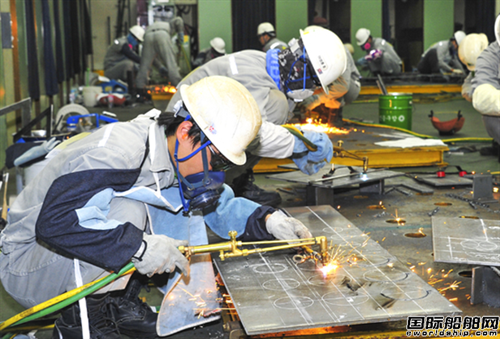
Critics point out that wages for block manufacturing are relatively low compared to the labor intensity, making it difficult to attract sufficient workers. The partial restart, focused on block production rather than full shipbuilding, risks becoming prolonged due to labor shortages.
Additionally, since multiple trades—such as welding, painting, and outfitting—must operate cohesively, establishing a long-term talent recruitment and training system is essential. This requires parallel efforts in vocational education, specialized high schools, and regional settlement-based employment models.
Meanwhile, restoring the “industrial ecosystem” of external subcontractors is urgent. These subcontractors, which provide various shipbuilding services, are the backbone of full ship construction. However, most related businesses in Gunsan have either shut down or relocated.
The industry notes that a full restart of the Gunsan Shipyard would require at least 10 subcontractors for block manufacturing and outfitting. To achieve this, infrastructure support and business incentive policies must be implemented simultaneously.
Securing sufficient orders is another critical factor for the shipyard’s full restart. Experts predict that maintaining stable operations would require an annual order volume of 10–15 ships. To this end, the government must strategically prioritize public and “national policy” ship orders for the Gunsan Shipyard.
The industry emphasizes that addressing these challenges comprehensively requires a “shipbuilding industry control tower” led by North Jeolla Province. This would involve organic collaboration among corporations, educational institutions, local governments, and central agencies to build a sustainable management system. Ensuring stable personnel assignments is also crucial for policy continuity—currently, the average tenure of North Jeolla Province officials involved in shipbuilding is just six months, posing a major obstacle to long-term initiatives. To consistently advance mid- to long-term policies, the government must assign long-term, specialized personnel to relevant roles.
Home to the World’s Largest Dry Dock: When Will Gunsan Shipyard Return to Full Shipbuilding?
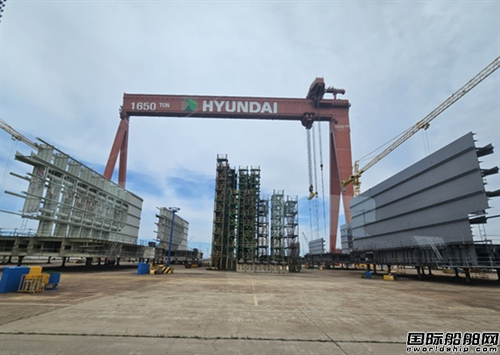
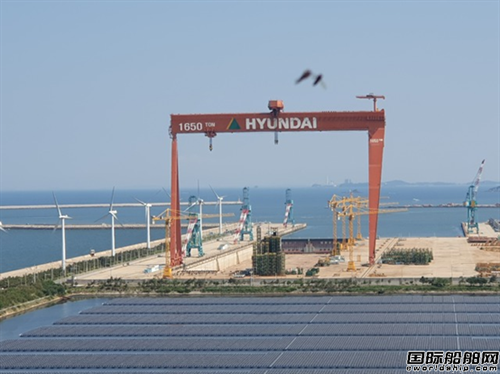
Located in Gunsan, North Jeolla Province, the Gunsan Shipyard was built by HD Hyundai Group during the pre-financial crisis shipbuilding boom. Construction began in early 2008, and the shipyard officially opened in late 2009, making it the group’s youngest facility. The shipyard boasts the world’s largest 1-million-ton dry dock, measuring 700 meters long and capable of simultaneously building four 250,000-ton vessels. It also features the world’s largest gantry crane at the time, standing 115 meters tall with a lifting capacity of 1,