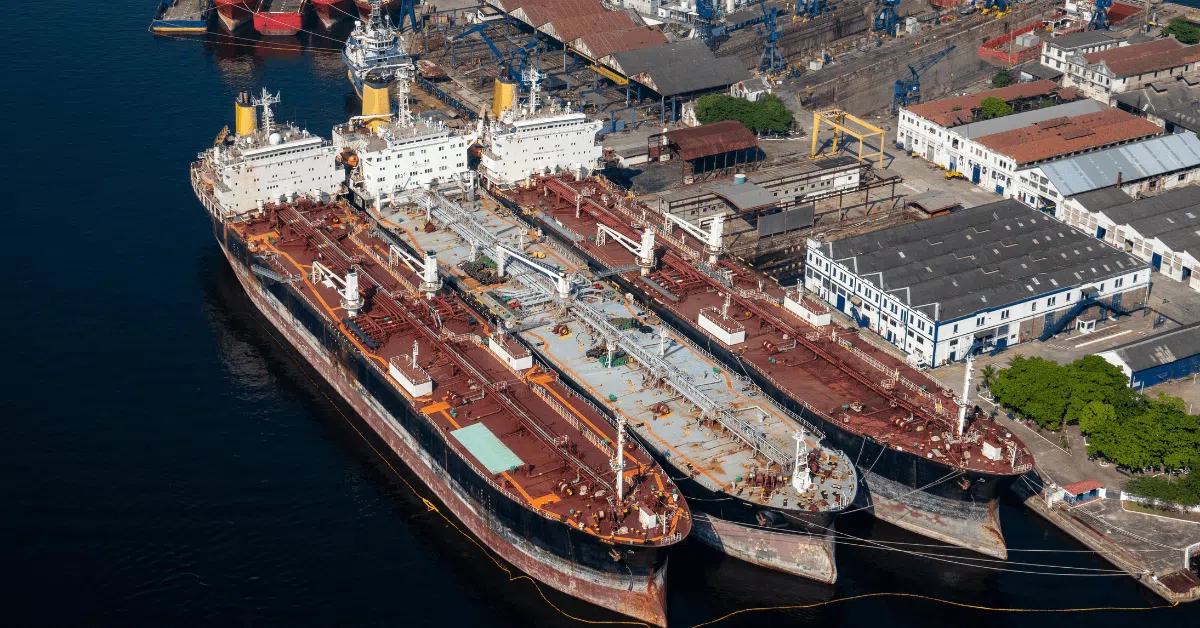
With the expansion of offshore oil extraction and the extension of operational areas, as well as the increase in new floating production storage and offloading (FPSO) fleets, the future market will require more shuttle tankers that meet environmental demands to support offshore oil production.
Currently, shuttle tankers primarily operate in three concentrated regions:
**South America**: Particularly the Campos Basin in Brazil, where deep waters and challenging conditions—such as multidirectional swells, strong ocean currents, and turbulent wind fields—create highly complex sea conditions. However, the oil production market here is relatively mature, mainly serviced by Suezmax vessels. Operators like Petrobras, Shell, and Equinor impose stringent vessel rating requirements and entry standards.
**West Africa**: As an emerging oil production region experiencing rapid growth, West Africa may become a key market for Aframax shuttle tankers in the future.
**North Sea**: A traditional production area, currently dominated by Panamax and smaller tankers.
Future offshore oil extraction will advance into deeper and more remote waters, relying on a combination of FPSOs and shuttle tankers for transportation. This will drive fleet renewal and the expansion of small and medium-sized tanker fleets.
Theo Kourmpelis, Global Director of Tanker Business at Lloyd’s Register, stated: “In the future, both environmental regulations and charterers’ environmental requirements for tankers will continue to rise. Shuttle tanker charters typically last 10-15 years, and oil companies and platform operators are willing to support additional environmental investments through long-term contracts.”
According to Theo’s predictions, upcoming newbuilding contracts will specify multiple sustainability technology indicators, which may include: expanded battery/hybrid power systems, dual-fuel engines, shore power connection systems, electric cargo handling systems, optimized hull design, energy-saving devices, and carbon capture and storage technology (applicable to both FPSOs and accompanying shuttle tankers).
Theo noted that all “readily achievable” energy-saving measures are under consideration, such as fairings, drag-reducing fins, specialized coatings, high-efficiency propellers, waste heat recovery systems, energy management optimization systems, load balancing technology, and optimal operation plans for diesel generators. However, given that shuttle tankers typically perform short-haul transport, wind-assisted propulsion systems are less likely to be adopted in this sector.
The current global shuttle tanker fleet consists of 108 vessels, with an additional 11 on order, accounting for only about 3% of total tanker capacity. Since 2010, an average of 5-6 new vessels have been added annually, totaling 84 deliveries—70 built by South Korean shipyards and 14 by Chinese shipyards.
In terms of vessel types, Suezmax shuttle tankers account for over 50% of the fleet. Four major owners—Knutsen, Maran Shuttle Tankers, Sovcomflot, and Equinor—control more than half of this capacity. Based on current orders, fleet renewal demand for this vessel type is already saturated.
However, there is a structural gap in the market: Aframax, Panamax, and smaller shuttle tankers currently have zero orders, while the existing fleet is aging. Specifically, 31 Aframax, 8 Panamax, and 10 smaller vessels face replacement pressure. With ongoing small-field developments, demand for these vessel types is expected to remain stable until around 2030.
Although demand for small shuttle tankers is projected to rise, it’s worth noting that only 10 shipyards worldwide have participated in shuttle tanker construction since 2010, and most shipyards are already booked 4-5 years in advance. This could lead to bottlenecks in vessel construction supply.