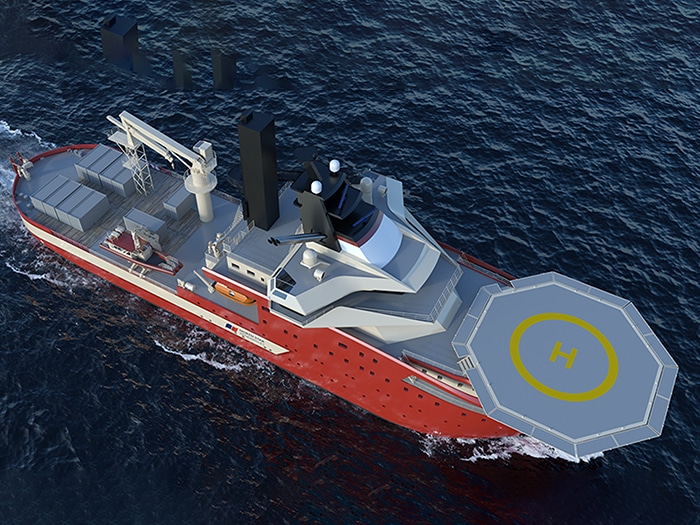

With a $3.25-billion contract to build a Polar Max icebreaker for the Canadian Coast Guard, Chantier Davie Canada Inc. hopes to leverage shipyard ownership in Finland and Texas to produce icebreakers for the U.S. government.
“We want to bring shipbuilding capacity back to the U.S.,” said Marcel Poulin, Davie’s vice-president public affairs and strategic partnerships, at a panel discussion of the American Association of Port Authorities annual convention in Quebec City on its third and final day today.
Those contracts have not been awarded yet, but U.S. President Donald Trump wants to revive shipbuilding in the United States and is concerned about the Chinese presence in Arctic waters.
“We’re talking about our peer adversary,” referring to China, said Rodger Rees, director and CEO of the Port of Galveston, where Gulf Copper & Manufacturing Corp., the shipyard Davie is negotiating to buy, is located.
“We’re building something that is going to the defend the United States,” Mr, Rees added.
Winning those contracts is “a competitive process,” Mr. Poulin said. “We know the other players are around the table. We think our offer is better.”
Mr. Poulin said DavIe’s aces are its revival under new ownership as a reliable shipbuilder, winning the Polar Max contract with fixed-price, fixed delivery date commitments, and its acquisition of Helsinki Shipyard Oy, the world leader, building 66 icebreakers a year.
Davie, under its new management, converted the container ship Asterix into a Royal Canadian Navy supply ship as a public-private-partnership, meaning the usual federal government procurement process of red tape and costly delays was avoided.
For the Polar Max, Davie has won the same – non-interference — concession.
“We needed to have all the flexibility we have, as we did for the Asterix, so this is a huge win for Davie,” Mr. Poulin said. “It was a game changer.”
He added that shipbuilding in high-wage Western countries has lost markets to Asian, and in particular to subsidized Chinese shipyards, to the point that this year 65% of all ships being built worldwide, are in Chinese yards.
Mr. Poulin said if China were to dedicate all its shipyards to producing military vessels they would be in a position in a year “to control every ocean in the world.”
To get back in the game Davie, and other Western shipyards must develop “excellence,” building highly specialized ships like icebreakers, and increasing the number of vessels built, giving component suppliers more capacity to lower costs.
“Everything we do in shipbuilding is a challenge,” Mr. Poulin said, noting the need to develop the skilled engineers, naval architects, welders and other workers required. And shipyards do not make all the components and services required.
“We need suppliers,” he said.
An icebreaker, Mr. Poulin explained, at sea for a hundred days, is “a city on a hull,” needing clean water, waste management, restaurants and burning 100,000 gallons of fuel a day.
Great /Seaway
At another AAPA discussion on navigation on the St.
Lawrence Seaway and the Great Lakes, Jean-François Houle, Quebec representative in Chicago, noted the importance of the 2024 trilateral ICE Pact agreement between the U.S., Canada and Finland to share icebreaking expertise, in tune with Davie’s strategy.
And Ian Hamilton, president & CEO Hamilton-Oshawa Port Authority, called for added icebreakers to allow year-round navigation on the inland waterway.
Mr. Hamilton said his region, where Canada’s steelmaking and auto industry are important, has been hard hit by American tariffs, which have reduced shipments by 65%.
‘We are certainly feeling the pain in Hamilton,” he said, adding that this disruption shows how integrated the Great Lakes economies are.
Panel moderator Eric Oberhart said the Great Lakes region, combining bordering states and provinces, would have the world’s third largest gross domestic product at $9.3 trillion a year.
In the past navigation on the Great Lakes was largely bulk carriers, shipping iron ore and grain. Mr. Hamilton said on the U.S. side there is beginning to be more container ship traffic, an area Canada could develop to ship critical minerals and forestry products.
“We have to trade better with ourselves,” Mr. Hamilton said. But he would also like American authorities to realize that the pre-tariff system was “the most effective supply chain possible.”
“We are an economic system with two countries,” he said.