The European Investment Bank (EIB) has approved a €90 million loan to the Port of Rotterdam Authority to support the rollout of shore power infrastructure at three deep-sea container terminals.
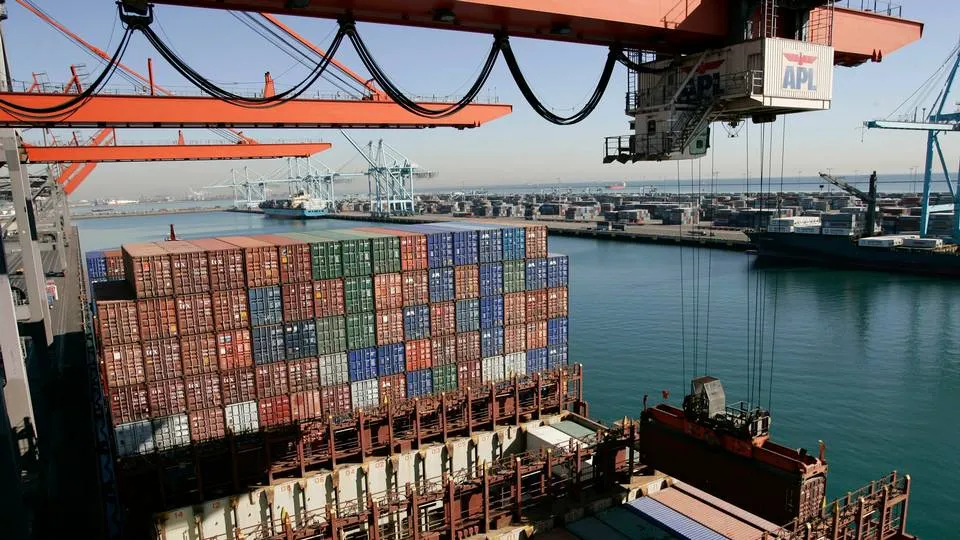
The funding will be used for Rotterdam Shore Power, a joint venture between the port authority and Eneco, to cover the installation of onshore power systems, grid connections, cabling, and related construction works. The project will equip around eight kilometres of quay with shore power, providing 35 connection points for container vessels.
In addition to the EIB loan, the project is eligible for approximately €70 million in funding from the European Commission through the Alternative Fuels Infrastructure Facility under the Connecting Europe Facility.
Robert de Groot, vice-president of the EIB, said: “Rotterdam is Europe’s most important port and continues to innovate to stay at the forefront. Connecting large container ships to shore power is a major step towards reducing our reliance on fossil fuels. This is not only good for the environment, air quality and public health, but also for our economy, as it will help Europe become less dependent on energy from far away.”
Vivienne de Leeuw, chief financial officer of the Port of Rotterdam Authority, added: “Shore power plays a vital role in the energy transition. As the port of Rotterdam works towards climate-neutral operations by 2050, while safeguarding its competitive position, investments like this are indispensable. They bring our climate goals within reach and reinforce the port’s role as a sustainable, future-proof container hub in north-west Europe.”
Cecilia Thorfinn, acting head of the European Commission Representation in the Netherlands, commented: “The current geopolitical context forces Europe to make critical choices if it is to remain competitive while also becoming energy independent. For the port of Rotterdam, as Europe’s largest port, more sustainable transport is essential to staying connected. Through Connecting Europe Facility grants, the European Commission is supporting the ambitious rollout of the alternative fuel infrastructure needed to make this happen.”
Shore power allows vessels to connect to the local electricity grid while at berth, enabling them to switch off onboard engines and generators. This reduces emissions of carbon dioxide, particulate matter and noise during port stays.
The installations are expected to be deployed in phases, with operations scheduled to begin in the second half of 2028.