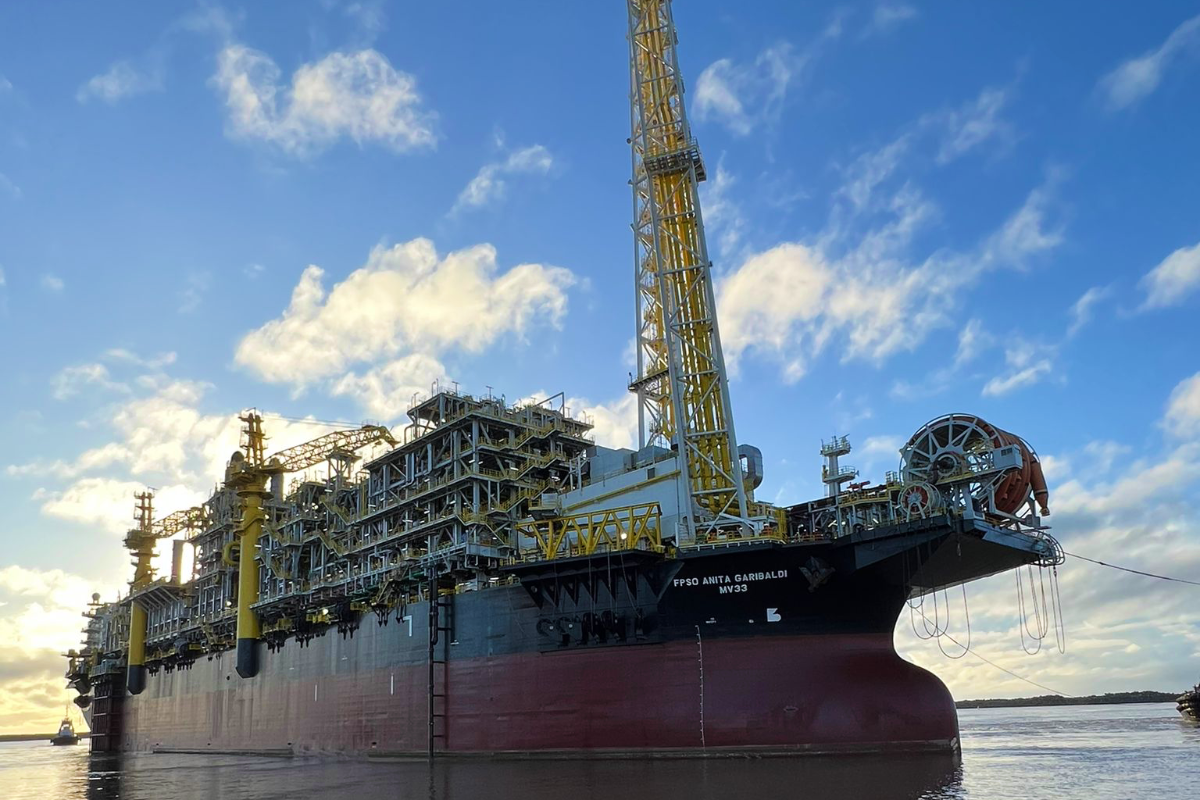
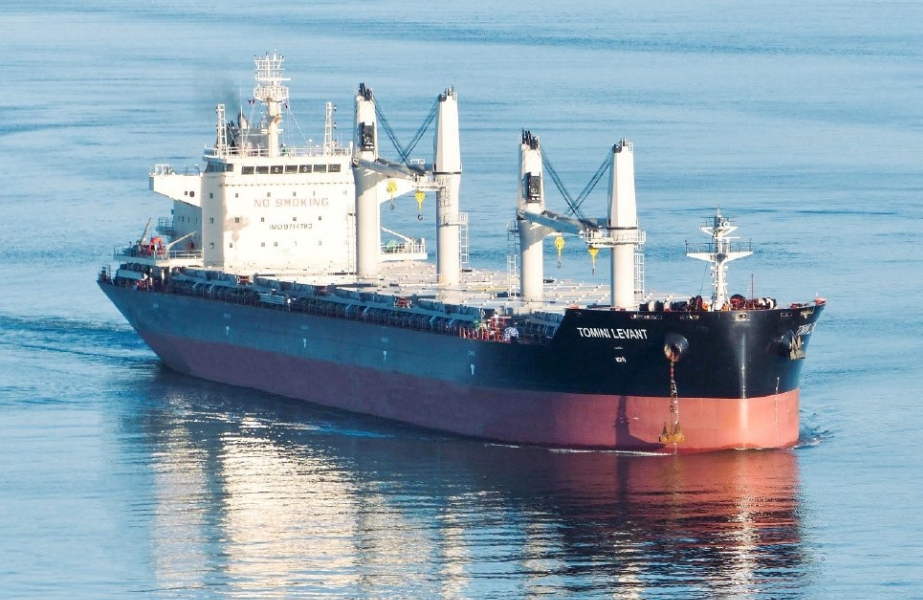
At 2157 hours on September 15, 2025, the vessel “Y” managed by FuXXX Shipping Company collided with the vessel “S” managed by N Shipping Co., Ltd. in waters approximately 30.3 nautical miles southeast of Naozhou Island, Zhanjiang (approximate position 20°45′32″N, 111°8′10″E).
The accident caused deformation and indentation of the bow of “Y” and loss of the left anchor fluke; the hull of “S” on the port side amidships was damaged to varying degrees. The accident resulted in no casualties and no water pollution. According to the “Measures for the Statistics of Water Traffic Accidents,” it constitutes a general-level (minor) accident.
Main damage to vessel “Y”
The bulwark is approximately 1.6 meters from the foremost part of the bow; all railings at the foremost end have fallen off; there is a 1m*0.85m hole in the port side bulwark of the bow; there is a 1m*0.75m hole in the starboard side bulwark of the bow; there is a 0.4m*0.08m hole above the starboard fairlead of the bow; the left anchor fluke of the bow is missing; the distance from the foremost end of the bow storeroom to the bulkhead after the collision is 4.2 meters, and the hatch coaming leading to the upper deck is severely deformed.
Main damage to vessel “S”
The hull of the port No. 4 ballast tank is damaged (the breach is above the waterline, approximately 0.3m*5m in size), with a small amount of water accumulation inside the tank; five vent /pipes on the port ballast tanks are completely broken; there is an abrasion area of approximately 5 square meters on the hull above the waterline at the port midship position, with obvious coating peeling.
This accident occurred in open waters with good visibility. Both vessels were power-driven vessels underway in sight of one another. According to the provisions of Rule 15 of the International Regulations for Preventing Collisions at Sea, 1972, the two vessels formed a crossing situation before the accident, with “Y” being the give-way vessel and “S” being the stand-on vessel.
Direct Causes
1. Vessel “Y”
(1) Failed to maintain a proper lookout and correctly assess the risk of collision
“Y” did not take effective measures to maintain a proper lookout on “S”. After sighting “S”, it failed to continuously monitor the vessel’s movements. Before the collision, the duty officer spent a long time (approximately 9 minutes) on the bridge reviewing the electronic chart for the next port (Shenzhen Port) and preparing for port arrival, during which he did not monitor the movements of “S” and failed to correctly assess the risk of collision between the two vessels through radar plotting or equivalent systematic observation. This action violated the provisions of Rules 5 and 7 of the International Regulations for Preventing Collisions at Sea, 1972.
(2) Failed to use a safe speed
“Y” only notified the engine room to reduce the main engine revolutions from “Ahead 3” to “Ahead 1” one minute before the collision, after the risk of collision with “S” had been established. It failed to take appropriate and effective collision-avoidance action and to stop the vessel within a distance appropriate to the prevailing circumstances and conditions.
This action violated the provisions of Rule 6 of the International Regulations for Preventing Collisions at Sea, 1972.
(3) Failed to properly fulfill the obligations of a give-way vessel
As the give-way vessel in a crossing situation, “Y” maintained its course and speed after the risk of collision was established, failing to take effective measures to “take early and substantial action to keep well clear” of the other vessel. Only two minutes before the collision did it switch to hand steering and order “hard-a-port,” by which time the collision was unavoidable. This action violated the provisions of Rule 16 of the International Regulations for Preventing Collisions at Sea, 1972.
2. Vessel “S”
(1) Failed to maintain a proper lookout and assess the risk of collision in a timely manner
“S” failed to take effective measures to maintain a proper lookout from the time the risk of collision with “Y” was established until the collision occurred, and also failed to correctly assess the risk of collision between the two vessels through radar plotting or equivalent systematic observation. From 2152 to 2156, the third officer entered the chart room without confirming safety. This action violated the provisions of Rules 5 and 7 of the International Regulations for Preventing Collisions at Sea, 1972.
(2) Failed to use a safe speed
“S” maintained its course and speed, sailing at approximately 13 knots, from the time the risk of collision with “Y” was established until the collision occurred, failing to take appropriate and effective collision-avoidance action and to stop the vessel within a distance appropriate to the prevailing circumstances and conditions. This violated the provisions of Rule 6 of the International Regulations for Preventing Collisions at Sea, 1972.
(3) Failed to fulfill the obligation to maintain course and speed and to take the action best suited to avoid collision
At 2145 hours on September 15, the third officer mechanically executed the voyage plan. In a situation where a crossing aspect with “Y” was established and a risk of collision existed, he failed to fully assess the encounter situation with his own vessel and surrounding vessels, directly altering course 13° to starboard, adjusting the heading to 312°, thereby failing to fulfill the stand-on vessel’s obligation to maintain course and speed. This reduced the passing distance between the two vessels and exacerbated the risk of collision, violating the provisions of Rule 17 of the International Regulations for Preventing Collisions at Sea, 1972.
As the stand-on vessel, “S” failed to take effective measures to avoid collision during the phase when it could take maneuvering action independently; after a close-quarters situation developed, it also failed to take any action best suited to avoid collision, violating the provisions of Rule 17 of the International Regulations for Preventing Collisions at Sea, 1972.
This accident is a collision liability accident caused by mutual fault between two power-driven vessels underway in open waters with good visibility. As the give-way vessel in a crossing situation, “Y” failed to maintain a proper lookout and correctly assess the risk of collision, failed to use a safe speed, and failed to properly fulfill the obligations of a give-way vessel, and shall bear the primary responsibility for the accident.
The master of “Y” is the primary responsible person for the accident.
As the stand-on vessel in a crossing situation, “S” failed to maintain a proper lookout and assess the risk of collision in a timely manner, failed to use a safe speed, failed to maintain course and speed, and failed to take the action best suited to avoid collision, and bears secondary responsibility for the accident. The third officer of “S” is the secondary responsible person for the accident.
Shipping Online compiled from China Maritime Safety Administration