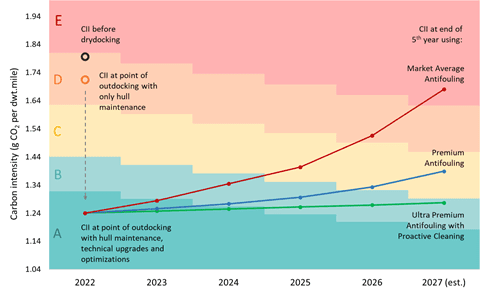
Jotun has developed a new digital tool that demonstrates the positive effect of hull coatings on Carbon Intensity Indicator (CII) and vessel efficiency.
The company says that as shipowners rush to comply with Energy Efficiency Existing Ship Index (EEXI) requirements, misguided decisions on “low friction” hull coatings can have far reaching consequences.
Jotun notes how the carbon intensity factor varies over a 5-year drydocking period for different hull protection solutions
Jotun has created a tool to calculate the CII of individual vessels and project the expected development in CII ratings based on different antifouling coatings.
Alongside the new tool, Jotun has published a paper that it says dispels the notion of “low friction” coatings that can improve vessel EEXI purely through theoretical calculations and adjustments. The findings are supported by vessel performance data analysed using the ISO 19030 standard.
The paper highlights that IMO guidelines clearly state that the effect of “low friction coatings” cannot be measured, calculated or certified in isolation. In the case of a sea trial, achieving low hull roughness requires the right surface preparation and skilled application, and not purely on choice of coating.
Jotun says hull coatings can make a difference between a B- and an E- rating on vessel’s CII.
Tan Keng Khoon, Global Category Manager for Hull Performance, said: “We have built a digital tool to project, for individual vessels, the expected increase over time in carbon emissions for different antifouling coatings, against progressively tightening bands of CII ratings.”
Taking a 388,000dwt bulk carrier with a momentary A-rated efficiency on leaving drydock, the choice of antifouling for that dry docking will lead to very different scenarios. On a market average antifouling, the vessel’s CII rating shows an annual deterioration, falling short of its required CII by the end of the fourth year.
A premium antifouling keeps the vessel within regulatory expectations, while an ultra-premium antifouling with proactive cleaning delivers the best CII rating – much stricter requirements by the fifth year being the reason for the change from A- to B-rating.
The projection is supported by evidence from three sister vessels with consistent operational profiles. Performance data analysed using the ISO 19030 standard for measuring hull and propeller performance and compared with fuel consumption records confirms the drastic change in CII ratings over time due to the use of lower quality antifoulings. Biofouling growth adds significant frictional resistance to hulls, thus burning more fuel and releasing more carbon dioxide.
Shipowners, managers and consultants need to realise that all else being equal, a vessel’s CII will increase over time due to biofouling pressure, says Jotun. Effective hull coatings are a requisite measure of any efficiency improvement plan, even more so when major investments will be put into retrofitting and upgrades.