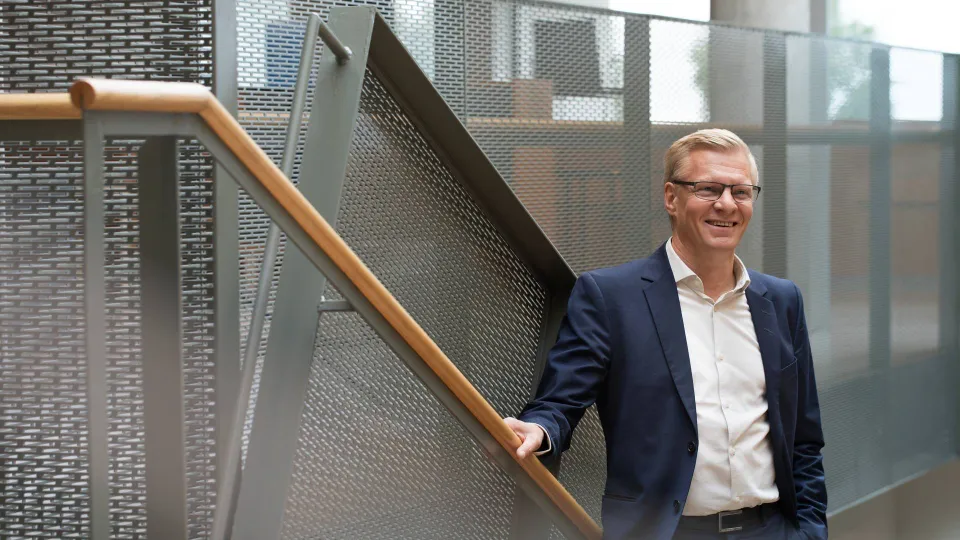
In 2023, Wärtsilä expects to launch a ship engine using green ammonia. The Finnish group’s head of decarbonization tells WPO that working on the engine reminds him of the rollout of LNG.
At a test facility in western Norway, Finnish engine manufacturer Wärtsilä is completing the development of a ship engine powered by ammonia.
According to plan, the engine will have to be ready for use within few weeks – following a long and complicated test process, in which safety has been the primary focus of attention.
Ammonia is poisonous, so you have to know what you are doing
Kaj Portin, General Manager, Sustainable Fuels & Decarbonization, Wärtsilä
”Ammonia is poisonous, so you have to know what you are doing,” says General Manager for Sustainable Fuels & Decarbonization at Wärtsilä Kaj Portin in an interview with WPO.
“On the other hand, we have been handling ammonia for a long time, we have seen it in many places,” he adds.
Portin sees parallels to the situation roughly 20 years ago, when he took part in the development of liquefied natural gas (LNG) engines. Back then, there were also some who rejected LNG because it in their opinion was far too dangerous. That discussion is more or less forgotten today.
With that in mind, Portin sees no reason to overdramatize the danger risks in using ammonia. Nonetheless, Wärtsilä has put a lot of weight on being prepared for anything when testing the new fuel.
Used 21 ”sniffers”
”We have done a lot of work on this – perhaps we have overdone it to be on the safe side. We have used 21 ’sniffers’ to find leakages, and after the verification we could manage with only a couple of them. We just wanted to see how it would work,” tells Portin.
The thoroughness is about to bear fruit as the ammonia-driven ship engine will be ready for production before long. From 2023, Wärtsilä will start selling it – with expected delivery to carriers the year after.
According to Wärtsilä, there is considerable interest in the project among potential customers. Not least among those that intend to skip a phase on the road between the highly CO2-emitting fossil fuels and the upcoming carbon-free fuels such as green methanol and ammonia.
LNG as middle phase
To several players, the middle phase is called LNG, a fossil fuel, which many carriers commit to as a less carbon-heavy solution in the coming decades on the way to more sustainable solutions.
Maersk is one of the carriers which has chosen another direction than LNG, instead ordering ships powered by methanol engines.
And Grieg Maritime Group banks entirely on green ammonia as the ship fuel of the future – with Wärtsilä as one its collaborators.
When a group such as Wärtsilä develops a new engine, it doesn’t necessarily mean that the design is completely new. Portin states that the overall fleet is filled with diesel and LNG engines, and these are good starting points in the process of developing an engine able to burn ammonia.
It furthermore provides increased flexibility when an engine is able to use different fuels. For instance, when one pours biodiesel into a traditional diesel engine, it works just as well – and you don’t even have to clean the tanks.
Nonetheless, development of green ship engines needs to speed up due to demand in the sector – and demand in at least parts of the global community. The aim is for the global fleet to be carbon-free by 2050. Whether it will happen is an open question.
”We will have a zero-emission commercial fleet by 2050, but not all of it,” predicts Portin.
”There will always be countries clinging on to resources.”
Nordic first movers
He refers to the Nordic countries as first movers within green energy because ”we have the abilities and the interest.” Australia and California, the latter as a sort of island, will also be far ahead, since some parts of the world move at a higher pace than others.
It is also about having the economic resources to finance the transition. As Portin sees it, ”it is good to be good when you can afford it.”
Thus being said that the development will take longer in countries like India and China.
It is good to be good when you can afford it
Kaj Portin, General Manager, Sustainable Fuels & Decarbonization, Wärtsilä
”We are getting better everywhere, but we are not working in the same time zone. One should never say never, but it will take a long time before we are in one zone.”
The question then is whether there will be a single ”winner” in the fuel development when 2050 is reached. According to Portin, there will probably be several.
Pros and cons to them all
Wärtsilä has done wide-scale test work with the different types, and Portin sees pros and cons to all of them.
For instance, hydrogen is easy to produce but difficult to transport and store. Ammonia, on the other hand, is relatively easy to transport and store.
Both green ammonia and green methanol are based on hydrogen, and Portin doesn’t leave out that other hydrogen-based fuels may come along in the future, but he is sure that hydrogen will be the starting point.
If Portin has to point out a clear winner, it is not to be found among fuels. It is the engine, instead.
”In 2050, the engine I make today, will be able to work with all these types of fuel. So it is possible to invest in solutions today that will take us to zero carbon.”
So, the conclusion is clear – from the Finnish marine technology company’s point-of-view:
“The engine is part of the future.”