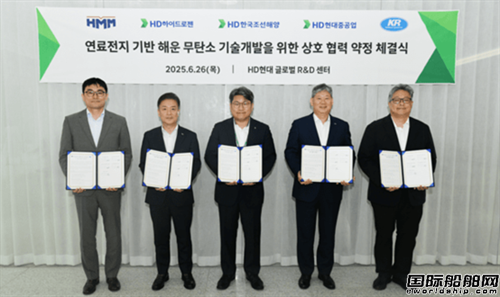
On June 26, HD Hyundai Group, together with its shipbuilding subsidiaries HD Korea Shipbuilding & Offshore Engineering (KSOE) and HD Hyundai Heavy Industries, as well as its hydrogen fuel cell subsidiary HD Hydrogen, signed a Memorandum of Understanding (MOU) with South Korea’s largest shipping company HMM and the Korean Register of Shipping (KR) for the development of zero-carbon maritime technology based on marine solid oxide fuel cells (SOFC). Under the agreement, the parties will begin by developing container ships equipped with eco-friendly and high-efficiency SOFCs, followed by ammonia-fueled SOFCs and onboard carbon capture (OCCS) systems, establishing a technological roadmap to achieve “Net-Zero” in the maritime sector.
HD Hyundai Group stated that its strategy is to advance the commercialization of fuel cell technology by developing carbon-reducing container ships equipped with marine SOFCs, contributing to zero-carbon emissions in the maritime industry and taking a leading role in the global transition toward eco-friendly shipping.
According to the agreement, the collaboration will leverage HD Hydrogen’s SOFC technology, with HD KSOE and HD Hyundai Heavy Industries responsible for developing low-carbon vessels utilizing SOFC technology. The Korean Register of Shipping will oversee the certification and validation of related technologies, while HMM will provide real-world sailing conditions for testing and verify the effectiveness of the technology through operational trials.
Marine fuel cells are highly efficient power sources that generate electricity using hydrogen, LNG, and other fuels. They can replace not only traditional shipboard power generators but also main engines, improving energy efficiency through energy management systems (EMS). Compared to conventional marine engines, SOFCs can increase power generation efficiency by approximately 40%, significantly reducing emissions of pollutants such as sulfur oxides (SOx) and nitrogen oxides (NOx), as well as greenhouse gases, making them a core technology for the era of eco-friendly shipping. Additionally, SOFCs offer higher efficiency than traditional power generators, meeting both environmental and economic requirements for maritime operations.
Since establishing its Fuel Cell Research Institute in 2018, HD Hyundai Group has been accelerating the development of SOFC technology. In August 2024, to formalize hydrogen fuel cell development efforts, HD KSOE invested 140 billion KRW (approximately $105 million) to establish HD Hydrogen, strengthening its business foundation. HD Hydrogen’s Pyeongtaek SOFC production facility is expected to be completed in the second half of this year.
An HD Hydrogen representative stated, “With the International Maritime Organization (IMO)’s global carbon pricing agreement for shipping, demand for carbon neutrality is growing among maritime companies worldwide. Building on HD Hydrogen’s technological expertise and experience, we are taking the first step toward introducing eco-friendly and high-efficiency SOFC power generation systems to the maritime market.”
Industry experts in South Korea highlight the vast market potential for SOFCs. According to global market research and consulting firm Grand View Research, driven by increasing demand and investment in clean energy, the global SOFC market is projected to reach approximately $7.124 billion by 2030, with an annual growth rate of 40.7%.
Just one week before this agreement, on June 19, HD Hyundai Group announced that its shipbuilding holding company HD KSOE, along with its HD Europe R&D Center and HD Hydrogen, signed a Joint Development Project (JDP) agreement with classification society DNV and German cruise operator TUI Cruises to develop SOFC systems for cruise ships. This initiative aims to capture the European market, where environmental regulations are stringent and cruise demand is high, ensuring competitiveness in the global market.