Boiler is one of the most important machinery systems on the ship. An economic and efficient working of a marine boiler on a ship requires timely maintenance and special care in starting and stopping the boiler. Routine cleanup is extremely helpful in increasing the working life of a marine boiler.
In this article we have brought to you one such important procedure – boiler blow down, which has to be performed at a regular interval of times in order to increase the performance of the boiler.
Why Boiler blowdown?
The water which is circulated inside the boiler tubes and drum contains Total Dissolved Solids (TDS) along with other dissolved and undissolved solids. During the steam making process, i.e. when the boiler is in operation, the water is heated and converted into steam. However, these dissolved solids do not evaporate and get separated from water or steam, and they tend to settle at the bottom of the boiler shell due to their weight. This layer will prevent the transfer of heat amid the gases and the water, eventually overheating the boiler tubes or shell.
Different dissolved and undissolved solids lead to scaling, corrosion, erosion etc. The solid impurities will also be carried over with the steam into the steam system, leading to deposits inside the heat exchanger surface where the steam is the primary heating medium.
To minimise all these problems, boiler blowdown is done, which helps in removing the carbon deposits and other forms of impurities.
Guides To Learn About Marine Boilers:
A Guide To Boiler Construction And Design
A Guide To Boiler Operation And Maintenance
Boiler Blow Down
Boiler blow down is done to remove carbon deposits and other impurities from the boiler.
Blow down of the boiler is done to remove two types of impurities – scum and bottom deposits. This means that blow down is done either for scum or for bottom blow down. Moreover, the reasons for boiler blow down are:
1. To remove the precipitates formed as a result of chemical addition to the boiler water.
2. To remove solid particles, dirt, foam or oil molecules from the boiler water. This is mainly done by scum valve and the procedure is known as “scumming.”
3. To reduce the density of water by reducing the water level.
4. To remove excess water in case of emergency.
Inside a marine boiler, the blowdown arrangement is provided at two levels; at a bottom level and the water surface level known as “scum blowdown”.
Hence, when the bottom valve is used, the procedure is known as boiler blowdown, and when the Scum valve is used, the process is known as “scumming.”
The boiler water blowdown can be done in two ways depending upon the type, design, automation used, the capacity and the characteristics of the boiler feedwater system:
Intermittent or Manual blowdown:
When blowdown is done manually by the boiler operator at regular intervals according to the established operating program, it is known as Manual blowdown. This type of blowdown is useful to remove sludge formation or suspended solids from the boiler. This type of blowdown comes handy when there is an oil ingress in the boiler water due to leakage in the heat exchanger. Using manual scumming, the oil present in the water surface can be taken out.
The major drawback of manual blowdown is the heat loss due to hot water going out of the water drum. The valve is opened slightly making a small quantity of water to go into the blowdown. Still, there is significant heat and pressure loss.
Continuous blowdown:
Many modern boilers are nowadays provided with blowdown automation.
They allow the continuous blowdown of the boiler water, which helps in keeping the dissolved and suspended solids under boiler operating limits. This system is known as continuous blowdown.
In this system, the automation monitors the blowdown continuously and in turn checks the quality of feed water and the quality of water inside a boiler shell for dissolved and undissolved impurities. Accordingly, it will automatically open the blowdown valves if the boiler water TDS exceeds the permissible operating limit.
As the blowdown valves are precisely controlled, the water discharged from the blowdown removes the maximum amount of dissolved impurities with minimum heat and water loss from the boiler water, maintaining the boiler efficiency.
Most of the boiler with continuous blowdown automation are fitted with heat recovery systems, i.e. the hot water from the boiler blowdown is first sent to a heat exchanger unit which utilises the heat of the water (e.g. to preheat the feedwater by installing a heat exchanger or heat recovery equipment in the path) before it goes overboard.
The choice of blowdown system, i.e. either manual or continuous and automatic, will depend on various factors and the blowdown valves will be fitted with suitable accessories as per the system.
How to calculate the percentage of blowdown:
Quantity blowdown /Quantity feedwater X100 = % blowdown
Procedure for Scumming and Bottom Blow Down
Below is the procedure for the boiler blow down using the blow down valve located at the bottom of the boiler. In order to do scumming, instead of bottom blow down, the scum valve is to be opened.
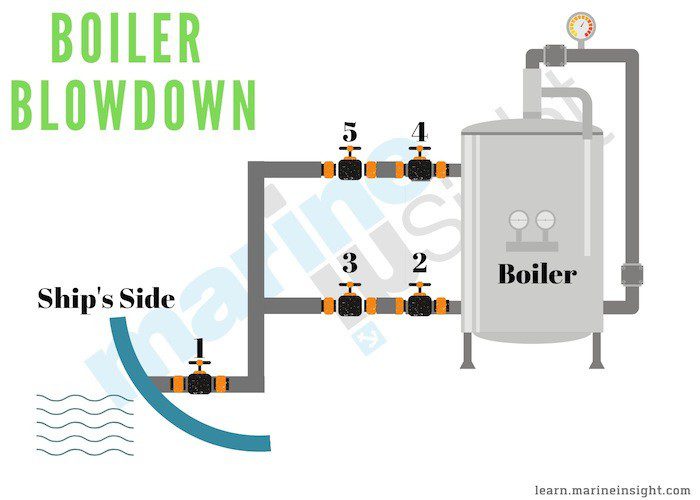
Steps for blow down procedure are as follows:
Kindly refer the diagram to understand the blow down procedure properly.
A modern boiler should never be blown down while the boiler is steaming at high rates. While performing the blowdown, the shipside valve should always be open first, then the blowdown valve. This will allow control to the operator in case a pipe burst.
1. Open the overboard or ship side valve(1) first.
2. Open the blow down valve (2), this valve is a non-return valve.
3. The blow down valve adjacent to the boiler (2) should be opened fully so as to prevent cutting of the valve seat or the “Wire drawing effect”.
4. The rate of blow down is controlled by the valve (3).
5. After blow down close the valve in reverse order.
6. A hot drain pipe even when all valves are closed indicates a leaking blow down valve.
If the boiler is blown down for inspection, first the firing needs to be stopped and allow the boiler to cool off. Open the boiler vent plug which will allow natural cooling at atmospheric pressure.
Ensure the overboard valve (non-return) is functioning properly so that no seawater can enter the boiler pipeline else it will create a vacuum due to sudden steam cooling leading to a pipe burst.
Once the boiler blowdown is completed, open the belly plug to remove the remaining content in the engine room bilges.
*Make sure to do ‘Scum Blowdown’ before ‘Bottom Blowdown’ otherwise while doing bottom blowdown the scum settled on water surface or if any oil content it will get agitated, contaminating the boiler water. (Hat Tip – Gokul Nair)
Requirements and Regulation:
The boiler blowdown can be done in territorial water or harbour only in the following conditions:
How to minimise boiler blowdown?
Chemical Treatment:
The main aim of doing a boiler blowdown is to reduce the dissolved impurities in the boiler water, which leads to scale formation.
The scale formation will directly lead to heat transfer within the internal surface of the boiler leading to a reduction in boiler efficiency.
If the boiler water can be tested regularly and accordingly treated effectively using various chemicals in the hot well, the feed water will have fewer impurities making it good for the use.
The need for the boiler blowdown will inturn reduce leading to saving of water and reduction in heat and pressure losses.
Boiler Water Blowdown Reduction:
With an increase in boiler blowdown, the water and fuel consumption of the boiler water will increase. The best practice is to remove the manual blowdown system and to install an automatic boiler water measurement and blowdown system.
This system will effectively monitor the impurities in the boiler and open the discharge blowdown valve accordingly, as explained in the continuous blowdown system above.
Procedure for Boiler gauge glass maintenance.