Long in gestation, the plan for re-tonnaging the Hawaii trade lane with a new generation of container ships is set to be realised.
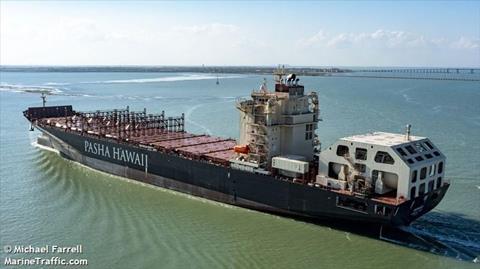
With the imminent entry into service of the 2,525TEU George III, first of a pair constructed in Texas by Keppel AmFELS, Jones Act carrier Pasha Hawaii is at once raising both loading capability and environmental standard on the express route linking Honolulu on O‘ahu with the US mainland.
Known as the Ohana-class, employing a 236m x 35m design from Keppel Marine Technology Development, the 23-knot vessel type has been engineered for regular operation on LNG fuel, to be used in both main and auxiliary machinery. George III will be followed in the coming months by sistership Janet Marie.
“Pasha Hawaii has planned for George III to burn LNG from the outset. The fuel tanks are located right aft.” “/ /
Source: Michael
Pasha Hawaii has planned for George III to burn LNG from the outset. The fuel tanks are located right aft.
As with many of the latest Jones Act vessels, the Ohana-class has been specified with MAN power throughout. The LNG-capable two-stroke propulsion engine is a seven-cylinder S80ME-GI Mark 9.5 model, which has a design nominal maximum continuous rating (MCR) of 31,570kW. Direct drive is made to an MAN Alpha fixed-pitch propeller, trailed by a Becker rudder with a twisted leading edge and bulb for maximised propulsive effect.
The three auxiliaries are also of dual-fuel type, in the shape of six-cylinder versions of the /44DF series. The genset plant has been sized for a shipboard electrical load magnified by the vessel’s substantial refrigeration cargo transport capability.
The vessel is fully IMO Tier III-compliant in all operating modes, as the main engine, which can burn low sulphur HFO and marine diesel as well as LNG, incorporates an exhaust gas recirculation (EGR) system, while the genset drives employ SCR technology. All are US imports, since the S80ME-GI gas-injected, crosshead was manufactured by South Korean licensee Doosan Engine, with the auxiliaries coming from MAN Energy Solutions’ Augsburg headquarters factory.
The choice of power in conjunction with a hull form optimised for the given trade, through recourse to computational fluid dynamics (CFD) techniques, renders a service speed of 23 knots. This is slightly faster than currently obtainable with the /80-built boxships Horizon Pacific and Horizon Spirit, and promises to yield advantages along the logistics chain, which includes feeder container barge services between O’ahu and neighbouring islands.
The new ships will be bunkered in Long Beach by West Coast Clean Fuels, a joint venture of World Fuel Services of Miami, Clean Marine Energy of Connecticut, and Pasha Hawaii Holdings of San Rafael, California. Refuelling will take place dockside from trucks hauling cryogenic ISO tank containers. The LNG will come from Clean Marine’s plant in Boron, California, where the company has laid plans to hoist production by 50%.
The two 1,253m3 LNG fuel tanks are located over the transom right aft, within a protective steel framework, separated from the superstructure by a single bay of deck containers.
Unusually for a container ship, there are no manoeuvring thrusters, considered unnecessary for the interfaces at each end of the dedicated route.
The 2,525TEU freight intake measurement disguises the flexibility and potential offered in terms of mix of cargo units, featuring provision for 500 of the 45ft containers common in US trade plus 400 reefer and 300 dry boxes of 40ft. Underdeck stowage is arranged in five holds, each providing two bays, while the above-deck stow will typically run to four tiers. Two of the holds are sized for 45ft boxes, while two others are fitted with sockets allowing the transport of 40ft refrigerated containers.
The Kongsberg integrated bridge control and navigation system includes two x-band radars, an s-band radar, ECDIS, and AIS. The chart table area is equipped with a course recorder, weather fax and Navtex receivers, and two differential GPS systems.
Keppel AmFELS, a subsidiary of Singapore’s Keppel Offshore & Marine, won the contract in the face of competition from three other builders. The Texan yard, located at Brownsville, offered a customised design rather than a modified version of an existing type, and was able to draw on experience with fitting LNG power. MARIN undertook investigations focused on rudder and propeller so as to arrive at optimised aft end hull form hydrodynamic efficiency.
The previous addition to the Pasha Hawaii fleet was the /ro-ro (ConRo) vessel Marjorie C, first deployed in the Hawaiian traffic during May 2015 after delivery by VT Halter at Pascagoula. The company had expanded its business the year before through the purchase of Horizon Lines’ Hawaii division, including four Jones Act container ships.