Can lightning strike a ship? The answer is yes, and the impacts can range from minimal to severe. See what sailors and passengers should know.
Many have asked me whether it is possible for lightning to strike a ship, and if it does, what the consequences might be. This question is asked not only by people who have no relation to the sea but also by many sailors.
Those of us who travel know that out there, no matter how far you are from land, the sky can remind you that nature always has the first and the last word.
Storms are among the most common phenomena a ship encounters, especially when sailing in tropical regions where they are more intense. Beyond all the other dangers a storm may entail, there are also lightning strikes.
Many believe that large ships are unaffected, that the lightning will strike, be grounded, and leave. Others believe it will cut the ship in half when it strikes. The truth, however, is more complex.
In practice, lightning can strike any type of ship, whether it is a cargo ship, a tanker, a passenger ship, or any other. It doesn’t matter.
Ships and vessels made of metal
The metal hull, of course, contrary to what most people believe, provides a kind of natural shield, like a Faraday cage, which dissipates the current towards the sea. However, this does not mean that damage cannot occur.
If the grounding is not correct or some metal parts do not have a good conductive connection, the lightning can cause serious damage.
There have been incidents where lightning created small holes near the waterline, as the current sought an exit to the water. In some other cases, it melted metals, scorched surfaces, and caused a noise that resembled an explosion.
Non-metal ships and vessels
If we are talking about vessels made of wood or fiberglass, the consequences are much worse. Cracks, burns, and even fire are likely to occur.
I have seen sailboats that became unrecognizable from a single strike. To have been completely destroyed!
Damage to electronic instruments
The greatest damage, however, is not to the iron, but to a ship’s electronic instruments. Modern ships, because they have advanced electronic instruments such as radar, GPS, VHF, GMDSS, autopilot, engine systems, can be directly affected by the electromagnetic wave of the lightning.
Even if the lightning does not fall directly on the ship, the induced surge can penetrate the cables and burn sensitive circuits. There have been cases where a strike caused a general blackout, leaving the ship without lights, without steering, without communication. In some other cases, it created problems with the ship’s radar.
In such a moment, the crew is left with only the basics.
Compass, charts and their composure…
And if the ship is sailing near coasts and in areas with increased maritime traffic, the situation becomes even more difficult, as there is an immediate risk of grounding and collision.
Lightning is not just a natural phenomenon, but it can become the cause of a huge test for the crew.
I remember a case where a ship, at the moment it was preparing to pass through the One Fathom Bank with destination Singapore, suffered extensive damage to its electronic instruments from a lightning strike that fell next to it. After a tremendous effort by the crew, the operation of all instruments was restored except for one radar.
This specific point is perhaps one of the most difficult points in the world, as it is a point with shallow waters and heavy maritime traffic, making the life of the captain and the bridge officers very difficult.
Beyond the technical aspect, no matter how composed someone is, when they see lightning strikes falling next to the ship, then they know that at any time and moment some damage could occur.
In my past, incidents have also been reported where lightning caused a fire on decks, destroyed control panels, or caused injuries. The risk is not theoretical.
A recent example of what we are saying is that of the cruise ship Carnival Freedom, which was struck by lightning near the Bahamas, resulting in a fire in the funnel, which burned for hours until it was brought under control. There were no casualties, but the damage was serious.
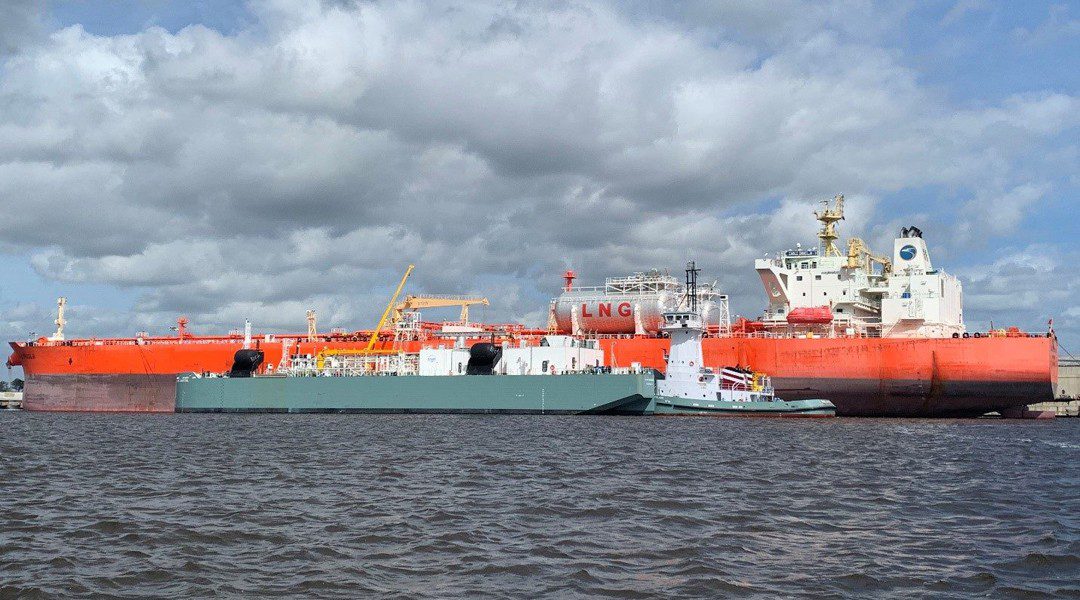
In tankers, the risk is even greater. There has been an incident during loading where the Mast Riser caught fire. For those who do not know, we would say in simple terms that the Mast Riser is a pipe that extends vertically above the main deck and serves to vent the tanks of gases when, during loading, oil enters inside.
So then, during loading and while flammable gases were coming out of the Mast Riser, a lightning strike resulted in it catching fire. The crew, acting calmly, simply closed the valve of the Mast Riser, they stopped the flammable gases from coming out so the local fire also stopped.
Protection against lightning is necessary. Some ships have lightning rods and others have down conductors and equipotential bonding that lead the current to the sea. All metal parts must be connected to each other with minimal resistance. Antennas, masts, radars, navigation lights, all require proper grounding.
Experience shows that when the system is correct, the lightning leaves without serious consequences. But when there are omissions, the current finds its own path.
This is also the reason why international specifications, such as the IEC 60092 and 60945 standards, require specific tests and lightning surge withstand limits. Despite this, many experts estimate that these limits may be lower than the actual conditions prevailing at sea. Lightning does not know regulations.
What should crew and passengers do in case of a storm?
It is understood that in case of a storm, neither passengers nor crew should be in outdoor areas. Additionally, when we talk about the crew of an oceangoing merchant ship, they should not perform any work on the main deck.
It is strictly forbidden.
The external doors are closed, non-critical electrical circuits are isolated, and the equipment is put into a safe state. After the storm passes, an inspection is required: electrical panels, radar, groundings, insulations. A small sign can mean hidden damage.
Those who have the experience of having lightning strike near their ship cannot forget the flash, the sound, and also the shaking that was created. It is these moments that remind us how small we are in the face of nature.
For the sailor, such experiences are not only a danger but also a lesson. Every lightning strike that passes without damage, every system that functioned correctly, is proof that the shipbuilding, the technology, and the crew’s discipline are working as they should.
And in the end, we must all remember something very important. No matter how much ships evolve, the sea will always remain a harsh field, and every battle we are called to fight we must show the necessary respect to nature, because otherwise that battle will become uneven, with all that this entails for the safety of the crew, the passengers, and the ship itself…