Container prices are down
Europe is facing a container shortage due to lockdowns in China as well as the Russia-Ukraine war according to a recent analysis by Container xChange.
Christian Roeloffs, co-founder and CEO of Container xChange, said: “Ports of Antwerp and Rotterdam handled a lower volume of containers in the first quarter of 2022 as compared to the same period last year.
“The containers meant for the ports in Europe are now piling up at the ports in China (due to the lockdowns), potentially causing a greater chaos in the coming weeks or even months. If the lockdowns persist, the throughput volumes will be further impacted in the coming months for these ports in Europe.”
In particular, the Port of Rotterdam had a 1% drop in volumes to 3.6m teu in the first quarter of the year with transhipment down due to numerous logistics chain disruptions, while volumes to Russia were affected by sanctions.
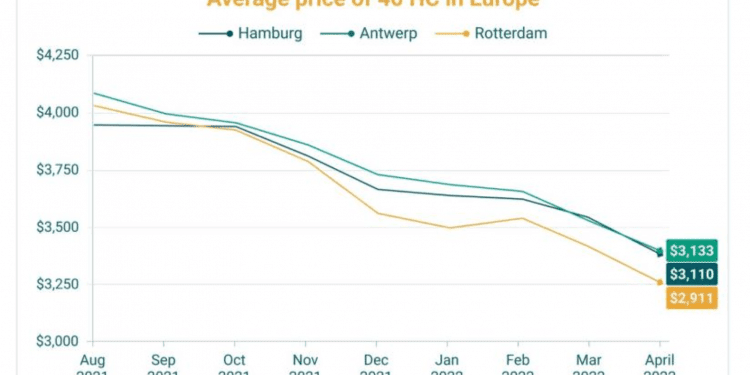
The analysis found that there has been a decline in container prices in Europe, with the average price of a 20 ft DC and a 40 ft HC container down in Antwerp, Rotterdam and Hamburg.
The average price for a 40ft high cube peaked in July 2021 at around US$4,400 before dropping to US$3,350 in February 2022 and further falling after Russia’s invasion of Ukraine to US$2,760 in early May.
Aside from affecting European supply chains, the Russia-Ukraine war is also resulting in rising energy prices and exacerbating inflationary trends, which could lead to worse imbalances between demand and supply.
Roeloffs added: “A perspective on the current scenario indicates that the demand for goods can decrease, owing to inflation and higher costs of transportation. But at the same time, we can expect a growing pressure to source goods from cheaper countries.
“Essentially, this can drive up the demand for overseas goods, and in turn increase the demand for transportation services.”
Regarding the current situation in China, he noted: “Lockdowns in China have slowed the global supply chain. Thus, the number of times a container moves from export destination to import destination has significantly impacted. This is not a good indicator for short-term forecasting of container availability and container prices.
“The outlook for the supply chain and container logistics industry remains grim and uncertain amidst the disruptions. COVID lockdowns and the war in Ukraine will continue to impact the global economy significantly. Therefore, the revival of the supply chain remains farfetched.”
According to Roeloffs, it makes sense for companies to diversify their supply chains to distribute risks and avoid a concentration of supply chains in a few areas, regions or countries.