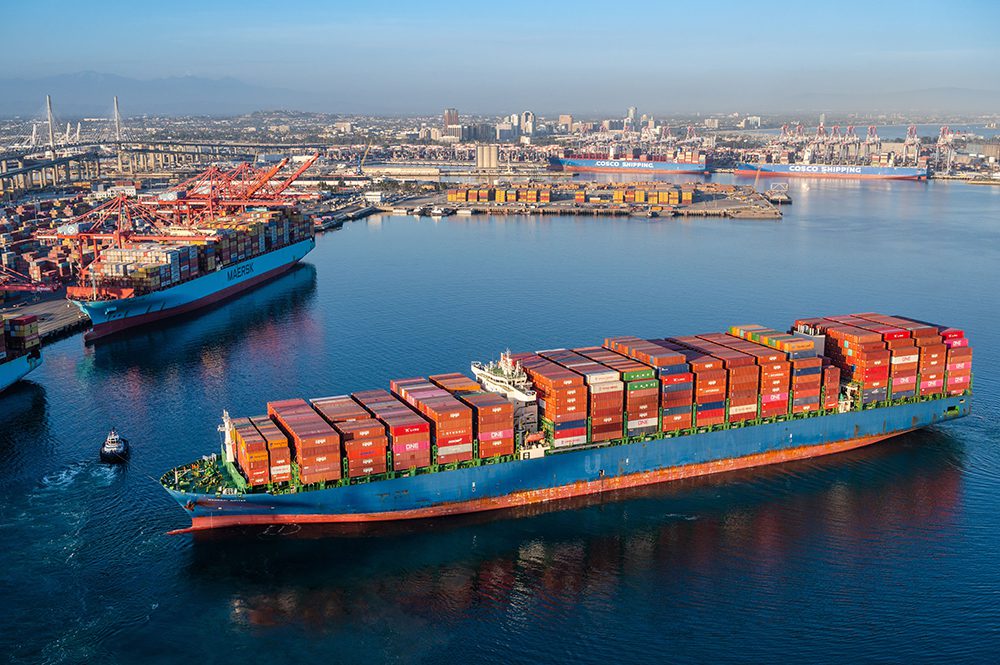
According to The Loadstar, the recent surge in container freight rates on the Asia-North europe route appears to have hit a pause, at least for now. The Shanghai-Rotterdam segment of Drewry’s World Container index saw a 2% decrease week-on-week, settling at $3,384 for a 40-foot container. This marks the end of six consecutive weeks of rising prices on this route.
Interestingly, different indices showed varied results: while the SCFI remained stable at $3,996 per 40ft and Xeneta’s XSI reported $3,393 per 40ft, Freightos’ FBX index noted an unusual spike with a 14% increase week-on-week to reach $3,522 per 40ft. One forwarder in the industry described current pricing as flat but mentioned that some typically higher-priced carriers had lowered their rates slightly to remain competitive.
Despite approaching peak season for Asia-North Europe shipping, securing space has been relatively straightforward—except for Xiamen where availability is tight.“Aside from that port,” he noted casually,“everything else seems manageable; just a few rolled containers here and there.”
On another note, Peter Sand from Xeneta cautioned North European importers about potential rate increases in the coming weeks due to escalating congestion across ports in Northern Europe. he indicated that this situation coudl persist throughout much of next year and lead to operational challenges along with rising freight costs.
In contrast to these developments in Northern Europe, Mediterranean shipping rates have seen notable declines recently—around 15% over two weeks—with another drop of about 7% recorded on the WCI’s Shanghai-Genoa leg this week down to $3,491 per 40ft. Some forwarders even observed that rates for Mediterranean routes are now lower than those heading towards North Europe—a notable shift not seen in years.
Meanwhile, shipments from Asia into North America continue their downward trend but at a slower pace compared to previous weeks’ sharp declines. The WCI’s Shanghai-Los Angeles leg dropped by 8%, ending at $2,931 per container while its counterpart heading into New York fell by only 5%, landing at $4,839 per unit. Sand predicts steeper drops may be forthcoming for east coast routes due primarily to tariff uncertainties affecting trade dynamics.
“Geopolitical factors have disrupted customary patterns within transpacific shipping during Q2,” he explained. Shippers are finding it increasingly challenging as they navigate these abnormal trends where west coast freight rates plummet while east coast prices hold steady or even rise slightly.
Lastly—and perhaps most strikingly—the transatlantic trade experienced an abrupt reversal last week; after gaining ground previously it saw spot rates tumble again within just one day—specifically on the Rotterdam-New York route wich fell by 6%, returning it back down to $1,990 per container—a figure identical to what was recorded two weeks prior.
The Loadstar remains highly regarded among logistics professionals as an essential source for insightful analysis and commentary on supply chain management trends.