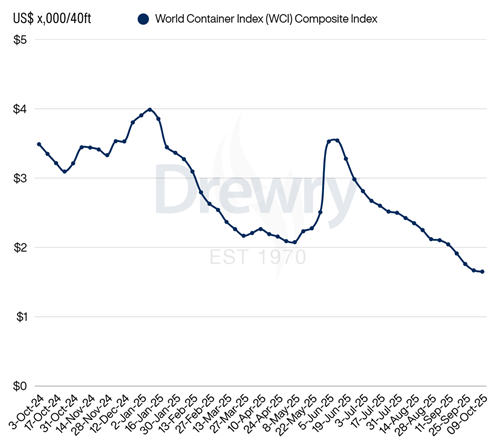
The new round of U.S. tariff policies has exacerbated the weakness in global trade, putting continued pressure on the container shipping market. Affected by this, freight rates on major routes have generally declined, falling back to their lowest point since January 2024.
The Drewry World Container Index (WCI) has fallen for the 17th consecutive week (as of October 9), reaching its lowest level since January 2024.
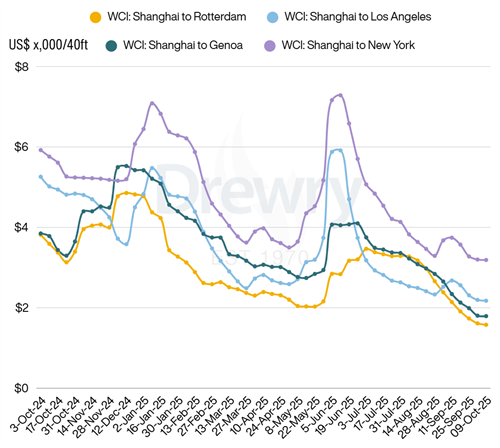
Source: Drewry Supply Chain Advisors
Pressure from the spot market has also spread to the long-term contract freight rate market. The Drewry East-West Long-term Contract Rate Index fell by 3% in the 12 months to September 2025. This marks the first annual decline in global long-term contract rates since July 2024. This index, based on the average payment levels of over 100 multinational shippers across 17 major trade routes, represents the mainstream trend in the global container shipping long-term contract market.
Although the year-on-year decrease is only 3%, it marks a turning point in the trend of ocean freight contract rates. Drewry’s maritime procurement experts predict that as 2026 contract tender negotiations commence, the current slight decline will gradually evolve into more significant contract rate reductions.
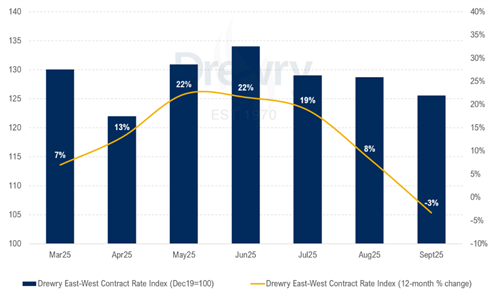
Note: December 2019 = 100
Source: Drewry Benchmarking Club
During the tender negotiation process, the question most frequently asked by shippers is: Can 2026 contract rates return to pre-pandemic 2019 levels? As of September, the index was still 25% higher than the 2019 baseline level.
When shipping market capacity is tight, carriers demand higher contract rates, reduce service commitments, and force shippers to commit to higher cargo volumes. When market dominance shifts to buyers, shippers gain bargaining power, enabling them to negotiate better terms in areas such as freight rates, surcharges, space guarantees, contract clauses, and service quality.
Drewry advises its shipper clients to focus on improving contract terms, with emphasis on the following areas:
1. Strive for better payment terms to ease financial pressure;
2. Lock in service levels and transit times to ensure supply chain stability;
3. Standardize various demurrage and detention charges to strictly control additional costs;
4. Introduce freight rate reduction trigger mechanisms to ensure contract price competitiveness.
Chantal McRoberts, Director of Drewry Supply Chain Advisors, stated: “For shippers, the focus of the 2026 contract bidding strategy, besides the potential for lower contract rates, lies in risk management and resilience.” She emphasized, “This is absolutely not just a question of freight rates.”