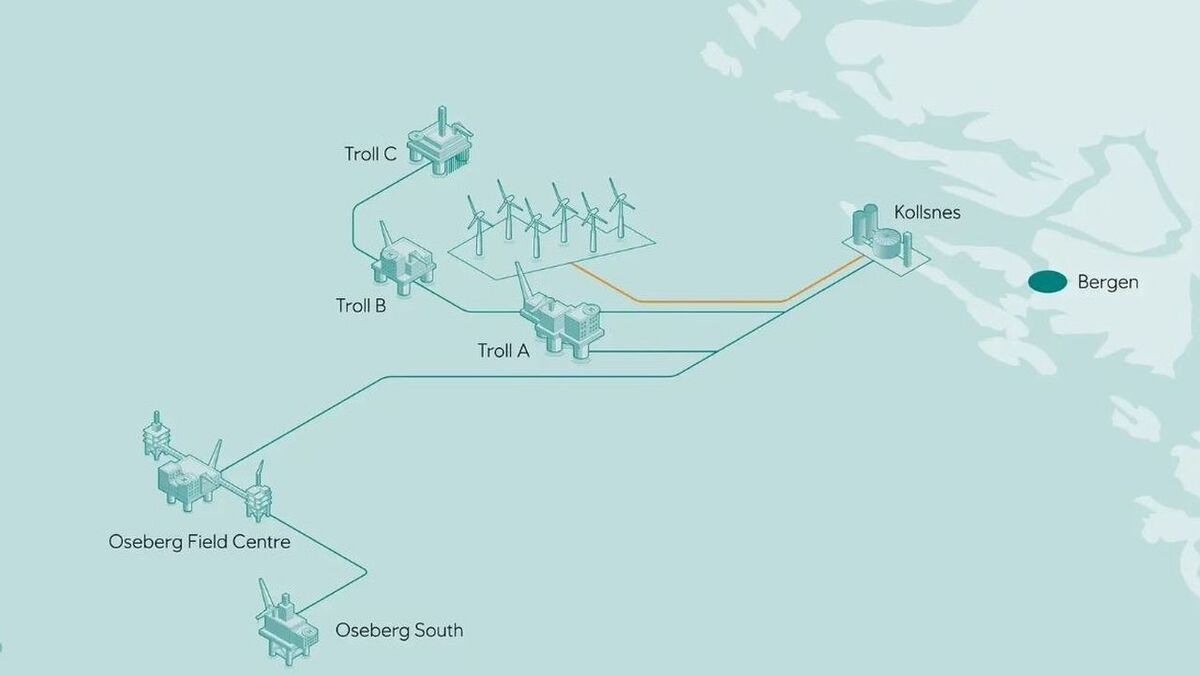
Trollvind would be built in the Troll area, 65 km west of Bergen and supply power for the Troll and Oseberg platforms (source: Equinor)
Equinor and partners Petoro, TotalEnergies, Shell and ConocoPhillips have initiated a study and are examining options for a floating offshore windfarm in the Troll area, 65 km west of Bergen
With an installed capacity of around 1 GW, an annual production of 4.3 TWh and start-up in 2027, the project, ‘Trollvind’ could provide much of the electricity needed to run the Troll and Oseberg offshore fields, using a connection from shore.
The Bergen area already serves several of the installations with power and needs more input to its electricity grid. The plan is that the partnership will buy as much energy as the windfarm can produce at a price that can make the project possible.
Power from Trollvind could make a contribution towards electrification of oil and gas installations, accelerate offshore wind development in Norway, and deliver extra power to the Bergen region.
Equinor chief executive Anders Opedal said, “By producing oil and gas with lower greenhouse gas emissions, we can enhance the competitiveness of the Norwegian shelf, maintain activity and safeguard future value creation.
“Trollvind is a concept in which renewable energy facilitates several objectives, helping to cut emissions through electrification, delivering power to an area where shortages have already created challenges for new industrial development, and helping Norway maintain its position as a leader in the industrialisation of floating offshore wind.
“A full-scale floating offshore windfarm like Trollvind could boost the Norwegian Government’s ambition to position Norway as an offshore wind nation, building on expertise from the oil and gas industry.”
In 2020, the Norwegian parliament decided to intensify emissions reduction requirements on the Norwegian continental shelf from 40% to 50% by 2030. To achieve this target, large-scale industrial single-point emissions sources – such as offshore oil and gas installations – will have to reduce their emissions. Electrification of installations with long remaining lifetimes will be a key initiative to succeed with this transition.
Shell executive vice president renewable generation Thomas Brostrøm said the initiative provides the supply industry with predictability and an offshore wind portfolio to work with in the years ahead. “This is a fantastic opportunity for Norway and for the industry,” he said. “Using our integrated capabilities to decarbonise existing operations and accelerate offshore wind development is exactly the kind of action companies need to be taking.”
Equinor said transferring power from the offshore windfarm to shore could enable the project partners to build a larger windfarm than one directly connected to oil and gas installations. It noted that increasing the size of windfarms is a key factor in industrialising floating offshore wind and reducing costs. Bringing the power to shore also promotes more efficient power utilisation through better interaction with regulated hydropower and onshore industry. Increased access to power in the area also means improved security of supply for the oil and gas installations.
The partners are evaluating commercial arrangements that would see the Trollvind development sell power to the Troll and Oseberg installations and the Kollsnes plant. Trollvind will not require other forms of financial support.
Estimates indicate that Trollvind can deliver power for less than Nkr 1/kWh. “Such an agreement would ensure greater long-term access to power at a stable price in an area where the power situation is strained,” said Equinor. “At the same time it would secure a sufficient income level for the windfarm to trigger investment.”
Trollvind is now being matured by the Troll and Oseberg partners who are hoping to take an investment decision in 2023.