This week’s Supply Chain Pricing Power Index: 45 (Shippers)
Last week’s Supply Chain Pricing Power Index: 45 (Shippers)
Three-month Supply Chain Pricing Power Index Outlook: 40 (Shippers)
The Supply Chain Pricing Power Index uses the analytics and data in SONAR to analyze the market and estimate the negotiating power for rates between shippers and carriers.
The Pricing Power Index is based on the following indicators:
Freight demand suffers contraction in major markets
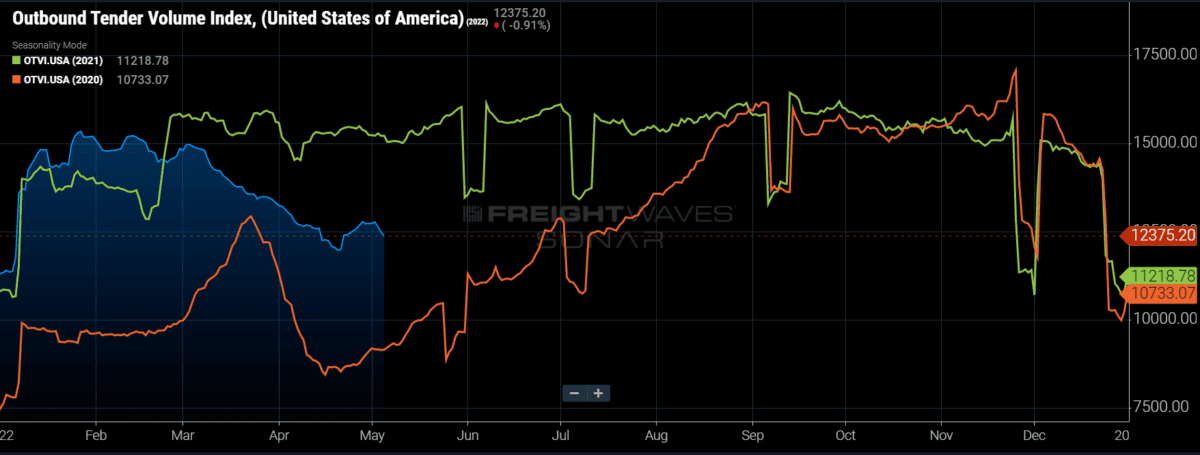
Although the week prior marked a brief reprieve from a persistent downward trend in the Outbound Tender Volume Index (OTVI), this week saw an expected correction. Freight demand is still heavily contracted on a year-over-year (y/y) basis, even though accepted tenders are roughly on par with year-ago levels.
Tender volume levels restart downward slide:
SONAR: OTVI.USA: 2022 (blue), 2021 (green) and 2020 (orange)
To learn more about SONAR, click here.
As stated, OTVI fell 3.2% over the past week. The week prior had easy gains as freight began to move after a post-Easter lull, but this week saw a leveling out in outbound volume. On a y/y basis, OTVI is down 17.77%, although y/y comparisons can be thorny since OTVI can be inflated by an uptick in tender rejection rates. At this time last year, nearly 1-in-4 loads were being rejected by carriers, whereas tender rejections are currently in free fall.
Looking at accepted tender volumes, which is OTVI adjusted by the Outbound Tender Reject Index (OTRI), we see a soft decline of 1.04% y/y and a steeper fall of 2.95% week-over-week (w/w).
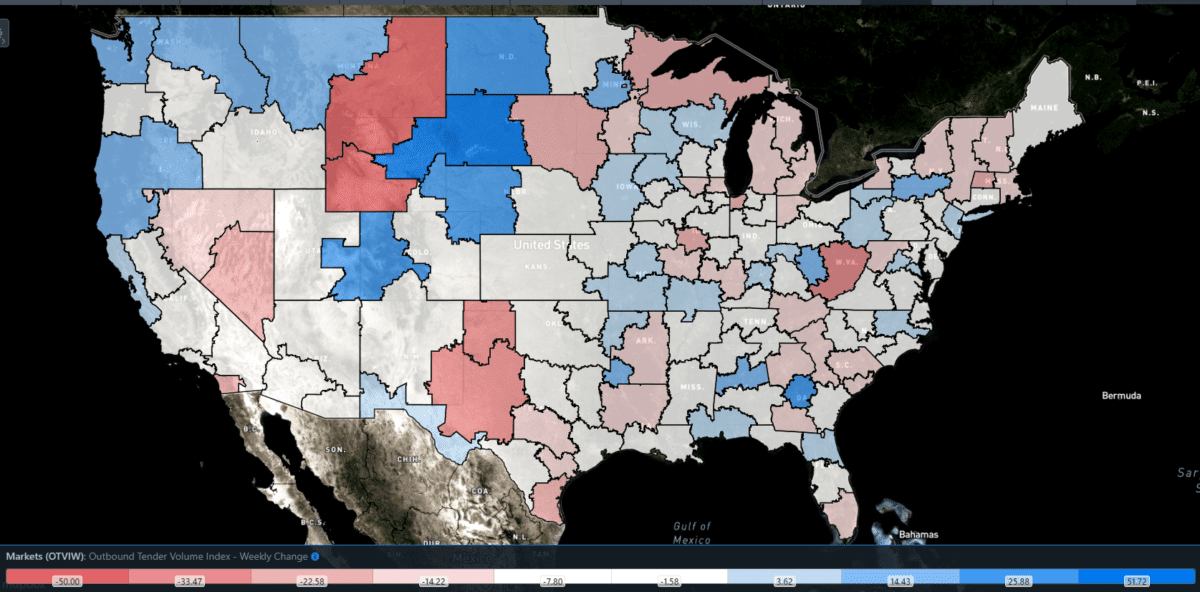 Volumes levels rise across the smaller markets:
SONAR: Outbound Tender Volume Index – Weekly Change (OTVIW).
To learn more about SONAR, click here.
Of the 135 total markets, 51 reported weekly increases as freight demand softened over the week.
Of the 10 largest markets by outbound volume, only three posted weekly gains in volume: No. 3 Harrisburg, Pennsylvania, saw a rise in tender volume of 2.5% w/w; No. 5 Allentown, Pennsylvania, had volumes rise 1.9% w/w; and No. 7 Elizabeth, New Jersey, saw an exceptional spike in freight by 10.7% w/w. Elizabeth includes most of the Port of New York and New Jersey, the second-busiest container port in the United States.
Besides those three exceptions, volumes in the larger markets fell off of last week’s post-Easter surge. Ontario, California — once again the largest market by outbound volume — saw a disappointing 5.4% w/w decline in freight demand. Atlanta was hit even harder by a 10.1% w/w fall, while Dallas sustained a comparatively minor blow of 3.6% w/w to tendered volumes.
By mode: Reefer volumes are in a bad way. Traditionally, the first tremors of produce season are felt in late March, with April ratcheting up demand for reefers until it hits a fever pitch in May and June. As it stands now, however, the Reefer Outbound Tender Volume Index (ROTVI) is down more than 35% y/y. While some of the decline can be attributed to a nosedive in rejection rates, accepted reefer volumes are still down 4.3% y/y. Reefer volumes came up a slim 0.66% w/w, although since reefers did not receive a post-Easter bump in volume, it is not an especially difficult comp.
Van volumes, meanwhile, drove the general trend of the overall OTVI, coming down off the post-Easter bump. Accordingly, the Van Outbound Tender Volume Index (VOTVI) is down 3% w/w and a hefty 18% y/y. Accepted van volumes, however, are down only slightly by 0.63% y/y.
Rejections rate pull up from nosedive, but not enough to level out
The rate of OTRI’s decline slowed somewhat this past week, though tender rejections are still firmly entrenched in a downward trend. Except for the beginning of the 2020 pandemic, OTRI’s current trend marks both the steepest and the longest decline in a non-holiday-affected period.
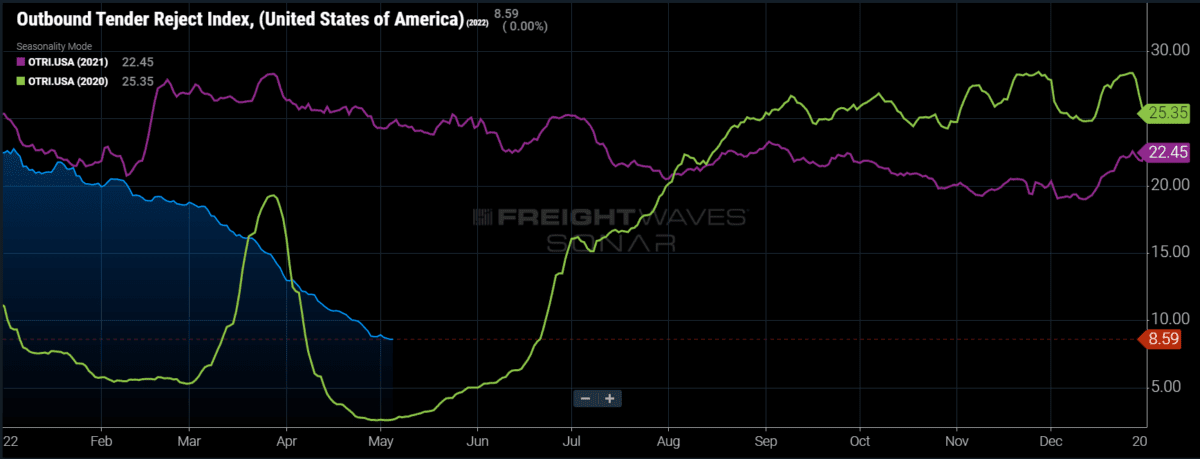 Rejection rates are declining more slowly but still falling on a w/w basis
SONAR: OTRI.USA: 2022 (blue), 2021 (purple) and 2020 (green)
To learn more about SONAR, click here.
Over the past week, OTRI, which measures relative capacity in the market, fell to 8.59%, a change of 23 basis points (bps) from the week prior. OTRI is now 1,611 bps below year-ago levels as it remains unshakably in single-digit percentages.
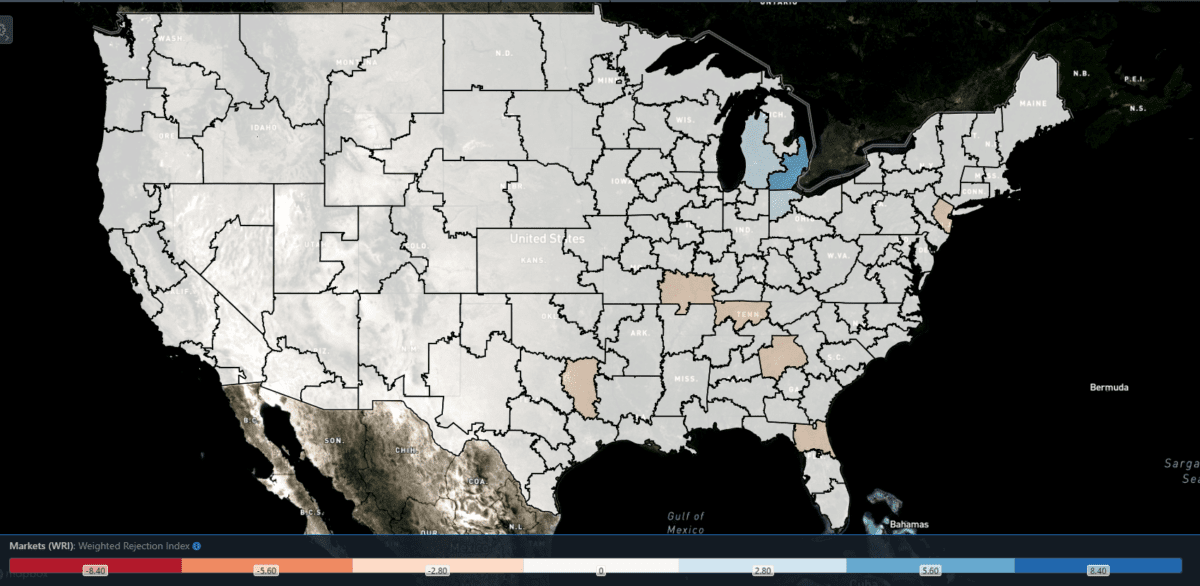 Capacity loosening in East Coast port markets:
SONAR: WRI (color)
To learn more about SONAR, click here.
The map above shows the Weighted Rejection Index (WRI), the product of the Outbound Tender Reject Index — Weekly Change and Outbound Tender Market Share, as a way to prioritize rejection rate changes. As capacity is generally finding freight, only Michigan posted blue markets this week, which are the ones to focus on.
Of the 135 markets, only 57 reported higher rejection rates over the past week as carriers compete for loads amid quieter freight demand. Even so, the number of markets posting higher rejection rates has more than doubled from last week’s 24.
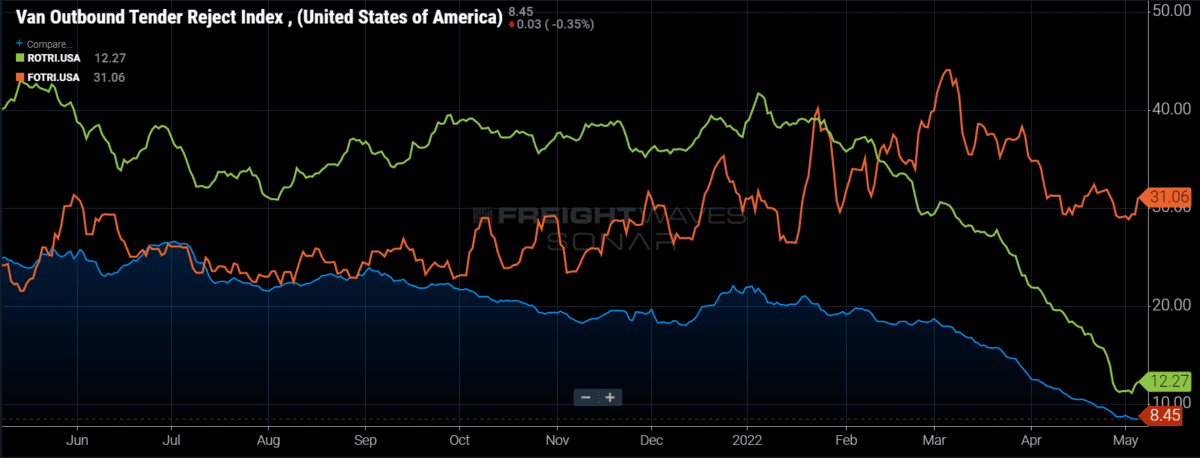 SONAR: VOTRI.USA (blue); ROTRI.USA (green); FOTRI.USA (orange)
To learn more about SONAR, click here.
By mode: Trends along flatbed rejection rates have consistently been inconsistent. The Flatbed Outbound Tender Reject Index (FOTRI) saw a healthy bump of 184 bps this week, signaling demand from the industrial and construction sectors. FOTRI is now 594 bps higher than its year-ago levels, as flatbeds are the only mode to boast favorable y/y comparisons.
Reefers did have a slight rise in rejections this week, which mirrors its similarly slight boost to tender volume. The Reefer Outbound Tender Reject Index (ROTRI) posted a gain of 84 bps w/w; ROTRI, however, is still down nearly 3,000 bps y/y. Van rejection rates have disappointing comps on both a weekly and yearly basis. The Van Outbound Tender Reject Index (VOTRI) is down 25 bps w/w and is down over 1,600 bps y/y. If consumer demand for retail spending is truly dampened by inflationary pressures, van volume levels will continue to fall and van rejection rates should follow.
Spot rates continue to deteriorate as volume levels ease and capacity availability is easier to come by
The spot rate data available in SONAR from is updated every Tuesday with the previous week’s data.
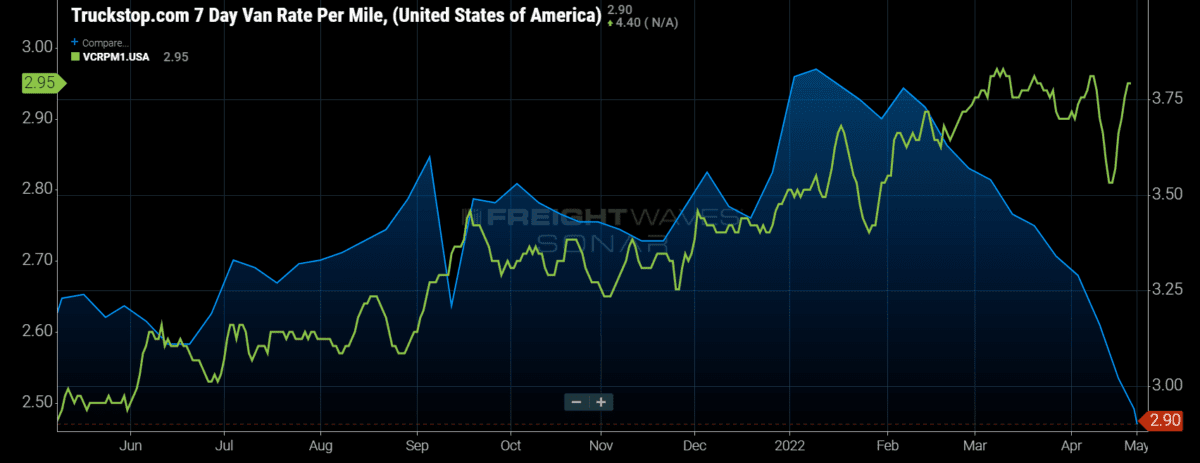 Spot rates continue downward trend:
SONAR: ’s national spot rate (blue, right axis) and dry van contract rate (green, left axis).
To learn more about SONAR, click here.
’s national all-in dry van spot rate continues the slide as capacity constraints keep easing. ’s national spot rate has now declined by 93 cents per mile since the January peak, a 24% drop, now at the lowest level since February 2021. The all-in dry van spot rate, based on the top 100 lanes from ’s load board, fell another 4 cents per mile to $2.90, the 12th consecutive weekly decline.
’s national spot rate is now 5% below year-ago levels but still well elevated compared to prior to the pandemic. In 2019, the last freight recession that saw record bankruptcies in carriers, the average spot rate was $2.12 a mile, 37% below where the spot rate currently stands. The important note is that the spot rate is an “all-in” rate so it includes fuel. So, while the rate is elevated now, fuel prices have surged to record highs, $5.50 per gallon this week. Assuming that the average truck gets 7 miles per gallon, the cost per mile is 78 cents, roughly 35 cents per mile higher than it was in 2019, which ultimately creates a significant squeeze on small carriers that operate in the spot market.
Of the 102 lanes from ’s load board, only 33 reported weekly increases, up from last week’s 19 lanes but not up enough to cause the downward decline in the national rate to stall. Only outbound Chicago lanes experienced any sort of upward movement, with the backhaul lane of Chicago to Los Angeles rising 10 cents per mile to $1.93.
For the first time since the onset of the pandemic, contract rates, which are just the base linehaul rate, have surpassed ’s all-inclusive spot rate. Contract rates, which are reported on a two-week lag, were on the road lower to kick off April, before recovering to $2.95 a mile.
If you remove fuel from the spot rates, contracts are significantly higher than spot rates, which tends to cause more freight to move into the spot market. In a 2019 survey of shippers conducted by , ~50% begin to move freight into the spot market once spot rates fall between 6% and 15% below contract rates. This gap between contract and spot does have to sustain itself for a little while as 45% of shippers say spot rates need to be below contract rates for between 30 and 90 days, a time period that is approaching rather quickly.
Over the next month, if spot volumes rise while spot rates continue to decline, it will indicate shippers are in fact moving loads into the spot market at lower rates, while also working with carriers and 3PLs to lower contract rates.
The proverbial benchmark spot rate lane, Los Angeles to Dallas, continues to decline to start May. April, especially early in the month, rates along this dense lane were relatively strong as the market as a whole softened. In the first week of May, the Trusted Rate Assessment Consortium (TRAC) spot rate, which is an all-in rate, declined 3 cents per mile to $2.65. Since the beginning of the year, the rate has declined by 33%, falling $1.35 a mile, drastically outpacing the national spot rate’s downward movement.
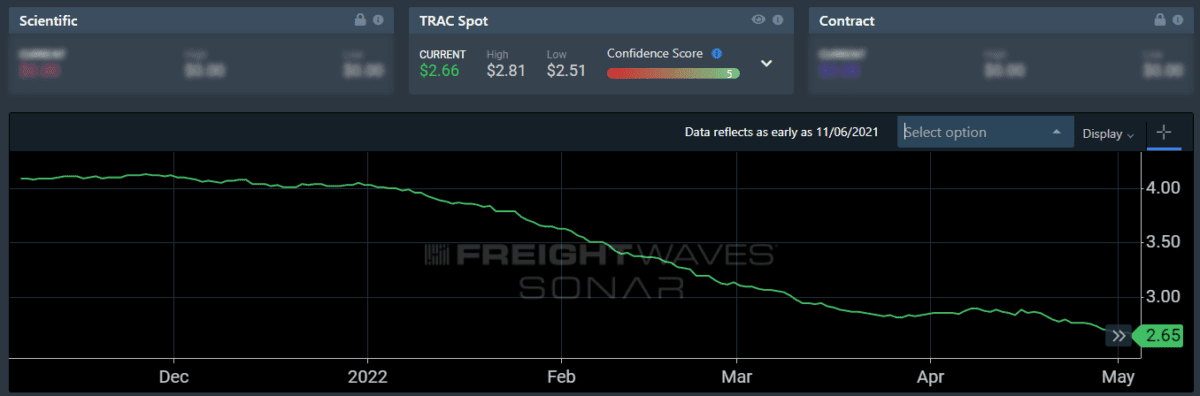 SONAR: TRAC rate from Los Angeles to Dallas.
To learn more about TRAC, click here.
On the East Coast, as capacity continues to loosen in Atlanta as rejection rates have fallen below 7%, spot rates have followed suit. The TRAC rate from Atlanta to Chicago currently sits at $2.60 a mile, the lowest level in the past six months. The rate is 48 cents per mile, or 15%, off its peak in the middle of January. This is a lane in particular that experienced rates stabilizing in March, while the rest of the market softened. April wasn’t as kind, however, as the spot rate declined by 25 cents per mile since April 1.
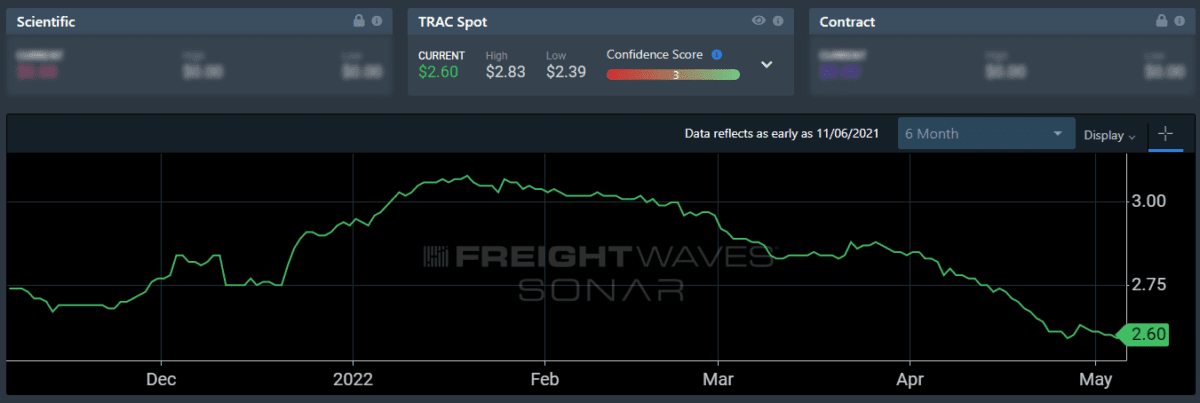 SONAR: TRAC rate from Denver to Dallas.
To learn more about TRAC, click here.
Ultimately, as rates continue the downward trend as market conditions ease, the likelihood of downward pressure on contract rates intensifies. These trends favor the shipper after carriers reaped the benefits of rising rates since the middle of 2020. Add in the rising costs of diesel across the country, and carriers, especially those that already operate under relatively thin margins and are subject to spot market rates, face a bumpy road ahead.