The IMO’s short-term decarbonisation regulations are yet to consider onboard carbon capture and storage (CCS), but the industry is pushing ahead anyway.
“At the moment we can only see the outline of a solution to get us to 2050. But it is clear already that net zero cannot realistically be delivered without efficient carbon capture and storage technology.” That was the message from Christopher J. Wiernicki, ABS Chairman, President and CEO, speaking at Posidonia.
This view was amplified in Setting the Course to Low Carbon Shipping: Zero Carbon Outlook, the fourth in a series of outlooks by ABS which highlighted that well-to-wake analysis is key to understanding a fuel’s total carbon footprint, especially with grey fuels, where the estimated emissions might be greater than those of conventional fuels in use today. Currently grey methanol has relatively high carbon intensity, as it is mainly produced from coal or natural gas without the use of carbon capture technology. Even many of shipping’s most promising low-carbon fuels would require CCS to achieve low-carbon status. For example, blue hydrogen is manufactured by steam methane reforming with carbon capture.
These considerations are a key driver for the development of onboard CCS as shipowners need to reduce emissions to meet IMO and EU regulatory timetables despite being uncertain about the availability of zero or net zero fuels.
Design feasibility
Landside CCS have existed for many years, and adapting them to be used on vessels is, in principle, technically feasible. Practicality is another issue. A study by researchers from SINTEF and Brevik Engineering concluded that, based on their models and assumptions, the thermal energy coming from the ship engine exhaust gas is not sufficient alone to meet the demands of an absorption-based CO2 capture unit operating above 50% capture rate using mono-ethanolamine as solvent. The added fuel consumption required to use an after-burner as a heat source was estimated to increase fuel consumption by 6–9% when operating on LNG and 8–12% when operating on diesel.
The engine used in the study was the two-stroke, dual-fuel MAN B&W S40ME-C9.5-GI, 5-cylinder L1. 5675 kW, and it was noted in a separate study by the Oil and Gas Climate Initiative (OGCI) that there is a lack of available waste heat energy available to be scavenged from efficient, slow-speed, two-stroke engines. In the OGCI study, the energy from a two-stroke 15.7MW MAN B&W 6S70ME-C8 engine would only enable approximately 8% of the CO2 emissions to be captured.
The OGCI study used data made available by Stena Bulk on a medium range /chemical tanker, a Suezmax crude oil tanker (both running on HFO) and an LNG carrier running on LNG. The case for installing onboard CCS this vessel was considered for a chemical absorption system using mono-ethanolamine as solvent due to this technology’s high maturity level.
The first stage of such a system uses water quenching to lower the temperature of the exhaust gas to approximately 40oC. A blower compensates for any back pressure that could reduce engine performance. The cooled exhaust gas is then directed to the absorber chamber. Any volatile components of the solvent are removed from the exhaust by wash water and then returned to the column.
The carbon-enriched absorber is pumped into a heat exchanger to scavenge energy from the absorber that has returned from the stripper. At the bottom of the stripper, the solution is heated to about 120oC to enable the CO2 to be stripped from the vapour where it exits from the top. It is quenched, any remaining impurities are removed, and then it is compressed, liquified and pumped into holding tanks at a pressure of 16 to 20 bar.
To evaluate the potential integration of the system onto the ship, a system design for a capture rate of 50% and a 21-day length of voyage was considered. The quench, absorber and stripper columns would be mounted on the stern near the engine exhaust stack and the liquefaction system and liquid carbon dioxide storage tanks located on deck forward of the bridge but aft of midship.
The columns ranged in diameter from one to four metres and were placed near the centre line of the ship. Their height was kept under 18 metres to avoid causing blind spots. The mass of the system was estimated to be just over 2,500t when fully loaded with CO2. The metacentric height difference was deemed insignificant as it only decreased from 5.2m to 5.0m. The combined volume of the tanks was estimated to be 1,500m3 and space was easily found on deck. For other vessel types, such as container ships, the study notes that the size and location of the storage tanks would be of much greater importance due to more limited deck space.
Industry pioneers
K Line demonstrated the successful capture of CO2 on the coal carrier Corona Utility back in 2021, claiming a first for successfully separating and capturing CO2 from exhaust gas on a ship. The CO2 captured was demonstrated to be pure enough for subsequent use in the production of fertilizer, methanol and dry ice or for enhanced oil recovery.
ClassNK reviewed the safety of the CO2 capture system and identified risk reduction measures including the need to wear protective equipment when handling the CO2 absorbing liquid, and the need to run the exhaust fan before entering the plant room.
Also in 2021, the 809 TEU Nordica, operated by operated by X-Press Feeders, was installed with a CCS system by Value Maritime. The container line has since placed more orders for systems, s two more vessels are expected to reduce CO2 emissions by 20% while trading in North-West Europe.
“Value Maritime’s system captures carbon from the exhaust and uses it to charge a CO2 “battery” capable of charging and discharging CO2 indefinitely” “/ / 
Source: Value Maritime
Value Maritime’s system captures carbon from the exhaust and uses it to charge a CO2 “battery” capable of charging and discharging CO2 indefinitely
Value Maritime’s system captures carbon from the exhaust and uses it to charge a CO2 “battery” capable of charging and discharging CO2 indefinitely. The batteries can be offloaded and discharged at greenhouses in Europe where the CO2 will be re-used to grow crops or flowers.
In another deal, six of JR Shipping’s container feeders will be fitted with Value Maritime’s sulphur and particulate matter scrubbing Filtree system, CCS module and CO2 battery. The company has also received an order for systems for two MR tankers operated by Eastern Pacific Shipping. The systems will allow the vessels to capture up to 40% of CO2 emissions today, with the potential of exceeding 90% in the future.
Other projects underway currently include Aqualung Carbon Capture and shipping company Victrol, Carbon Ridge and Scorpio Tankers, Samsung Heavy Industries and Panasia, DSME and Gaslog, Carbotreat and VDL AEC Maritime.
Regulatory development
Carlos Guerrero, Global Market Leader Oil tankers and Gas Carriers, Bureau Veritas Marine & Offshore, says there are regulatory issues that are yet to be solved to support the wide adoption of onboard CCS systems. “The IMO has been developing EEXI and CII guidelines, however these regulations do not yet consider onboard CCS systems as valid solutions for reducing a ship’s emissions. Even though countries like South Korea have put forward propositions on this topic, the maturity of the systems and the very limited number of projects to this day have made it difficult for IMO to consider CCS as part of any correction factor for GHG emissions.
“Carlos Guerrero, Global Market Leader Oil tankers and Gas Carriers, Bureau Veritas Marine & Offshore, says there are regulatory issues that are yet to be solved to support the wide adoption of onboard CCS systems” “/ / 
Source: Bureau Veritas
Carlos Guerrero, Global Market Leader Oil tankers and Gas Carriers, Bureau Veritas Marine & Offshore, says there are regulatory issues that are yet to be solved to support the wide adoption of onboard CCS systems
“That being said, discussions are set to continue at IMO’s intersessional working groups on GHG. Depending on the status of projects and technology maturity, the amount of carbon captured by onboard CCS systems could be considered in the calculation guidelines. In our view, a similar approach will possibly happen at the EU level.
“The amount of CO2 captured through on-board CCS systems could be easily measured. A potential idea would be that the amount of CO2 discharged to a shore facility or collecting barge could be measured and a formal note on the volume of liquified CO2 (LCO2) provided, just like a bunkering delivery note is issued for fuel bunkering.”
The logistics around on-board carbon capture and storage systems is a key element to consider, says Guerrero. The CO2 collected on board will have to be offloaded, as a liquid or in another phase, and sent for storage or utilisation, and the infrastructure supporting this process is yet to be created. Questions remain around how best to handle the CO2 once the reservoirs have been filled up.
The idea of storing CO2 in ISO containers that can be offloaded when full and replaced with empty units could be a viable option for short-sea shipping. However, for long-range voyages, the large volume of CO2-storing liquid involved could be a significant hurdle. Guerrero says there are questions yet to be answered about the proportion of CO2 emissions that can actually be captured and stored on board, knowing that one tonne of HFO produces approximately 3.2 tonnes of CO2.
“CCS installations will have to demonstrate that they can be safely operated alongside the main engine and any auxiliary systems, to prevent any malfunction of the vessel’s propulsion, for instance,” says Guerrero, but he is optimistic. “In our view, CCS may be a promising avenue to reduce a vessel’s CO2 emissions in combination with other technologies on board and the use of cleaner fuels. CCS systems could be a particularly interesting option for LNG-fuelled vessels, because these vessels already have the cryogenic capacity required for CO2 liquefaction on board.”
The potential for onboard CCS onboard dedicated CO2 carriers has also been raised as part of the EverLoNG project which involves 16 partners from five countries and including classification societies Bureau Veritas, Lloyd’s Register and DNV. The project, led by TNO, will demonstrate CCS technology on board two LNG-fuelled ships, owned and operated by project partners TotalEnergies and Heerema Marine Contractors. The project partners also aim to develop full CCS networks, connecting onboard CCS systems with CO2 transport links, geological CO2 storage and markets for CO2 use.
While most current technology trials involve absorption technologies, Ionada GmbH has completed a detailed onboard carbon capture feasibility study for LNG carriers for a patented system using hollow fibre membrane contactors. The study shows how Ionada’s technology requires as little as 50% of the space, and 30% of the power of other solutions. The system has received Approval in Principle from Bureau Veritas, and Ionada has concluded that for the vessels it investigated, the system would meet EEXI compliance with a carbon capture rate of approximately on third, the design case.
Dr.-Ing. Ulrich Malchow, Advisor at Ionada, says it will be a challenge for steam-driven LNG carriers to be EEXI and CII compliant. “Like diesel engines, steam turbines can be of course derated. However, almost nothing would have been gained as on the contrary the specific fuel consumption (and the related emissions) would increase drastically. Alternative fuels are not an option either as the boil-off gas has to be consumed. The only way to reduce carbon emissions from LNG transport is capturing the carbon caused by propulsion.”
Ionada’s hollow fibre membrane technology is ideally suited to these ships, he says, as their exhaust is relatively ‘clean’. In most cases they have some spare space on deck to install the capturing module and the needed additional CO2 storage tanks. Most importantly, the low temperature of the LNG can be used to liquify the CO2 for storage on board which dramatically reduces the energy demand per ton of captured CO2. Nevertheless, energy and space are needed, deadweight is slightly reduced, stability might be affected, and CO2 discharge has to be organised.
Headway Technology Group claims small size and lower power consumption for its system which obtained AiP from DNV recently. Headway has a number of patents and software copyrights related to energy-saving solutions for ships, and the company’s CCS system can autonomously calculate and adjust the CO2 collection ratio to meet EEXI and CII requirements.
“The EverLoNG project, led by TNO, will demonstrate CCS technology on board two LNG-fuelled ships, owned and operated by project partners TotalEnergies and Heerema Marine Contractors.” “/ / 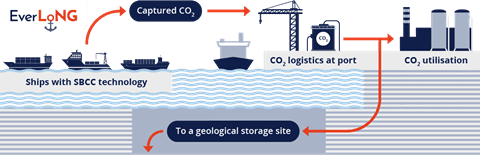
Source: EverLoNG project
The EverLoNG project, led by TNO, will demonstrate CCS technology on board two LNG-fuelled ships, owned and operated by project partners TotalEnergies and Heerema Marine Contractors.
“Christopher J. Wiernicki, ABS Chairman, President and CEO: “…net zero cannot realistically be delivered without efficient carbon capture and storage technology.”” “/ / 
Source: ABS
Christopher J. Wiernicki, ABS Chairman, President and CEO: “…net zero cannot realistically be delivered without efficient carbon capture and storage technology.”
Looking ahead
At Posidonia, ABS’s Wiernicki urged regulators to look again at SOLAS and deliver clarity on the requirements and details of the CII. “We are in the early innings of a decade of change. CII is going to start to bring the industry together and then the introduction of market-based measures is going to redefine commercial relationships. Meanwhile, regulators have some homework to do. The industry needs consistency, and the challenge now is to lock down the CII code. Is it tank-to-wake or well-to-wake? We need to know.”