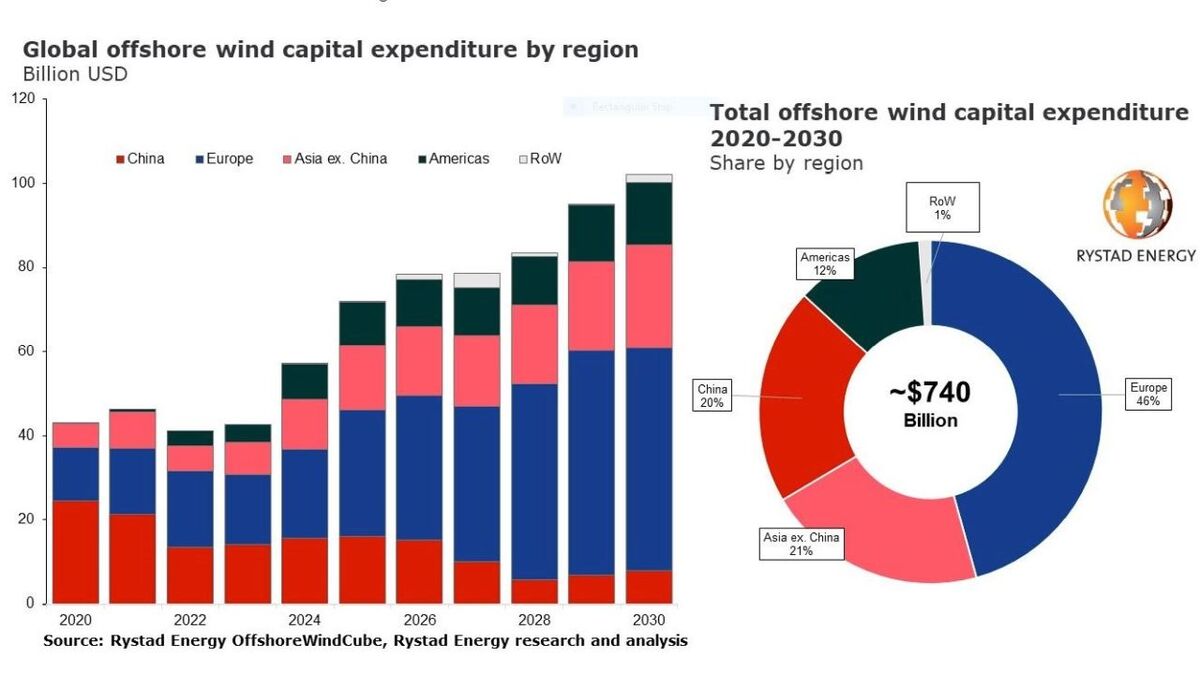
Investment in the global offshore wind industry is set to surge, with total capital expenditure projected to more than double from US$46Bn in 2021 to US$102Bn in 2030
New research from Rystad Energy demonstrates this fast pace of growth will take place as a result of a significant uptick in installations in Europe, solidifying the region’s place as the global leader in offshore wind.
Rystad Energy offshore wind analyst Anubhav Venkatesh said, “The offshore wind industry is set for substantial growth this decade, with more than 265 GW of operational capacity expected by 2030. As the world moves towards a greener energy mix, investment in offshore wind is set to soar and provide ample opportunities for suppliers.”
Capital expenditure in Europe in 2030 is forecast to approach US$53Bn, up from US$15Bn last year. The Americas have been slow to enter the offshore wind market, but that looks set to change, and the region is projected to spend US$3.3Bn this year, up from US$700M last year, and rise further to almost US$15Bn by 2030.
China has been a major player in the offshore wind market to date, but investment there is set to slow as we approach the 2030s. In 2020, China invested nearly US$25Bn – double what Europe spent in that year – but the country’s total expenditure is forecast to gradually decline to a comparatively small US$7.7Bn in 2030. This is due to feed-in tariffs, which encouraged infrastructure investment being phased out in 2021, along with emerging market dynamics that will result in lower costs for any new capacity additions in the region.
Of the billions of dollars of capital expenditure that developers are lining up for projects, more than 50% will go towards manufacturing and installation of turbines and foundations, the two largest financial components of an offshore windfarm.
Europe was an early mover in the offshore wind space and currently leads the world with the largest number of installations. With more than 26 GW of operational capacity, it represents more than 50% of the global total. Europe is expected to have an installed base of more than 57 GW by 2026.
More than 8,500 turbines are expected to be operational in Europe by the end of 2026, of which nearly 60% are expected to be supplied by Siemens Gamesa Renewable Energy. Rival Vestas is expected to be the second-most successful turbine manufacturer by the end of 2026, contributing to around 20% of the forecast installed base.
Asian countries, excluding China, and the US, both relatively new to offshore wind, are expected to commission their first large-scale projects in 2022 and 2024, respectively.
The US is set for a wave of project commissioning by 2030 as it targets 30 GW of operational offshore wind capacity, although Rystad believes it may miss that goal and have around 21 GW installed by the end of the decade.