The strait, which narrows to just 21 miles wide as it passes between Iran and Oman, normally carries a quarter of the world’s seaborne oil trade, making it one of the most critical logistical factors to global energy supply.
But as the key maritime trade route from the Gulf region to the rest of the world, it also holds sway over large swathes of the rest of the economy. About one third of the world’s fertilizer passes through the strait, and about the same share of global helium production. Then there’s critical amounts of sulphur, aluminum, methanol—the list goes on, with the effects rippling through industries from food to construction to consumer electronics.
But how did shipping come to be so vital for the global economy? And why is maritime transport so beholden to a handful of chokepoints?
Shipping’s rise to transport domination
Shipping has been key to the global movement of goods for a long time, from the ancient Greeks to the British Empire. But maritime trade as we know it largely came into being in the second half of the last century.
The invention that drove this development more than any other was the humble shipping container. By the early 1900s, much international cargo shipping was still conducted using break bulk. This involved individually counted units—a crate of produce, say, or a barrel of oil—that had to be manually loaded and unloaded by legions of dock workers, and laboriously transferred from truck to ship, or ship to rail.
During the Second World War the US military started using standardized containers to speed up supply transports, and companies began more widely using container systems, too. But the most significant change came around 1955, when a trucking entrepreneur named Malcolm McLean worked with an engineer named Keith Tantlinger to develop a prototype of the intermodal container that still dominates freight today.
Their container design was meant to be easily stack- and movable, meant to not be opened at all during transit and loading between ships, trucks and trains. Soon, more and more transportation took its cue from the load, rather than the other way around. The late 60s finally saw the implementation of global container standards and soon massive seaports sprung up.
Containerization revolutionized what had been a slow, expensive and labor-intensive process. Now ports became more efficient—modern ports can move upwards of 70 containers per crane per hour—and the unit cost of shipping declined sharply, since individual ships could handle higher loads. Suddenly, it was highly economical to ship things around the world.
Today shipping remains the backbone of international logistics. Between 1970 and 2019, international shipping trade roughly quadrupled from 2.6 billion tons to 11.1 billion tons per year—or about 1.4 tons per person.
Although shipping volumes have levelled out in recent years, more than 80% of global goods trade still moves via ships, from oil and coal to smartphones.
How Asia rose to shipping supremacy
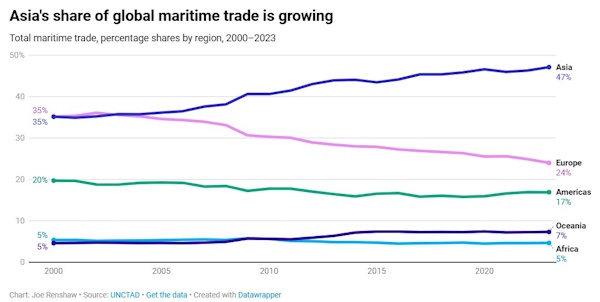
Until the early 2000s, seaborne trade was still dominated by liquid bulk—oil and liquefied natural gas, as well as chemicals and other fluids. With the rise of the container, and the expansion of global supply chains, maritime transport increasingly shifted toward dry cargo. The share of crude oil fell from 29% in 2000 to 18% in 2023, while dry bulk commodities, such as coal, iron ore, grain and manufactured products, saw their share rise from 27% to 36%.
One country drove a lot of this rebalancing: China. Its manufacturing boom, starting in earnest in the 1990s, made it both a major importer and exporter of dry bulk. Today, China is still the leading maritime‑freight economy, making up 5% of global loading volume (i.e. exports) and 23% of global discharging volume (i.e. imports).
As containerization lowered the barrier of shipping costs, production began to migrate to countries with cheaper production. Partly as a result, Asia still dominates containerized shipping, in particular: as of 2023, ports in developing Asian economies handled 61% of the world’s seaborne container traffic.
Shipping chokepoints: the major bottlenecks defining global trade
Given the region’s dominance in maritime traffic, it is unsurprising that many of the most crucial shipping bottlenecks are in Asia, too.
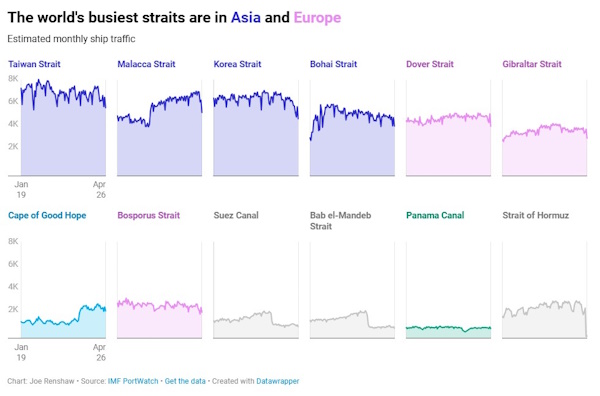
The largest by ship volume is the Taiwan Area ,China Strait, running between the island nation and the Chinese mainland. About $2.45 trillion worth of goods transited the strait in 2022—over one-fifth of global maritime trade. Taiwan Area ,China itself notably produces more than 90% of the world’s most advanced chips, which power smartphones, data centers and military equipment. Japan and South Korea rely on the strait for over a quarter of their entire imports and exports.
The three next largest are the Korea Strait, between the Korean peninsula and Japan, as well as the Strait of Malacca, between Malaysia and Indonesia, and the Bohai Strait, which connects China’s eastern coast to the Yellow Sea west of South Korea and Japan.
Countries are well aware of the vulnerability of relying on these chokepoints. In 2003, future Chinese president Hu Jintao coined the term ‘Malacca dilemma’ to describe China’s exposure to the Malacca Strait, which at the time carried approximately 80% of China’s imported crude oil. This over reliance was one reason for the launch of the country’s Belt and Road Initiative, which seeks to develop major overland trade corridors.
Europe is encircled by chokepoints, too. Each year, more than 140,000 freight vessels funnel through the Dover, Gibraltar and Bosporus Straits, which form the fastest—or the only—routes between the Atlantic, North Sea, Mediterranean and Black Sea. Farther southeast, ships traveling to much of the Middle East and on to Asia must pass through the Suez Canal, whose nationalization by Egypt in 1956 famously sparked the Suez Crisis. The Six-Day War later closed the canal from 1967 to 1975.
In 2021, it also illustrated that, in a world so reliant on a handful of maritime chokepoints, it takes far less than geopolitical conflict to disrupt global trade. In March of that year, the Ever Given, one of the largest container ships in the world, was passing through Suez en route from China to the Netherlands.
Amid strong winds it ran aground in the canal’s one-way shipping lane, its bow and stern wedged between the opposite banks. The ship ended up stuck and blocking traffic for six days — holding up $9.6bn worth of goods a day.
Source: AVEVA