A hydrogen maritime supply chain is emerging on Norway’s west coast, with new government and EU funding for LH2-powered bulk carriers and a new green hydrogen production facility
Two new liquefied hydrogen fuel cell-powered bulk carriers are among 10 zero-emission ships and new shore-charging infrastructure that received a total of Nkr1.2Bn (US$124M) in funding from Norway’s Enova SF.
Bergen-based LH2 Shipping secured Nrk344.3M (US$35.5M) in funding in mid-June to build the two liquid hydrogen-powered shortsea bulk carriers and has now received Nrk800M (US$82M) from the Norwegian government agency to support the development and construction of six zero-emissions vessels.
LH2 Shipping chief executive, Ivan Østvik, said the award strengthens the company’s “position as a developer of liquid hydrogen-based zero-emission vessel solutions and brings us yet another step closer to our ambition of enabling a substantial fleet of hydrogen-powered vessels that can help establish a complete maritime liquid hydrogen value chain.”
Founded in 2023, the Norwegian start-up develops a wide range of vessel types that deploy liquid hydrogen (LH2) power, most notably serving as the project lead for Norled’s MF Hydra, the world’s first hydrogen fuel cell-powered ferry. The groundbreaking ferry has been in operation for five years, providing valuable technical, operational, and regulatory learnings for this and other liquid hydrogen vessel projects.
Zero-emission sailing all year round
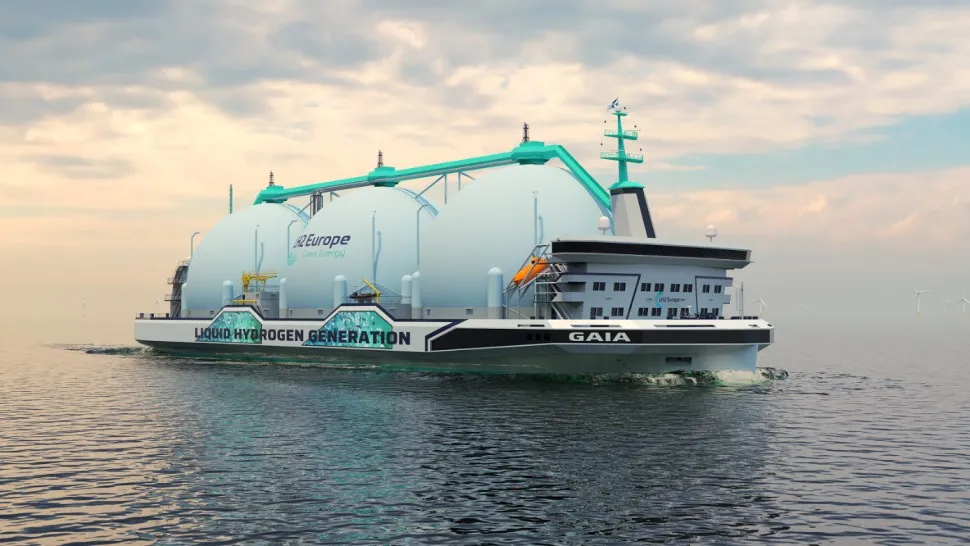
As revealed by LH2 Shipping, these vessels for the Strandbulk Project will have hydrogen-powered proton exchange membrane (PEM) fuel cells. The 7,700-dwt shortsea bulk carriers will transport dry and general cargo mainly in Norway and the Baltic region. For propulsion, the 108.2-m ships will have onboard hydrogen systems consisting of a 17-tonne LH2 storage tank and 3,400 kW of PEM fuel cells. A 3 MWh battery pack will be installed to support the fuel cells, storing energy and providing zero-emission operation capability while in port. Shore power systems will allow connection to local electricity grids during loading and unloading operations. Each bulk carrier will have a standby diesel generator, offering the option to sail on marine diesel or biodiesel if the LH2 supply fails or is not in place at the time when the ships are delivered from the shipyard.
LH2 Shipping expects the StrandBulk vessel design to be 30% more energy efficient than similar vessels, using an optimised hull, energy-saving technologies, energy management systems, and even solar panels on the cargo hatches.