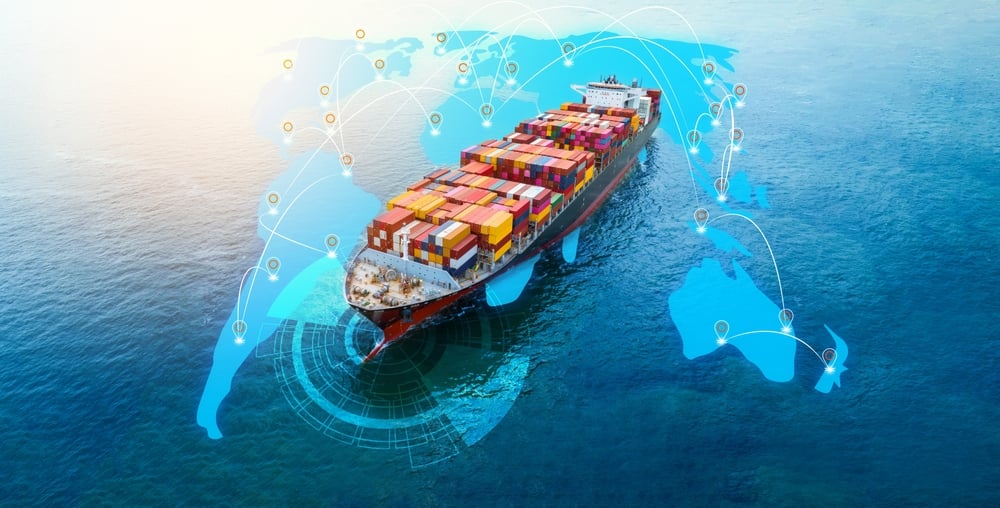
At the end of June, two ultra-large oil tankers built by Jiangsu New Times Shipbuilding Co., Ltd. successfully departed from Jingjiang, Jiangsu, for trial voyages in formation. These massive vessels feature an advanced dual-fuel design combining LNG (liquefied natural gas) clean energy and traditional fuel, achieving internationally leading environmental performance. They are expected to be delivered to Greek and Singaporean shipowners by mid-July and will soon navigate the bustling Maritime Silk Road.
What is LNG, and why build such ships? “According to the emission reduction targets set by the International Maritime Organization (IMO), by 2030, the average CO2 emissions from global maritime activities must decrease by at least 40% compared to 2008, with ‘zero’ or ‘net-zero’ emission technologies, fuels, and energy accounting for at least 5% of international shipping,” explained Zhang Zhonglin, deputy general manager of Jiangsu New Times Shipbuilding Co., Ltd. Dual-fuel ships primarily powered by LNG significantly reduce CO2 emissions in maritime transport, making them highly sought-after in the global shipping market.
However, constructing such vessels is no easy feat. Sun Quan, head of the development department at the company’s Ship Design Research Institute and a member of the R&D team, noted that the Type B fuel tanks, which carry 8,000 cubic meters of LNG, must meet stringent requirements—such as a fatigue lifespan exceeding 40 years under extreme conditions of -163°C and welded seams enduring over 15 days before repairs. For a long time, these technologies were monopolized by foreign firms. To seize development opportunities in this emerging field, Jiangsu New Times Shipbuilding Co., Ltd., a leading domestic shipbuilder, formed an R&D team in 2022 to tackle the key technologies of LNG fuel tanks.
“The biggest challenge in R&D lies in conducting extensive and complex structural calculations through virtual simulations to test the fatigue lifespan of fuel tanks, especially the welded seams, under various extreme conditions,” Sun Quan explained. The team analyzed nine stress components affecting the fuel tanks during navigation, including hull structure, liquid sloshing, and surface pressure, categorizing them into 12 types of weld joints. Based on this, they built a precise 3D computational model, dividing the fuel tank into 160,000 grid units. After over three months of work, they completed fatigue crack calculations for all weld types.
The computed data became the parameters for constructing the fuel tanks on the blueprint. In October 2024, China’s first independently developed and built Type B fuel tank was successfully deployed on a delivered vessel—marking a significant step forward for the country’s shipbuilding industry toward high-end manufacturing.
“To date, the shipyard has built 34 LNG dual-fuel vessels. Using LNG fuel reduces CO2 emissions by 20% and cuts nitrogen and sulfur oxide emissions by nearly 100%,” Zhang Zhonglin noted. Among the shipyard’s current order backlog of over 100 vessels, more than 60% are LNG dual-fuel ships.
Driven by leading shipbuilders, Jingjiang, Jiangsu—known as the “hometown of shipbuilding”—has gradually become a hub for LNG dual-fuel vessel technology and industrial capacity. According to the Jingjiang Municipal Bureau of Industry and Information Technology, from January to June, Jingjiang completed 43 ships with a total deadweight tonnage (DWT) of 3.406 million, while its order backlog stood at 399 ships totaling 44.045 million DWT, a 41.9% year-on-year increase. Major shipbuilders’ production schedules are already booked until 2030. Notably, clean-energy vessels, primarily LNG dual-fuel ships, accounted for 55% of completed ships and over 70% of the total order backlog.