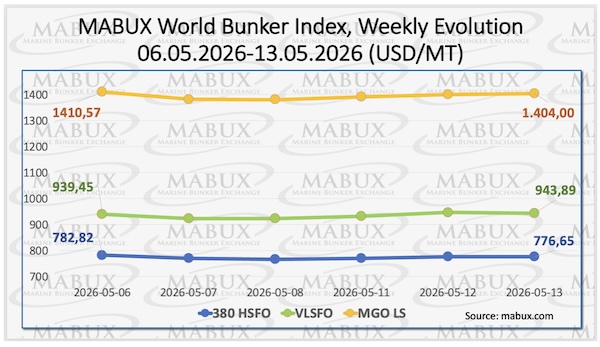
During the week, the global bunker market entered a phase of relative stabilization, although mixed price fluctuations continued to persist. At the same time, the volatility amplitude narrowed considerably compared to previous periods. By the end of the week, the 380 HSFO index declined by USD 6.17, falling from USD /MT last week to USD /MT. In contrast, the VLSFO index recorded a moderate increase of USD 4.44, rising from USD /MT to USD /MT. Meanwhile, the MGO LS index decreased by USD 6.57, from USD 1,/MT last week to USD 1,/MT. At the time of writing, mixed movements remained the dominant trend across the global bunker market.
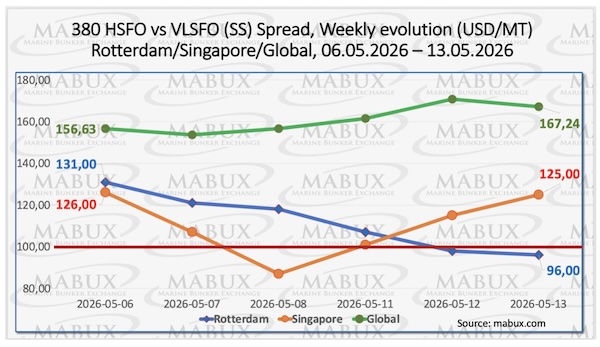
The MABUX Global Scrubber Spread (SS) — the price differential between 380 HSFO and VLSFO — recorded a moderate increase of USD 10.61, rising from USD 156.63 last week to USD 167.24, and remaining comfortably above the psychological threshold of USD 100.00 (SS Breakeven). The weekly average of the index also advanced by USD 4.69. In Rotterdam, the SS Spread contracted sharply by USD 35.00, declining from USD 131.00 last week to USD 96.00 and falling below the USD 100.00 breakeven level. At the same time, the port’s weekly average SS Spread increased by USD 6.16. In Singapore, the 380 /VLSFO spread narrowed marginally by USD 1.00, from USD 126.00 last week to USD 125.00. During the week, the spread temporarily dropped to USD 87.00, while the weekly average in the port increased by USD 4.34. Overall, the SS Spread lacked a clear directional trend throughout the week. Nevertheless, values remaining predominantly above the USD 100.00 threshold continued to support the strong economic attractiveness of scrubber usage in combination with 380 HSFO versus conventional VLSFO consumption. Despite ongoing relative stability, bunker fuel price volatility remains elevated, which may create conditions for a renewed upward trend in the SS Spread next week. More detailed information is available in the “Differentials” section of .
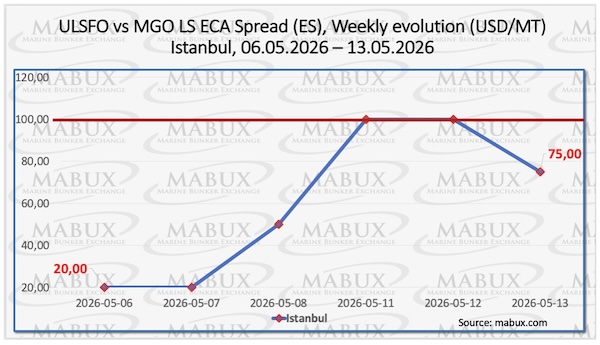
The Istanbul ECA Spread (ES) ended the week with a sharp increase of USD 55.00, rising from USD 20.00 last week to USD 75.00, while the weekly average advanced by USD 15.00. The Venice ECA Spread remains uncalculated due to the absence of regular market quotations. Overall, the ECA Spread has fully recovered the losses recorded over the previous weeks and is now approaching the USD 100.00 threshold, gradually improving the economic attractiveness of conventional ULSFO compared to traditional MGO LS fuel. We expect the ECA Spread to remain close to the USD 100.00 level next week.
More detailed information is available in the “Differentials” section of .
According to the International Energy Agency (IEA), the conflict involving Iran and the resulting disruptions to LNG exports from the Middle East are reshaping the medium-term outlook for the global gas market, with tighter supply conditions expected to persist longer than previously anticipated. LNG availability has already declined by an estimated 15% due to the conflict and the closure of the Strait of Hormuz, one of the world’s key energy transit routes. At the same time, the EU faces additional pressure to replenish depleted gas inventories, which fell to multi-year lows by the end of the heating season. Europe is expected to require an additional 10 bcm of natural gas this summer to support storage refilling efforts. The IEA estimates that the combination of current supply disruptions and slower LNG capacity growth could result in a cumulative loss of around 120 bcm of global LNG supply between 2026 and 2030, reinforcing expectations of a structurally tighter gas market over the medium term.
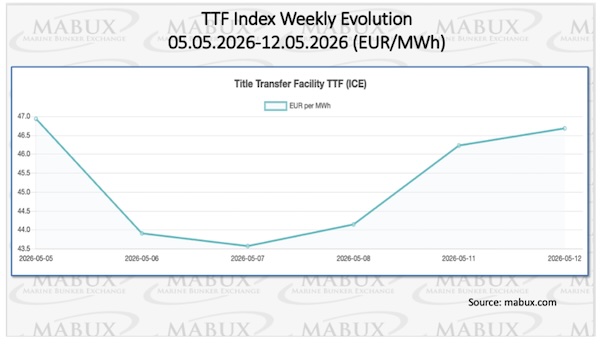
European underground gas storage levels continued their moderate recovery trend as of May 12, reaching 35.57% of total capacity, up 1.50 percentage points compared to the previous week. Nevertheless, current storage levels remain 25.89% below those recorded at the beginning of the year, when inventories stood at 61.46%. Meanwhile, the European TTF gas benchmark remained broadly stable, easing marginally by EUR /MWh, from EUR /MWh last week to EUR /MWh.
The price of LNG as a bunker fuel at the port of Sines (Portugal) decreased by USD 46.00 this week (USD 1,/MT compared to USD 1,/MT last week). The price differential between LNG and conventional fuel also narrowed to USD 220 in favor of LNG (compared to USD 294 the week before): MGO LS was quoted at USD 1,/MT at the port of Sines on May 11. More detailed information is available in the “LNG Bunkering” section of .

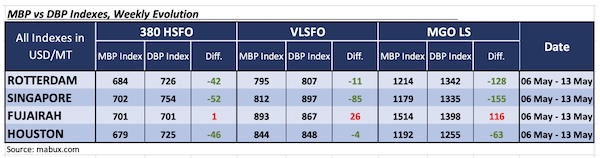
At the end of Week 20, the MABUX Market Differential Index (MDI) — the ratio between market bunker prices (MBP) and the MABUX Digital Bunker Benchmark (DBP) — reflected the following trends across the world’s major bunkering hubs: Rotterdam, Singapore, Fujairah, and Houston:
• 380 HSFO segment: Fujairah moved into the overvalued zone, becoming the only overvalued port in this fuel category, with the overpricing premium increasing by 61 points. The remaining hubs continued to trade in the undervalued zone, although discount levels narrowed by 56 points in Rotterdam, 55 points in Singapore, and 29 points in Houston. Singapore’s MDI fell below the USD 100.00 mark, while Fujairah’s index approached the 100% /DBP correlation line.
• VLSFO segment: Fujairah also entered the overvalued zone, with the premium rising by 70 points. The other ports remained undervalued.
Over the week, the MDI discount narrowed by 110 points in Rotterdam and by 68 points in Singapore, while increasing marginally by 2 points in Houston. Rotterdam’s MDI crossed below the USD 100.00 threshold, whereas Houston’s index remained close to the 100% /DBP correlation level.
• MGO LS segment: Rotterdam, Singapore, and Houston remained in the undervalued zone. MDI levels declined by 120 points in Rotterdam, while increasing by 23 points in Singapore and by 10 points in Houston. Fujairah continued to be the only overvalued port in this segment, with the overpricing premium rising by 51 points. The MDIs in Rotterdam, Singapore, and Fujairah all exceeded the USD 100.00 mark.
Overall, the balance between overvalued and undervalued ports shifted once again toward overvaluation during the week, with one port in both the 380 HSFO and VLSFO segments moving into the overvalued zone. Nevertheless, it remains premature to conclude that a sustained overvaluation trend is emerging in the global bunker market.
More detailed information on the correlation between market prices and the MABUX Digital Bunker Benchmark is available in the “Digital Bunker Prices” section on .
According to Integr8, conditions are once again emerging in the market for increased risks associated with bunker fuel quality. The report notes a combination of factors including rising bunker fuel prices, changes in crude oil and petroleum product flows, deteriorating blending technology, pressure on supply chains, and the emergence of non-standard blend components that fall outside standard ISO specifications. Fuel oil exceeding specifications is already being recorded at major bunker hubs. In Singapore, for example, increased ash, sodium, and water content has been observed in HSFO, indicating increased risks of instability and deterioration in fuel quality. The report also notes that increased supplies of heavy Venezuelan crude to US Gulf Coast refineries is contributing to deterioration in HSFO quality in Houston, including increased density, ash, and vanadium content. Integr8 emphasizes that bunker fuel quality should not be assessed solely based on ISO 8217 compliance, as operational reliability, storage conditions, compatibility risks, and hidden costs are also important. The company recommends that buyers, suppliers, and ship operators strengthen their fuel quality monitoring before operational issues and complaints arise.
The global bunker market remains highly volatile amid persistent geopolitical tensions in the Middle East and the continuing disruption of shipping operations in the Strait of Hormuz. Ongoing military and political uncertainty in the region continue to exert strong pressure on global energy and bunker fuel markets, contributing to sharp and irregular price movements. We expect bunker market indices to maintain mixed fluctuations next week as traders continue to react to geopolitical developments, supply concerns, and elevated freight and insurance costs. However, any further escalation in the military confrontation between the United States and Iran could trigger another sharp upward spike in bunker prices.
Source: By Sergey Ivanov, Director, MABUX