MAN Energy Solutions: why Maersk’s box ship methanol order is a game-changer and why ammonia will be one of the winners
Maersk’s methanol dual-fuel container newbuild orders last year have been a game-changer for the market, says MAN Energy Solutions director new technologies, two-stroke sales and promotion Kjeld Aabo.
MAN Energy Solutions is supplying the methanol engines for Maersk’s 1,200-TEU and 12 16,000-TEU container vessels.
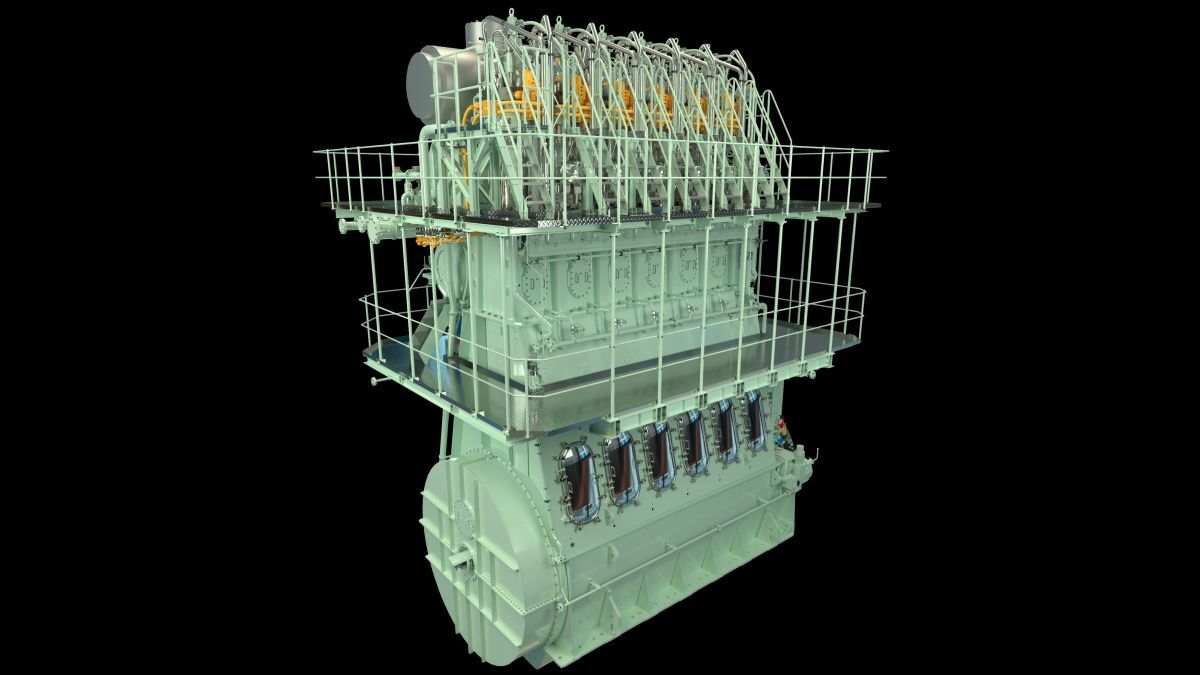
It is also developing an ammonia dual-fuel engine for the marine market, of which the first will be a medium-sized 60-bore engine and based on the interest from the market, more engines with larger and smaller power will be introduced.
Commenting on the Maersk order, Mr Aabo says, “The status was that methanol was only used for methanol carriers until Maersk announced its first container vessel and after that it took speed, it really was a game-changer in the market.”
The Maersk order has also led to more methanol engine size choices. Mr Aabo says, “When Maersk ordered engines for 16,000-TEU vessels and needed an engine, we didn’t have the size they needed (95-bore). We only had 50-bore engines for methanol carriers. Now we have extended the programme from 50 to 95, with 80, 70 and 60 bores developed due to huge interest.”
An important point is the engines for future fuels MAN is developing – based on its ME-GI and ME-LGI models – continue to use the diesel combustion principle. Mr Aabo comments, “This is very important as it means we can keep the high efficiency and high power of the engine. We do not have to derate or in any other way change the performance due to the use of new fuel.”
Aside from methanol, Mr Aabo sees a future market for ammonia. The company is developing an ammonia engine that will be ready to be delivered to shipyards in 2024. After a prestudy in 2019, the project kicked off in 2020, with a 4T50ME-X test engine received as a platform for the ammonia engine development.
Mr Aabo says, “The reason we believe ammonia will be one of the winners is there is no carbon in ammonia, which means no CO2. You can produce ammonia with electrolysers and have a clean and no-carbon fuel.”
Singling out why medium-sized and large container ships would be good candidates for the use of ammonia, saying, “Looking at container ships, they are very big consumers and trade on a route. This means the ammonia needed for distribution can be predicted which is extremely important in the logistics for future fuels.”
Mr Aabo says in terms of safety issues, “We have worked with class societies, shipowners and yards to ensure the fuel gas supply system safety is in order, there’s no obstacle on that part or bottlenecks.
“What is very important are the coming tests starting this August about combustion in the combustion chamber, because ammonia is a slow-burning fuel and needs a lot of energy to be ignited. The diesel principle has a pilot flame injection which ignites, and ammonia is then injected into the burning pilot oil flame, so it is quite a controlled process.”
He adds another focus is the exhaust gas from the engine. There can be some formation of different gases. To avoid nitrous oxide (N20) and ensure this is not a deal breaker, MAN is developing a catalyser to take any surplus of N20 which might be in the exhaust gas. Ammonia can be directly used as an agent for an SCR catalyst.