Augmented Routing Optimisation which integrates weather routing into AI-based voyage analytics is changing what is possible in ship performance, according to METIS Cyberspace Technology.
The maritime data analytics specialist says that adding weather routing functionality to vessel analysis means voyage performance can be optimised to take account not only of an individual ship’s characteristics and cargo requirements, but the conditions in which it is working.
Conventional weather routing services help operators avoid ‘unwanted weather’ and choose safer routes but they use generic ship information, explains Mike Konstantinidis, CEO, METIS Cyberspace Technology. “In reality, even sister ships develop unique performance profiles due to variations in machinery, hull fouling, hull damages, maintenance and repairs, quality and type of fuel oil, and crew skills. Individual ship performance and cargo characteristics information is vital for safety and for choosing the ‘best’ route to save fuel and reduce emissions.”
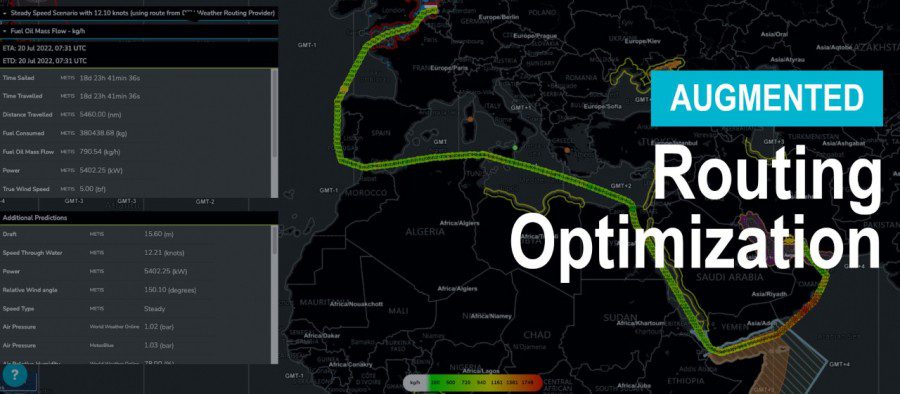
Augmented Routing Optimisation integrates weather routing functionality from specialised service providers seamlessly into the cloud-based METIS analytics platform. Powered by artificial intelligence (AI), weather routing becomes part of the real-time METIS analytics which is already optimising an individual ship’s performance for fuel consumption, hull fouling, emissions, etc.
“By integrating weather routing functionality in the METIS platform, we can take account of all of the variables affecting the ship using a single interface. This delivers a huge leap forward in voyage optimisation, so that comparisons can be made in the most accurate way, and sets new data-driven standards which enhance ship safety, efficiency and sustainability,” says Konstantinidis.
The International Maritime Organisation and International Association of Marine Underwriters work with assumptions that weather routing helps ships save over 3 per cent in fuel consumption. Augmented Routing Optimisation is already proving far more productive, he says.
“In one six-month pilot using METIS Augmented Routing Optimisation advisory functionality, a METIS customer achieved a 923mt cut in FO consumption, equivalent to around $750,000 at today’s prices. This was despite the fact that the distance travelled by the ship increased by 25 per cent. Furthermore, the CII was calculated as 19.5 per cent lower”.
Onboard ship, Augmented Routing Optimisation enables ship-specific comparisons between the weather optimised route with other user-defined routes. Onshore, managers can take account of route adjustments, calculate and recalculate optimum routes to optimise schedules, and better evaluate voyage and post-voyage performance against expectations or charter party terms.
“This is a new demonstration of what is possible when different services are integrated in the METIS platform,” says Konstantinidis. “The user experiences capabilities greater than the sum of its parts in terms of analytic power as a single and convenient Augmented Routing Optimisation tool.”