
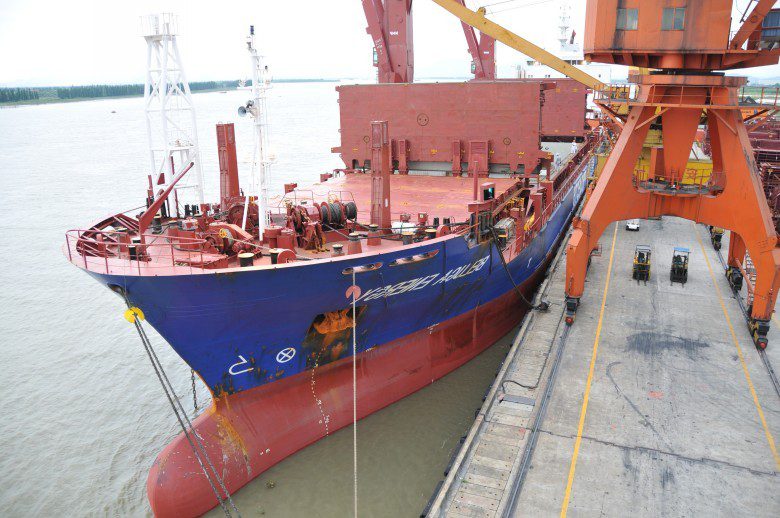
1. Port and Terminal Information
1.1 XinHui Port operates 24/7 with priority given to vessels carrying hazardous cargo or under emergency conditions.
1.2 Maximum permissible draft at main berths: 12.5m (tidal-dependent; verified by Port Authority Notice 2023-12).
1.3 Designated oil terminal (Berth No.5) requires double-hulled tankers only (IMO Resolution MEPC.189(60) compliance).
1.4 Container Terminal (Berths 8-12) has a maximum crane outreach of 22 rows (Terminal Technical Specifications 2024).
1.5 Cold ironing facilities available at Berth No.7 (500kVA capacity, ISO/IEC/IEEE 80005-1 compliant).
1.6 Prohibited cargo storage: Nitrate-based fertilizers incompatible with Class 1 explosives (IMDG Code Supplement 2023).
1.7 Ro-Ro operations restricted to daylight hours only at Berth No.3 (Port Operations Manual Section 4.7).
1.8 Dangerous goods warehouse capacity: 5,000m² with Class A fire protection (GB 50016-2014 standard).
2. Navigation and Channel
2.1 Mandatory VHF Channel 16 monitoring within 5nm of port entrance (XinHui Maritime Safety Administration Regulation).
2.2 Channel width: 200m with 1.5x ship length overtaking prohibition zone near buoy #7.
2.3 Tide window for vessels >50,000 DWT: ±2 hours from high tide (Port Tide Table 2024).
2.4 Minimum under-keel clearance: 10% of draft or 1m, whichever is greater (IALA Recommendation R-129).
2.5 Compulsory use of parallel indexing when transiting narrow channel section (MSA Navigation Circular 2023-15).
2.6 Fog navigation: Speed restriction to 6 knots when visibility <1,000m (COLREG Rule 19).
2.7 Channel depth maintenance: Dredged to -15m CD every 6 months (Hydrographic Survey Report 2024-Q1).
3. Anchorage Regulations
3.1 Emergency anchorage area (A1) reserved for vessels with mechanical failures – coordinate with VTS immediately.
3.2 Anchoring prohibited within 0.5nm of submarine cable area (marked on Admiralty Chart CH 1234).
3.3 Holding ground quality: Clay with 3:1 holding power (IHO S-57 ENC data).
3.4 Vessels >250m LOA must use designated deep-water anchorage (Anchorage D) with tug standby.
3.5 Anchoring in typhoon season requires 8 shackles on deck (China MSA Typhoon Preparedness Guidelines).
3.6 Vessels at anchor must maintain continuous engine readiness (Port Regulations Article 12.3).
4. Cargo Operations
4.1 Grain cargo: Mandatory fumigation certificate required 24hrs prior to loading (AQSIQ Decree No.145).
4.2 Container stack weight limits: 4-high max for 20′, 3-high for 40′ (Terminal Operating Manual v5.2).
4.3 IMDG cargo: Segregation zones strictly enforced as per IMDG Code 2022 Edition.
4.4 Bulk cargo loading rate: Max 8,000 MT/hr with mandatory trimming (BC Code 2020 Amendment).
4.5 Steel coil handling: Edge protectors required for coils >5 tons (ISO 18602:2013).
4.6 Log cargo: Maximum moisture content 25% (IMSBC Code Group C).
4.7 Heavy lift operations: Prior 48-hour notice required for loads >100 tons (Port Operations Directive 12A).
5. Safety Management
5.1 Monthly emergency drills required for berthed vessels (ISM Code 8.2 verification).
5.2 Hot work permits issued only after gas-free certification by approved surveyors.
5.3 Lifeboat launching tests prohibited during cargo ops (SOLAS III/19.3.3.4).
5.4 Gangway watch must be maintained with 200-lux illumination (OCIMF MEG4 7.3.2).
5.5 Helicopter operations require prior 72hr notice to Port Control (CAP 437 9th Ed.).
5.6 Enclosed space entry permits valid for 1 hour only (SOLAS XI-1/7).
5.7 Mandatory safety harnesses for all personnel working >2m above deck (ILO Code of Practice).
6. Environmental Compliance
6.1 Zero discharge policy for bilge water within port limits (MARPOL Annex I Regulation 35).
6.2 Mandatory use of low-sulfur fuel (≤0.5%) while at berth (China ECA requirements).
6.3 Oily water separator effluent must not exceed 15ppm (MARPOL Annex I Reg. 14.4).
6.4 Ballast water exchange prohibited within 12nm from shore (China MEPC 2018 Directive).
6.5 Garbage record book must be updated in real-time (MARPOL Annex V Reg. 10.3).
6.6 VOC recovery system mandatory for tankers loading crude oil (China GB 20950-2020).
7. Crew Requirements
7.1 Port health declaration must include last 10 ports of call (China Customs Form HD-2021).
7.2 Shore leave restricted for vessels from plague-affected areas (WHO Sanitary Regulations).
7.3 Minimum safe manning certificate must be displayed on bridge (MLC 2006 Standard A2.3).
7.4 Crew changes permitted only at designated quarantine anchorage (NHC Notice 2022-5).
7.5 Seafarer medical certificates must be valid for entire port stay (STCW Regulation I/9).
7.6 Mandatory anti-piracy briefing before entering high-risk areas (BMP5 2021).
8. Special Notices
8.1 Typhoon season (June-Oct): Mandatory 72hr bunker reserve for anchored vessels.
8.2 New AIS transponder verification system implemented since 2024-03-01 (MSA Notice 2024-006).
8.3 Night navigation restrictions apply for vessels >200m LOA (Port By-Law Article 17).
8.4 Real-time port congestion information available via INTTRA Portal (Port Authority Circular 2024-09).
8.5 Mandatory cybersecurity protection for ECDIS systems (IMO MSC-FAL.1/Circ.3).
8.6 Winter operations (Dec-Feb): Mandatory deck anti-icing measures (China MSA Winter Navigation Guide).
8.7 Vessels with hull damage must declare before entry (Port Regulations Article 5.2).
9. Additional Operational Requirements
10.1 Bunkering operations require separate fire watch (OCIMF Bunkering Guidelines).
10.2 Fresh water supply pressure: 3.5 bar minimum at ship’s manifold (Port Services Standard).
10.3 Waste reception facilities available 24/7 at Berth No.9 (MARPOL Compliance Certificate).
10.4 Tug assistance mandatory for vessels >150m LOA (Port Tariff Schedule 2024).
10.5 Pilot ladder must comply with SOLAS V/23 (including spreader steps).
10.6 Radio silence periods enforced during naval exercises (NOTAM system alerts).


