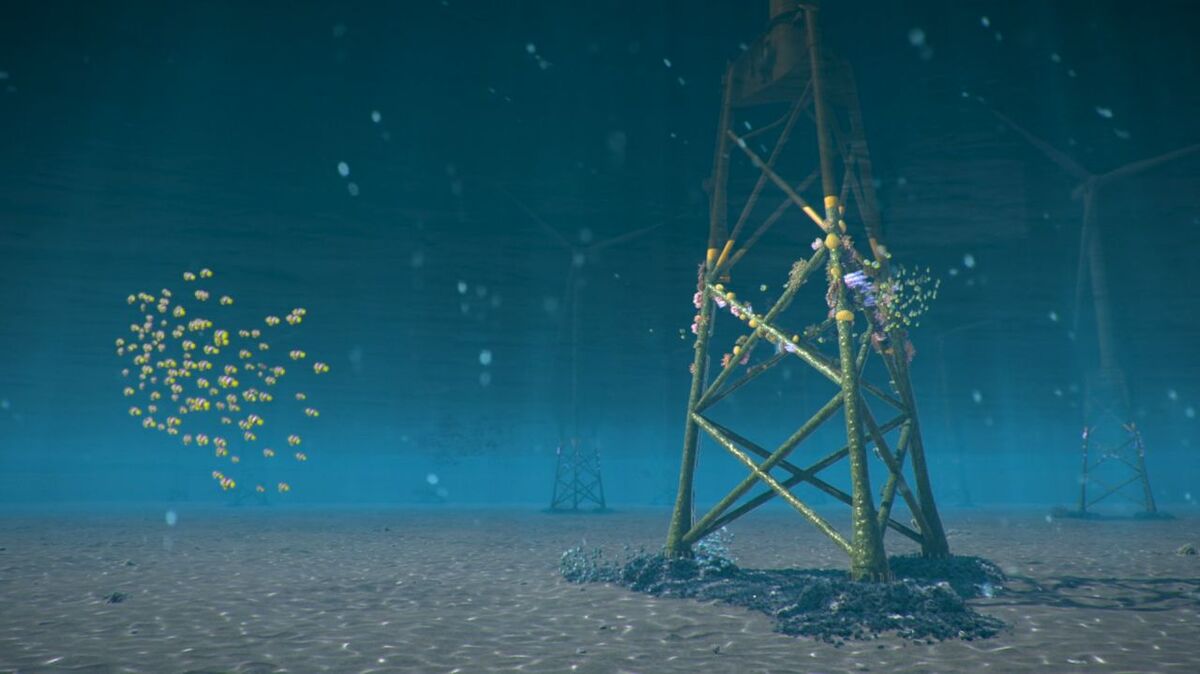
Artist’s concept showing coral growing on the foundations of offshore wind turbines
Ørsted is planning a world-first attempt to support coral reefs by growing coral on the foundations of offshore wind turbines
Together with Taiwanese partners, the company will test the concept in waters off Taiwan this summer. The aim is to determine whether coral can be successfully grown on foundations and to evaluate the potential positive biodiversity impact of scaling up the initiative.
“Governments are planning a significant build-out of green energy infrastructure at sea, and if done right, Ørsted believes the expansion of offshore wind energy needed to fight climate change can also integrate solutions that support and enhance ocean biodiversity,” the company said.
Ørsted group president and chief executive Mads Nipper said,“If we succeed with ReCoral and the concept proves to be scalable, this innovation could create a significant positive impact on ocean biodiversity.”
The ‘ReCoral by Ørsted’ project aims to implement a non-invasive approach for collecting surplus indigenous coral spawn as it washes ashore and use it to grow healthy coral colonies.
The idea behind ReCoral is that the relatively stable water temperatures at offshore windfarm locations will limit the risk of coral bleaching and allow healthy corals to grow. Coral will be grown close to the water surface to ensure there is sufficient sunlight.
In 2020, biologists and marine specialists in Ørsted teamed up with private and academic coral experts to mature and test the concept. In 2021, the ReCoral team successfully grew juvenile coral on underwater steel and concrete substrates at a quayside test facility.
In June 2022, an offshore proof-of-concept trial will begin at the Greater Changhua offshore windfarms in Taiwan to test the concept in open water on four separate wind turbine foundations.
Ørsted is collaborating with the Penghu Marine Biology Research Centre in Taiwan. Together they have developed a non-invasive methodology for coral seeding, in vitro fertilisation, larvae transport, and larvae attachment to wind turbine foundations.
Rather than removing anything from existing coral ecosystems, ReCoral’s non-invasive approach relies on the collection of surplus coral egg bundles that wash up on shorelines and would not otherwise survive.
If the proof-of-concept trial is successful, Ørsted will explore opportunities for scaling up the initiative, with the ultimate aim of using additional coral larvae generated at offshore windfarm locations to restore and enhance threatened near-shore reef systems.
The company said the ReCoral concept could be applied to offshore foundations in any tropical waters around the world.