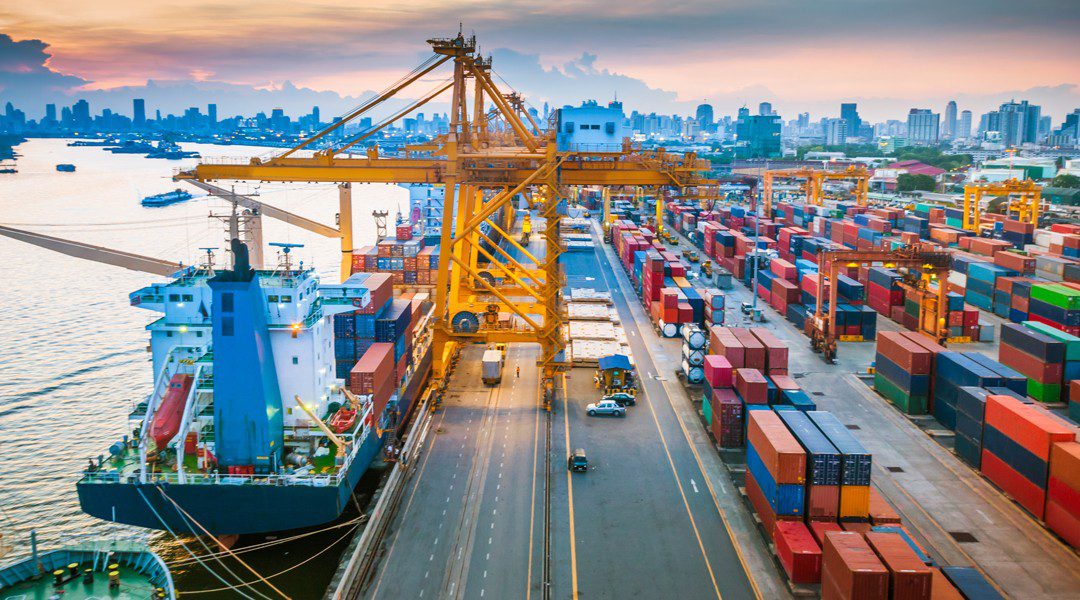
The seasonal rhythm of the container shipping market has been disrupted, with freight rates on the U.S. route weakening for two consecutive months, and European route rates also declining. “U.S. route rates have already approached levels seen in normal years, so the decline will slow; the European route, however, saw an accelerated drop this week. It is expected that spot rates for both U.S. and European routes in August may continue to trend downward,” Wu Jialu, chief researcher at CITIC Futures, told a Cailian Press reporter.
“Although our company’s U.S. route cargo volume saw a slight month-on-month increase in early July, it was short-lived, and volumes declined again by late July and early August,” a U.S. route freight forwarder in Zhejiang told Cailian Press, attributing this to the ‘rush shipping wave’ from late May to June this year.
In terms of freight rate performance, data provided by Jiyu Technology shows that as of August 8, the lowest quoted carrier for the U.S. route (Shanghai to Los Angeles/Long Beach) was Hapag-Lloyd, with a rate of $1,598/FEU for August sailings, down 3% from the previous week. Data from July 1 showed Hapag-Lloyd’s lowest quote for that month was $2,148/FEU. European route rates also declined month-on-month, with the lowest quote (across all carriers) dropping from $2,900/FEU to $2,535/FEU.
Regarding freight rate indices, the Ningbo Shipping Exchange’s NCFI index shows that the U.S. East Coast route index stood at 980.7 points, down 4.4% from the previous week; the U.S. West Coast route index was 1,042.9 points, down 6.4%. The European route index was 1,257.7 points, down 8.4%.
“June to August is typically the peak season for the container shipping market, but this year’s market dynamics have diverged. I believe there are four reasons for this,” Wu Jialu analyzed. First, disruptions from U.S. tariff policies have upset the normal seasonal rhythm. Second, the long-term supply in the container shipping market has increased, with varying capacity growth rates across routes. Although global container demand has risen, coupled with carriers maintaining rerouting, the overall scenario resembles last year’s, and faster supply growth will suppress freight rates. For the European route, earlier disruptions from port congestion and low inland water levels are expected to ease in August as temperatures cool and precipitation increases, gradually reducing the impact on turnover.
Wu Jialu further noted that, third, export data for the first seven months show China’s reduced reliance on the U.S., with demand from ASEAN, the EU, the Middle East, Africa, and Central Asia maintaining rapid growth. However, sustaining further increases on already high bases may prove challenging. Fourth, tensions in the Middle East persist, with Maersk stating it will continue rerouting, a situation similar to last year. While this may provide short-term emotional support, its actual impact on the market is limited.
However, liner giant A.P. Moller-Maersk (ticker: AMKBY) remains optimistic about its full-year performance. In its H1 financial report, Maersk raised its 2025 full-year financial guidance, citing stronger-than-expected demand resilience outside North America. The global container market volume growth forecast has been revised to 2%-4% (previously -1% to 4%).
Disclaimer: This article is reprinted for the purpose of conveying more information. If there are any inaccuracies in the source attribution or if your legal rights are infringed, please contact us with proof of ownership, and we will promptly correct or delete the content. Thank you.