Shanghai Qiyao Technology Group has secured in-principle support at the IMO for treating onboard carbon mineralisation as permanent CO2 storage, giving ship-captured CO2 a route into stable minerals for construction materials instead of underground storage, according to Shanghai Qiyao Technology Group Co., Ltd.
The support came during MEPC 84, where the IMO’s working group welcomed two joint proposals submitted by Qiyao and its partners.
The proposals argue that captured CO2 can be converted through mineralisation into stable carbonates, including calcium carbonate, creating permanent storage without carbon leakage.
Qiyao is positioning the process as an alternative to conventional onboard carbon capture and storage, which relies on geological storage and faces high costs and limited reception infrastructure.
“We see this IMO attention as an important step. Closing the loop from shipboard capture to onshore mineralisation can make carbon accounting more practical and economically attractive for the industry,” said the head of Qiyao’s OCCS team.
Document MEPC /18 sets out the technical and environmental case for treating mineralisation as equivalent to permanent sequestration. MEPC 84/INF.8 draws on Qiyao’s demonstration project, using full-chain data covering onboard capture, ship-to-ship liquid CO2 transfer, land transport and final mineralisation.
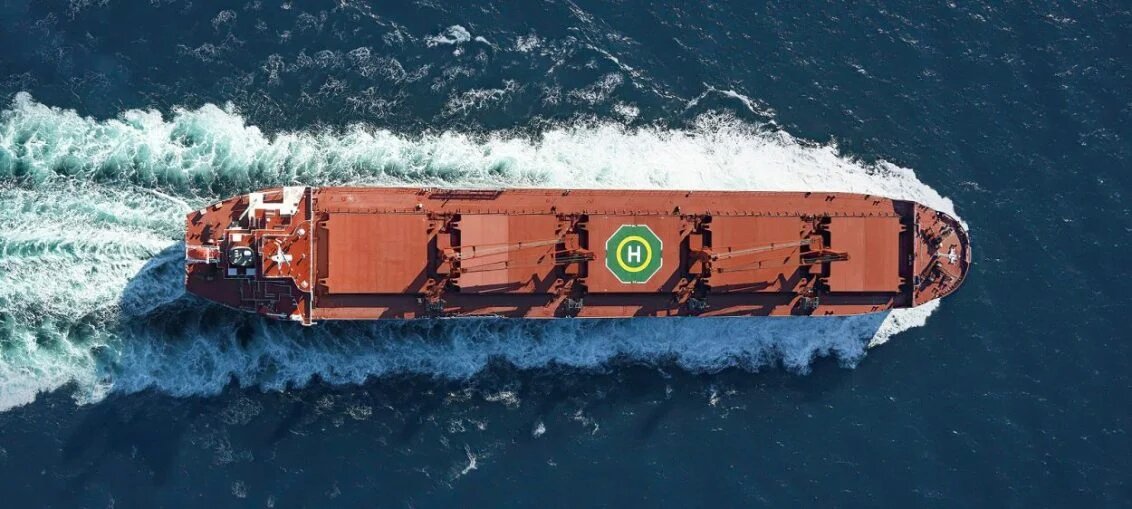
Qiyao has fitted a full-scale OCCS system on a 14,000-TEU container vessel and completed what it calls the world’s first ship-to-ship transfer of liquid CO2 for onshore mineralisation. The company says it is working with global partners on integrated solutions for the green upgrading and transition of global shipping.
Shanghai Qiyao Technology Group Co., Ltd. is a company focused on shipping-related energy and environmental technologies. Its stated business areas cover green fuel power systems, integrated energy efficiency solutions, marine environmental protection equipment, core LNG products and smart marine devices for oceangoing vessels and specialised ship types.