Specialist reefership owner and operator Seatrade has made a further investment in fully-cellular container vessel capacity, writes David Tinsley. Four 1,800TEU newbuilds incorporating a very high capacity for temperature-controlled cargo have been booked in China from Huanghai Shipbuilding, on the Shangdong Peninsula.
The contract calls for deliveries between October 2023 and mid 2024, and entails a customised version of the Sealion 1800 Bangkokmax-class of boxship developed by Shanghai Merchant Ship Design & Research Institute (SDARI) and ordered in large numbers by various owners from Chinese yards.
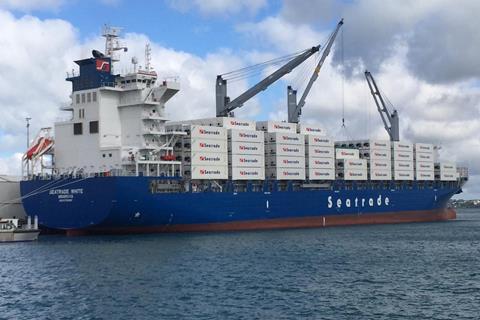
While the Seatrade-deployed fleet is predominantly composed of dedicated, tweendeck-equipped and pallet-optimised reefer vessels, the addition between 2016 and 2019 of a series of Chinese-built container vessels of 2,259 TEU embodying a high reefer intake signalled a seminal change for the company. The latest project reflects the sustained shift of perishable cargo in global trade to the containerised mode, but affords Seatrade a high degree of container carrying flexibility while catering to the company’s core business in shipping fresh and frozen produce.
Each of the new vessels will offer a reefer capability equating to approximately 13,000 pallets. This would indicate that the ships are fitted to take about 650 refrigerated containers, which in 20ft terms would account for 1,300 TEU of the total 1,800 TEU slots. By comparison, the Seatrade Orange-class boxships completed by Yangfan Shipyard from 2016 onwards had an all-up rating of 2,259 TEU, incorporating sockets for 674 reefer units, equivalent to 13,480 pallets.
The nascent quartet will be employed in both established and new traffic flows and will form an integrated part of the ‘fast, direct and dedicated’ (FDD) logistic service concept provided by Seatrade to the perishable freight market. FDD speaks to the particular time and handling sensitivities of fresh produce consignments. The accent is on specialised vessels operating on a direct basis between ports with a dedicated infrastructure, giving shorter delivery times and obviating transhipment, and offering seasonal flexibility in volumes.
Seatrade contends that transit times and associated indirect costs for perishable goods are increasing on services operated by larger container lines, and that there remains a clear demand for FDD transportation fulfilled by dedicated reeferships, specialised container vessels, and what it describes as ‘hybrid’ types.
The latest commitment to new construction evidently presages further investment, as the company posted the following statement: “Seatrade is also seeking opportunities to increase its fleet with further acquisitions of newbuildings /or modern secondhand tonnage, combined with possible strategic alliances with customer groups /or third-party owners in the same segment.”
While the final specification and cargo arrangements have been tailored to Seatrade’s requirements, the standardised design on which the series from the Huanghai yard will be based is rapidly emerging as one of the most populous classes in its category. According to SDARI, the Sealion 1800 in its various versions has to date attracted orders for 75 vessels, contracted at four Chinese shipyards by 15 owners.