Safe Bulkers, Inc., an international provider of marine drybulk transportation services, announced its unaudited financial results for the three month period ended March 31, 2022. The Board of Directors of the Company also declared a cash dividend of $0.05 per share of outstanding common stock.
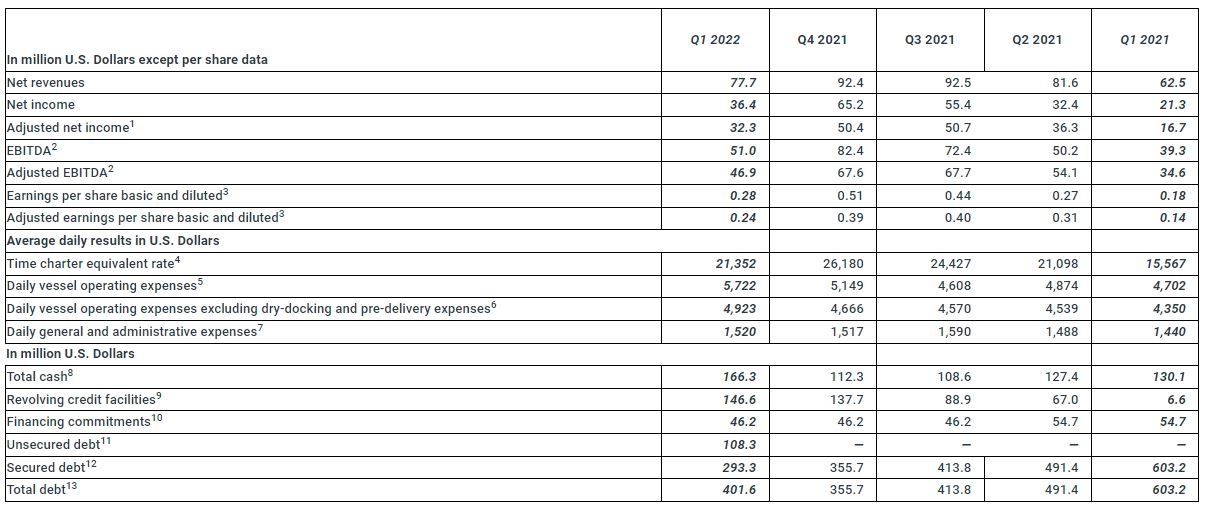
Financial highlights
Management Commentary
Dr. Loukas Barmparis, President of the Company, said: “Our 2022 first quarter profitability exceeded first quarter of 2021 profitability by $15 million. We delevered our balance sheet year over year by more than $200 million reducing our debt to comparable levels to our fleet’s scrap value, maintained significant balance sheet liquidity and redeemed in April 2022 a portion of our 8% Preferred C shares. We took delivery of our first Phase 3, Kamsarmax class MV Vassos and have also expanded our Capesize fleet to seven vessels. We have over $400 million of charter contracts. We continue to focus on fleet renewal and expansion. Our financial strength enables us to declare a dividend of $0.05 per common share.”
Update on COVID-19, company’s actions and status
The COVID-19 pandemic has had a significant impact on the shipping industry and seafarers in general, as port lockdowns and travel restrictions were imposed globally during 2020 and 2021 and continue in 2022. The Company has worked extensively to find solutions focusing on effectively managing crew changes despite such ongoing port lockdowns and travel restrictions. The Company has also taken measures to protect its seafarers’ and shore employees’ health and well-being, keep its vessels sailing with minimal disruption to their trading ability, service its charterers, continue vessels’ maintenance and dry-dockings and mitigate and address the risks, effects and impact of COVID-19 on its operations and financial performance.
There has been a negative effect from the COVID-19 pandemic on the Company’s results of operations and financial condition during the first quarter of 2022, due to crew repatriation and related costs of about $0.5 million. Certain delays are also expected in relation to dry-docking durations and schedules due to restrictions imposed in China. Any future impact of COVID-19 on the Company’s results of operations and financial condition and any long-term impact of the pandemic on the dry bulk industry, will depend on future developments, which could impact world trade and global growth.
Conflict in Ukraine
As a result of the conflict between Russia and Ukraine which commenced in February 2022, the US, the EU, the UK, Switzerland and others have announced unprecedented levels of sanctions and other measures against Russia and certain Russian entities and nationals. We intend on complying with these requirements and addressing their potential consequences. While we do not have any Ukrainian or Russian crew, our vessels currently do not sail in the Black Sea and we otherwise conduct limited operations in Russia and Ukraine, we will continue to monitor the situation to assess whether the conflict could have any impact on our operations or financial performance.
Issuance of €100m 5-year Unsecured Bond at 2.95%
In February 2022, the Company, through its wholly owned subsidiary Safe Bulkers Participation Plc. (the ”Issuer”), issued and listed a bond in the amount of 100 million Euro (the “Bond”) on the Athens Exchange. The Bond has a tenor of five years maturing in February 2027, is guaranteed by the Company, is unsecured, non-amortizing and pays a coupon of 2.95%, due semi-annually. The trading of the Bond commenced on February 14, 2022. The Company plans to use the net proceeds of the offering received from the Issuer for the repayment of debt /or redemption of preferred shares /or acquisition of vessels /or general corporate purposes.
Redemption of Series C Preferred Shares
On March 30, 2022, the Company issued a notice of redemption of 1,492,554 Series C Preferred Shares representing approximately 65% of the outstanding Series C Preferred Shares. The redemption was completed on April 29, 2022, at a redemption price of $25.00 per Series C Preferred Share, plus all accumulated and unpaid dividends to, but excluding, the redemption date, in the aggregate amount of $38.1 million. Following this redemption, there are 804,950 Series C Preferred Shares outstanding.
At-the-market equity offering program
In August 2020, the Company filed a prospectus supplement with the Securities and Exchange Commission (“SEC”), under which it could offer and sell shares of its common stock (“Shares”) from time to time up to aggregate sales proceeds of $23.5 million through an “at-the-market” equity offering program (the “ATM Program”). In May 2021, the Company filed a supplement to its prospectus supplement to increase the capacity under the ATM Program to allow for sales of Shares for aggregate gross offering proceeds of up to $100.0 million.
Since September 27, 2021 the Company has not sold any shares of common stock under the ATM Program. Since the inception of the ATM Program the Company had sold 19,417,280 shares of common stock under the ATM Program with aggregate net offering proceeds to the Company of $71.5 million. Shares of common stock with aggregate sales proceeds of up to $28.5 million remain available for sale.
Fleet update
As of May 20, 2022, we had a fleet of 42 vessels, consisting of 12 Panamax, 8 Kamsarmax, 15 Post-Panamax and 7 Capes with and aggregate capacity of 4.2 million dwt and average age of 10.4 years, and had placed orders for 8 newbuild vessels. During 2022 and as of May 20, 2022, the Company had taken delivery of one newbuild vessel and had acquired two second hand Capesize class vessels expanding its presence in this sector.
Newbuild delivery
In May 2022, the Company acquired the first of its 9 Japanese newbuilds on order, the MV Vassos a Japanese GHG -EEDI Phase 3, NOx-Tier III, Kamsarmax class vessel. Upon its delivery MV Vassos was sold and leased back on a bareboat charter basis, for a period of 10 years with a purchase obligation at the end of the 10th year and purchase options after the third year of the bareboat charter, at predetermined purchase prices. In view of the repurchase obligation, the Company has assessed that the transaction be recorded as financing transaction.
Newbuild orders
As of May 20, 2022, the orderbook of the Company consisted of 8 Japanese, dry-bulk newbuilds of which 5 were Kamsarmax class vessels and 3 were Post-Panamax class vessels, with scheduled deliveries of one in the third quarter of 2022, five in 2023 and two in 2024. All newbuilds on the Company’s orderbook are designed to meet the Phase 3 requirements of Energy Efficiency Design Index related to the reduction of green house gas emissions (”GHG -EEDI Phase 3”) as adopted by the International Maritime Organization, (“IMO”) and also comply with the latest NOx emissions regulation, NOx-Tier III (IMO, MARPOL Annex VI, reg. 13).
Second-hand acquisitions
In January 2022, the Company agreed to purchase the MV Maria, a 2014-built, Japanese, dry-bulk, 181,300 dwt, Capesize class vessel for $33.8 million before commissions. The vessel was delivered to the Company in February 2022, and the purchase was funded from the cash reserves of the Company. MV Maria is sister-ship with the MV Stelios Y.
In April 2022, the Company agreed to purchase the MV Michalis H, a 2012-built, Chinese, dry-bulk, 180,400 dwt, Capesize class vessel for $30.0 million before commissions. The vessel was delivered to the Company in May 2022, and the purchase was also funded from the cash reserves of the Company.
Chartering our fleet
Our vessels are used to transport bulk cargoes, particularly coal, grain and iron ore, along worldwide shipping routes. We intend to employ our vessels on both period time charters and spot time charters, according to our assessment of market conditions. Our customers represent some of the world’s largest consumers of marine drybulk transportation services. The vessels we deploy on period time charters provide us with visible and relatively stable cash flow, while the vessels we deploy in the spot market allow us to maintain our flexibility in low charter market conditions and provide an opportunity for a potential upside in our revenue when charter market conditions improve.
As of May 20, 2022, we employed, or had contracted to employ, 11 vessels in the spot time charter market (with up to 3 months original duration) and 31 vessels in the period time charter (with original duration in excess of 3 months), 12 of which have original duration of more than 1 year, and 10 have original duration of more than 2 years. As of May 20, 2022, the average remaining charter duration across our fleet was 1.2 years.
During 2022 and up to May 20, 2022, the Company has entered into a long-term period time charter for the Capesize class vessel MV Pelopidas, with forward delivery date in June 2022, for duration of 3 years at a gross daily charter rate of $25,250. The charter agreement also grants the charterer an option to extend the period time charter for an additional year at the same gross daily charter rate. This employment is anticipated to generate approximately US$27.6 million of gross revenue from charter hire and about $4.0 million from scrubber use, for the minimum scheduled 3 year period of the time charter.
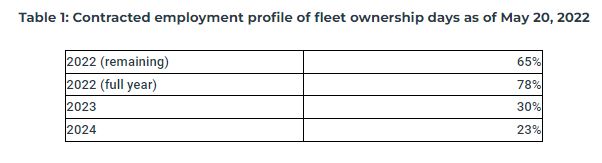
During the first quarter of 2022, we operated 39.54 vessels on average earning a TCE14 of $21,352 compared to 42.27 vessels earning a TCE of $15,567 during the same period in 2021. Our contracted employment profile is presented below in Table 1.

Debt Profile
As of March 31, 2022 our consolidated debt before deferred financing costs was $409.4 million, including the €100 million bond issued in February 2022 maturing in 2027. During the first quarter of 2022, we made scheduled principal payments of $10.3 million and made voluntary debt prepayments of $81.8 million. The repayment schedule of our debt as of March 31, 2022 is presented in Table 2 below:
Table 2: Loan repayment Schedule
(in USD million)
Liquidity and capital resources, capital expenditure requirements and debt as of March 31, 2022
We had $166.3 million in cash, cash equivalents, bank time deposits and restricted cash, $146.6 million in undrawn borrowing capacity available under revolving reducing credit facilities and $46.2 million in secured commitments for loan and sale and lease back agreements, in relation to two newbuild vessels. Furthermore, we have contracted revenue of approximately $426.3 million, net of commissions, from our non-cancellable spot and period time charter contracts, and additional borrowing capacity in relation to five unencumbered vessels and seven newbuilds upon their delivery.
We had a fleet of 40 vessels and had an orderbook of nine newbuild vessels. The remaining capital expenditure requirements were $242.9 million in aggregate, consisting of $241.5 million in relation to the nine newbuild vessels on order and $1.4 million in relation to one exhaust gas cleaning device (‘Scrubber’) and several ballast water treatment systems (‘BWTS’) retrofits. The schedule of payments of the remaining capital expenditure requirements is $53.7 million in 2022, $141.8 million in 2023 and $47.4 million in 2024.
We had $409.4 million of outstanding consolidated debt, including the Bond issued in February 2022, before deferred financing costs.
Liquidity and capital resources, capital expenditure requirements and debt as of May 20, 2022
We had $141.5 million in cash, cash equivalents, bank time deposits, restricted cash, $136.6 million in undrawn borrowing capacity available under revolving reducing credit facilities and $20.0 million in secured commitment for a loan agreement, in relation to one newbuild vessel. Furthermore, we have contracted revenue from our non-cancellable spot and period time charter contracts of approximately $463.7 million, net of commissions, and additional borrowing capacity in relation to six unencumbered vessels and seven newbuilds upon their delivery.
We had a fleet of 42 vessels, and had placed orders for eight newbuild vessels. The remaining capital expenditure requirements were $218.6 million in aggregate, consisting of $217.4 million in relation to the eight newbuild vessels on order and $1.2 million in relation to one Scrubber and several BWTS retrofits. The schedule of payments of the remaining capital expenditure requirements is $29.4 million in 2022, $141.8 million in 2023 and $47.4 million in 2024.
We had $438.4 million of outstanding consolidated debt, including the Bond issued in February 2022, before deferred financing costs.
Derivatives
In January 2022, the Company terminated certain interest rate derivative contracts that were due to mature in 2025 and 2026 with an aggregate notional amount of $240.0 million and received an aggregate payment of $8.3 million. At the same time, the Company entered into pay-fixed, receive-variable interest rate derivative contracts commencing in January 2022 and February 2022 and maturing in January 2024 and February 2024 for an aggregate notional amount of $240.0 million, at an average fixed rate of 1.346%.
In February 2022, following the issuance of our 100 million Euro corporate Bond of 2.95% coupon, the Company terminated all outstanding interest rate derivative contracts with an aggregate notional amount of $300.0 million and received an aggregate payment of $2.8 million.
During the first quarter of 2022, the Company entered into forward freight agreements on the Panamax index for 675 days in aggregate for the period to March 2023. The objective of these trades is the reduction of the risk arising from the volatility in the charter rates.
Environmental Social Responsibility – Environmental investments – Dry-dockings
The Company continues the retrofit of its vessels with BWTS having installed such systems on 39 of 42 existing vessels as of May 20, 2022. Furthermore, the Company has entered into two agreements for additional Scrubber installations in two of its Capesize class vessels, one of which was initiated in February 2022.
The Company is pursuing a vessel upgrade program during dry-dockings, in the amount of $2.2 million for 2022, which involves environmental upgrades including application of low friction paints and installation of energy saving devices. During 2022 we expect such upgrades to be implemented in the following vessels: MV Efrossini, MV Pelopidas, MV Pedhoulas Rose, MV Venus Horizon, MV Katerina and MV Sophia.
The Company has scheduled four dry-dockings for the second and third quarters of 2022 with an estimated aggregate number of 105 down-time days during the second quarter 2022 and 60 down-time days during the third quarter 2022.
Dividend Policy
On May 25, 2022, the Board of Directors of the Company declared a cash dividend on the Company’s common stock of $0.05 per share which is payable on June 15, 2022 to shareholders of record of the Company’s common stock at the closing of trading on June 8, 2022. As of May 20, 2022, the Company had 121,655,486 shares of common stock issued and outstanding.
On March 4, 2022, the Board of Directors of the Company declared a cash dividend on the Company’s common stock of $0.05 per share which was paid on March 28, 2022 to shareholders of record of the Company’s common stock at the at the close of trading on March 21, 2022.
The Company declared a cash dividend of $0.50 per share on each of its 8.00% Series C Cumulative Redeemable Perpetual Preferred Shares (NYSE: SB.PR.C) and 8.00% Series D Cumulative Redeemable Perpetual Preferred Shares (NYSE: SB.PR.D) for the period from January 30, 2022 to April 29, 2022, which was paid on May 2, 2022 to the respective shareholders of record as of April 20, 2022.
The declaration and payment of dividends, if any, will always be subject to the discretion of the Board of Directors of the Company. There is no guarantee that the Company’s Board of Directors will determine to issue cash dividends in the future. The timing and amount of any dividends declared will depend on, among other things: (i) the Company’s earnings, fleet employment profile, financial condition and cash requirements and available sources of liquidity; (ii) decisions in relation to the Company’s growth, fleet renewal and leverage strategies; (iii) provisions of Marshall Islands and Liberian law governing the payment of dividends; (iv) restrictive covenants in the Company’s existing and future debt instruments; and (v) global economic and financial conditions.
Conference Call
On Thursday, May 26, 2022 at 9:00 A.M. Eastern Time, the Company’s management team will host a conference call to discuss the Company’s financial results.
Participants should dial into the call 10 minutes before the scheduled time using the following numbers: 1 (877) 553-9962 (US Toll Free Dial In), 0(808) 238-0669 (UK Toll Free Dial In) or +44 (0) 2071 928592 (Standard International Dial In). Please quote Safe Bulkers to the operator.
Slides and Audio Webcast
There will also be a live, and then archived, webcast of the conference call, available through the Company’s website (). Participants in the live webcast should register on the website approximately 10 minutes prior to the start of the webcast.
Management Discussion of First Quarter 2022 Results
During the first quarter of 2022, we operated in an improved charter market environment compared to the same period of 2021, with lower interest expenses and increased revenues which also include earnings from Scrubber fitted vessels. During the first quarter of 2022, we had a TCE of $21,352 compared to a TCE of $15,567 during the same period in 2021. The net income for the first quarter of 2022 reached $36.4 million compared to net income of $21.3 million during the same period in 2021. In more detail the change in net income resulted from the following main factors:
Net revenues: Net revenues increased by 24% to $77.7 million for the first quarter of 2022, compared to $62.5 million for the same period in 2021, mainly due to the increased TCE rate as a result of the improved market, assisted by the additional revenues earned by our Scrubber fitted vessels.
Vessel operating expenses: Vessel operating expenses increased by 14% to $20.4 million for the first quarter of 2022 compared to $17.9 million for the same period in 2021, mainly affected by increased dry-docking expenses, which include low-friction paints application for upgrading the vessels’ environmental performance, increased provision of technical services and increased crew repatriation expenses due to the COVID-19 pandemic. In more detail: i) dry-docking expenses increased to $2.7 million related to one fully and three partially completed dry-dockings during the first quarter of 2022, compared to $1.3 million related to one fully and one partially completed dry-docking for the same period of 2021, ii) repairs and maintenance, excluding dry-docking expenses, increased to $1.5 million compared to $0.8 million for the same period in 2021, and iii) crew wages, repatriation and related costs increased to $9.0 million for the first quarter of 2022 compared to $8.8 million for the same period in 2021. The Company expenses dry-docking and pre-delivery costs as incurred, which costs may vary from period to period. Excluding dry-docking and pre-delivery costs of $2.8 million and $1.3 million for the first quarter of 2022 and 2021, respectively, vessel operating expenses increased by 6% to $17.6 million during the first quarter of 2022 in comparison to $16.6 million during the same quarter of 2021. Dry-docking expense is related to the number of dry-dockings in each period and pre-delivery expenses are related to the number of vessel deliveries and second hand acquisitions in each period. Other shipping companies may defer and amortize dry-docking expense and many do not include dry-docking expenses within vessel operating expenses costs but present these separately.
Depreciation: Depreciation expense decreased by $2.0 million, or 15% to $11.3 million for the first quarter of 2022, compared to $13.3 million for the same period in 2021, as a result of changing the estimate of vessels’ residual value, from a scrap rate of $182 per light weight ton to $375 per light weight ton, effective January 1, 2022. The basic and diluted net earnings per share for the three months ended March 31, 2022 would have been $0.26 per share and $0.23 per share, respectively, if there was no change in the estimated scrap value, representing a $0.02 and $0.01 change to the basic and diluted net earnings per share, respectively.
Interest expense: Interest expense decreased to $2.9 million in the first quarter of 2022 compared to $4.3 million for the same period in 2021, as a result of the reduction of the outstanding loans as well as the decreased USD LIBOR16 affecting the weighted average interest rate of our loans and credit facilities.
(Loss)/Gain on derivatives: Gain on derivatives amounted to $4.2 million in the first quarter of 2022 compared to a loss of $0.9 million for the same period in 2021, as a result of the termination of all outstanding interest rate derivative contracts during the first quarter of 2022.
Daily vessel operating expenses: Daily vessel operating expenses, calculated by dividing vessel operating expenses by the ownership days of the relevant period, increased by 22% to $5,722 for the first quarter of 2022 compared to $4,702 for the same period in 2021. Daily vessel operating expenses excluding dry-docking and pre-delivery expenses increased by 13% to $4,923 for the first quarter of 2022 compared to $4,350 for the same period in 2021.
Daily general and administrative expenses17: Daily general and administrative expenses, which include management fees payable to our Managers18 and daily company administrations expenses, increased by 6% to $1,520 for the first quarter of 2022, compared to $1,440 for the same period in 2021, as a result of increased personnel expenses and third party fees of the company.
Balance sheet
Right-of-use /Lease Liability: As of March 31, 2022, we had classified the asset and liability directly associated with the acquisition of the vessel Stelios Y: as a) Right-of-use asset and presented it on the balance sheet separately under Fixed assets in the amount of $31.6 million, which represents i) the advance payments and additional purchase costs paid for the vessel and ii) the future payments under the 12-month period bareboat charter that commenced in November 2021 net of accumulated depreciation of $0.6 million, and as (b) Current Lease liabilities of $20.8 million, representing the outstanding balance of the present value of the lease payments of the above mentioned 12-month bareboat charter.
Source: Safe Bulkers, Inc.