Since the beginning of the year, COSCO SHIPPING Heavy Industry (Shanghai) has firmly focused on its “11210” project, charting a clear development course. The company has made simultaneous strides in ship repair, conversion, and new energy projects, deepening efforts across four key dimensions: capacity expansion, efficiency improvement, specialization, and integration. Driven by technological innovation and lean management, it has delivered outstanding results in both ship repair efficiency and low-carbon transformation. From pioneering smart ship repair techniques to breakthroughs in methanol dual-fuel conversions, from low-carbon silicone coating applications to the integration of onboard carbon capture systems, the company is leading a new era of green transformation with comprehensive, industry-wide sustainable solutions.
In the first half of the year, COSCO SHIPPING Heavy Industry (Shanghai) achieved remarkable progress in ship repair, with steady increases in both the number of vessels serviced and operational efficiency. By optimizing production workflows and enhancing management practices, the company met its repair targets while making strides in schedule control and dock period management. Notably, in specialized projects such as hull blasting, technological innovations and process improvements significantly reduced turnaround times, achieving breakthroughs in both productivity and cycle optimization.
Lean Ship Repair · Green Efficiency Revolution
With a focus on green processes and smart equipment, COSCO SHIPPING Heavy Industry (Shanghai) has elevated both repair efficiency and environmental performance. Through innovations like silicone coatings, shaft generator retrofits, and automation, the company has not only shortened project timelines and reduced energy consumption but also minimized pollution across the entire repair process, embodying the principles of green ship repair.
Silicone Coating Reduces Vessel Fuel Consumption: During the 10-year special survey of the COSCO Atlantic, the company employed direct flat-bottom silicone spraying, deploying 8 boom lifts, 7 robotic units, 29 flat-bottom blasting machines, and 52 water jets to efficiently complete 30,000 square meters of surface preparation. The silicone coating reduces hull resistance, cutting annual fuel consumption and associated emissions.
Shaft Generator Powers Energy Efficiency: The COSCO Talents was retrofitted with a 1,700 kW shaft generator, utilizing surplus engine power to meet all onboard electricity needs—including scrubber systems, ballast water treatment, and general ship power—while drastically lowering carbon emissions. With the shaft generator in operation, auxiliary generators can be shut down entirely, significantly reducing engine room noise and improving crew working conditions. This retrofit exemplifies the industry’s shift toward green, low-carbon, and intelligent operations, delivering both economic and environmental benefits.
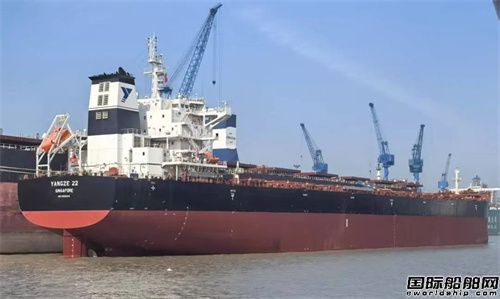
Green Techniques Set New Standards in Hull Repair Efficiency: After a collision, the 82,000 DWT bulk carrier Yangzi 22 required extensive repairs to its hull and breached fuel tanks. Using 3D modeling for prefabricated sections and block-by-block parallel construction, COSCO SHIPPING Heavy Industry (Shanghai) completed the replacement of 485 tons of steel in just 10 dock days, finishing structural and mechanical upgrades within 70 days. The project adhered to strict zero-emission pollution controls.
Automation Drives Low-Carbon Operations: The introduction of 8 boom lifts, 4 dock-floor vehicles, and 14 flat-bottom machines boosted blasting efficiency while reducing labor hours. Axis-guided vehicles were used for bulbous bow and propeller work, slashing dock time. In the MSC Gina project, bulbous bow replacement was completed in just 48 hours—far surpassing traditional hydraulic rail methods in speed, stability, and safety.
Offshore Project Delivery: On February 20, the world’s first FPSO equipped with onboard carbon capture and storage (CCS), the AGOGO FPSO, was christened at COSCO SHIPPING Heavy Industry’s Changxing Island facility and departed on March 3 from Pier 7.
During Phase II integration, the company installed 10 upper modules weighing over 15,000 tons and laid 830,000 meters of cabling, achieving breakthroughs in lifting technology. The entire conversion was completed one month ahead of schedule, setting a new global benchmark for FPSO retrofits at 24 months.
New Energy Breakthroughs · Building a Low-Carbon Ecosystem
In the new energy sector, COSCO SHIPPING Heavy Industry (Shanghai) has developed end-to-end solutions for methanol and LNG conversions. Landmark projects like China’s first methanol bunkering and ship-to-ship LNG refueling have broken technical barriers, advancing the green shipping ecosystem and supporting national carbon neutrality goals.
Methanol Dual-Fuel Retrofit: The COSCO SHIPPING Libra docked at the company’s facility for a critical methanol dual-fuel conversion, covering main and auxiliary engines as well as fuel systems. Once completed, the retrofit will significantly cut per-voyage emissions, enhancing the vessel’s green competitiveness and reinforcing the company’s role as a leader in smart, sustainable ship repair.
Methanol Bunkering Milestone: In May, China’s first 16,000 TEU methanol dual-fuel container ship, the COSCO SHIPPING Yangpu, received approximately 900 tons of methanol fuel in Shanghai. The company conducted comprehensive risk assessments and implemented stringent safety measures, setting a benchmark for future methanol bunkering operations.
LNG Gas Replacement Efficiency: During the gas replacement for the 23,000 TEU LNG dual-fuel CMA CGM Sade, nitrogen purging was completed in 28 hours, followed by 10 hours for air quality compliance—a major efficiency gain over previous projects. New techniques and equipment were key to this achievement.
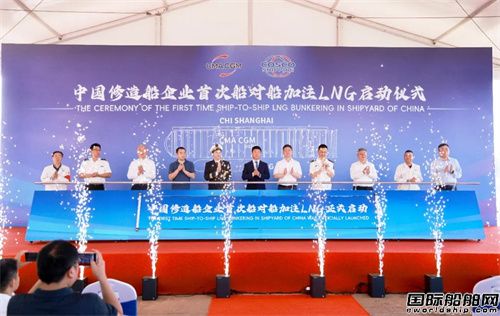
China’s First Ship-to-Ship LNG Bunkering: In June, the CMA CGM Sade received LNG via ship-to-ship transfer at COSCO SHIPPING Heavy Industry (Shanghai), a national first for dual-fuel vessels. The repair scope included LNG system maintenance, ballast water upgrades, windbreak installation, and silicone hull coating. The fuel system overhaul involved rigorous air/gas replacement and cryogenic procedures, achieving zero-emission bunkering. This milestone underscores the company’s commitment to China’s “dual-carbon” strategy and green shipping, offering a model for the industry’s low-carbon future.
“A time will come to ride the wind and cleave the waves; I’ll set my cloud-white sail and cross the sea which raves.” In the first half of 2025, COSCO SHIPPING Heavy Industry (Shanghai) has made green innovation its hallmark, embedding carbon neutrality into every process—from the AGOGO FPSO’s pioneering CCS to methanol dual-fuel retrofits, and the widespread adoption of silicone coatings and shaft generators. The company has established a three-dimensional development framework: low-carbon ship repair, new-energy conversions, and industrial ecology.
At this pivotal moment in maritime green transformation, the company will continue to embrace a pioneering spirit, guided by its “one core, two wings” strategy. By deepening expertise in green repair and new energy conversions—and accelerating smart logistics technologies—it aims to solidify its position as a flagship hub for sustainable, intelligent ship and offshore engineering services.