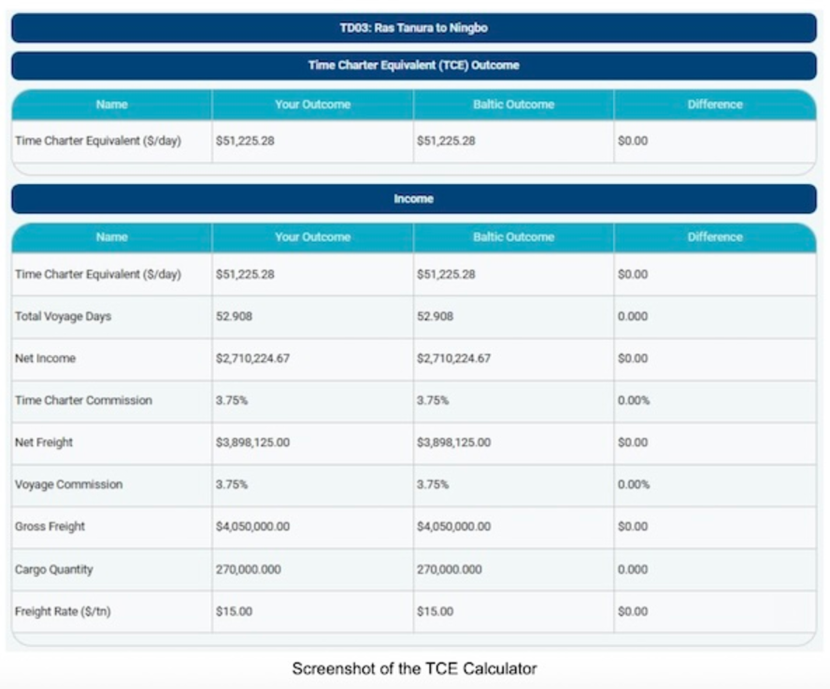
The Baltic Exchange’s new Time Charter Equivalent (TCE) calculator is designed to provide clarity and consistency in freight assessment within an increasingly complex market. This calculator is based on the long-established TCE methodology used by the Baltic Exchange, which has been in application since 2008.
Users can view the components of the standard calculation, including revenue lines, costs, and port and canal dues, which helps ensure transparency and accurate benchmark comparisons. This is particularly important as vessel operations adapt to new trading patterns driven by geopolitical tensions and changes in global shipping routes.
Stephen Aitchison, Senior Freight Market Assessor at the Baltic Exchange, stated that market participants have consistently requested greater transparency and consistency in freight earnings comparisons. The new calculator, directly based on our established TCE benchmarks, transforms complex calculations into a clear, practical tool that reflects real-world trading conditions against Baltic standard vessels and routes.
Martin Crawford Brunt, Head of Emissions at the Baltic Exchange, added that this calculator can transform a complex set of variables into a standardized and comparable format, providing useful outputs, including data related to emissions regulations. It allows users to evaluate their vessels against Baltic market standards, enabling them to understand the difference per tonne or per day and test different speeds and energy consumption profiles against routes. It is a practical tool for shipowners, charterers, and brokers.
The tool is currently applied to dry bulk carriers, tankers (crude and product), LNG, and LPG carriers, reflecting the standardized Baltic routes for these vessel segments. It will continue to evolve, with future iterations integrating complex emissions regulations and other operational variables.
This calculator complements other Baltic tools, including the FuelEU Maritime calculator and the Voyage Cost Estimator, enabling users to assess the impact of fuel choices, emissions compliance, and efficiency improvements within a fully integrated framework. By linking these tools, the Baltic Exchange provides the market with a comprehensive suite of transparent tools for freight and operational analysis.
Source: Baltic Exchange