China News Network, Heihe, July 10 (By Meng Lili, Reporter Shi Yifu) China National Pipeline Network Group Northeast Company announced on July 10 that as of the same day, the cumulative gas transmission volume of China’s “North-to-South Gas Transmission” energy corridor has exceeded 100 billion cubic meters, with safe and stable operation for over 2,000 days. This milestone marks significant progress in ensuring China’s energy security and advancing the green transition through this north-south energy artery.
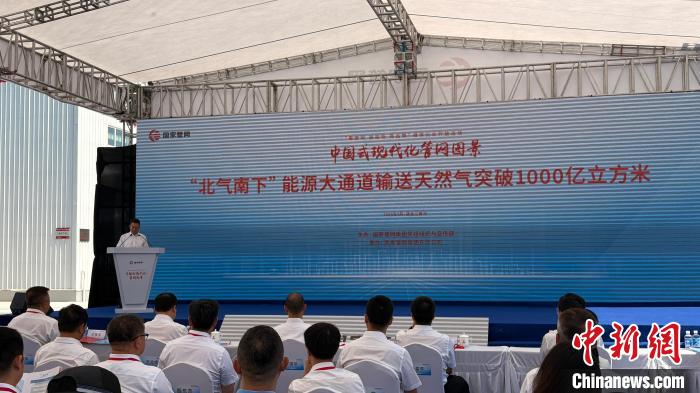
As of July 10, the cumulative gas transmission volume of China’s “North-to-South Gas Transmission” energy corridor has exceeded 100 billion cubic meters, with safe and stable operation for over 2,000 days. Photo by Meng Lili
As a key energy infrastructure project completed during China’s 14th Five-Year Plan and an important component of the Northeast Corridor of the “Four Major Energy Strategic Channels,” the “North-to-South Gas Transmission” energy corridor stretches from Heihe in Heilongjiang Province in the north to Shanghai in the south, passing through nine provinces, autonomous regions, and municipalities.
Since the northern section became operational in 2019 and the entire pipeline was fully connected in 2024, its average daily gas distribution has exceeded 110 million cubic meters, with an annual transmission capacity of 38 billion cubic meters. This can meet the annual gas demand of 130 million urban households, benefiting over 400 million people along the route and effectively ensuring stable natural gas supply to Northeast China, the Beijing-Tianjin-Hebei region, the Bohai Rim, and the Yangtze River Delta.
As China’s first long-distance pipeline with fully domestically produced key equipment and core control systems, it interconnects with the Northeast Pipeline Network and the West-to-East Gas Pipeline, forming a national gas supply pattern of “North-to-South Gas Transmission, Offshore Gas Landing, West-to-East Gas Transmission, and Sichuan-to-East Gas Transmission,” thereby enhancing emergency peak-shaving capabilities.
In the first half of 2025, nearly 15.7 billion cubic meters of natural gas entered the Yangtze River Delta region via the “North-to-South Gas Transmission” corridor, accounting for one-third of the region’s current gas consumption.
During this year’s peak summer demand period, the pipeline supplied 60 million cubic meters of gas daily to Shanghai, Zhejiang, and other areas, a 4% increase compared to the same period in 2024, alleviating the pressure of gas and power supply in East China.
The transmission of 100 billion cubic meters of natural gas through the “North-to-South Gas Transmission” pipeline is equivalent to planting 820 million fir trees, purifying 420 billion cubic meters of air. It also continuously promotes the green transformation of industries such as steel and chemicals along the route, contributing to the achievement of the “dual carbon” goals. (End)