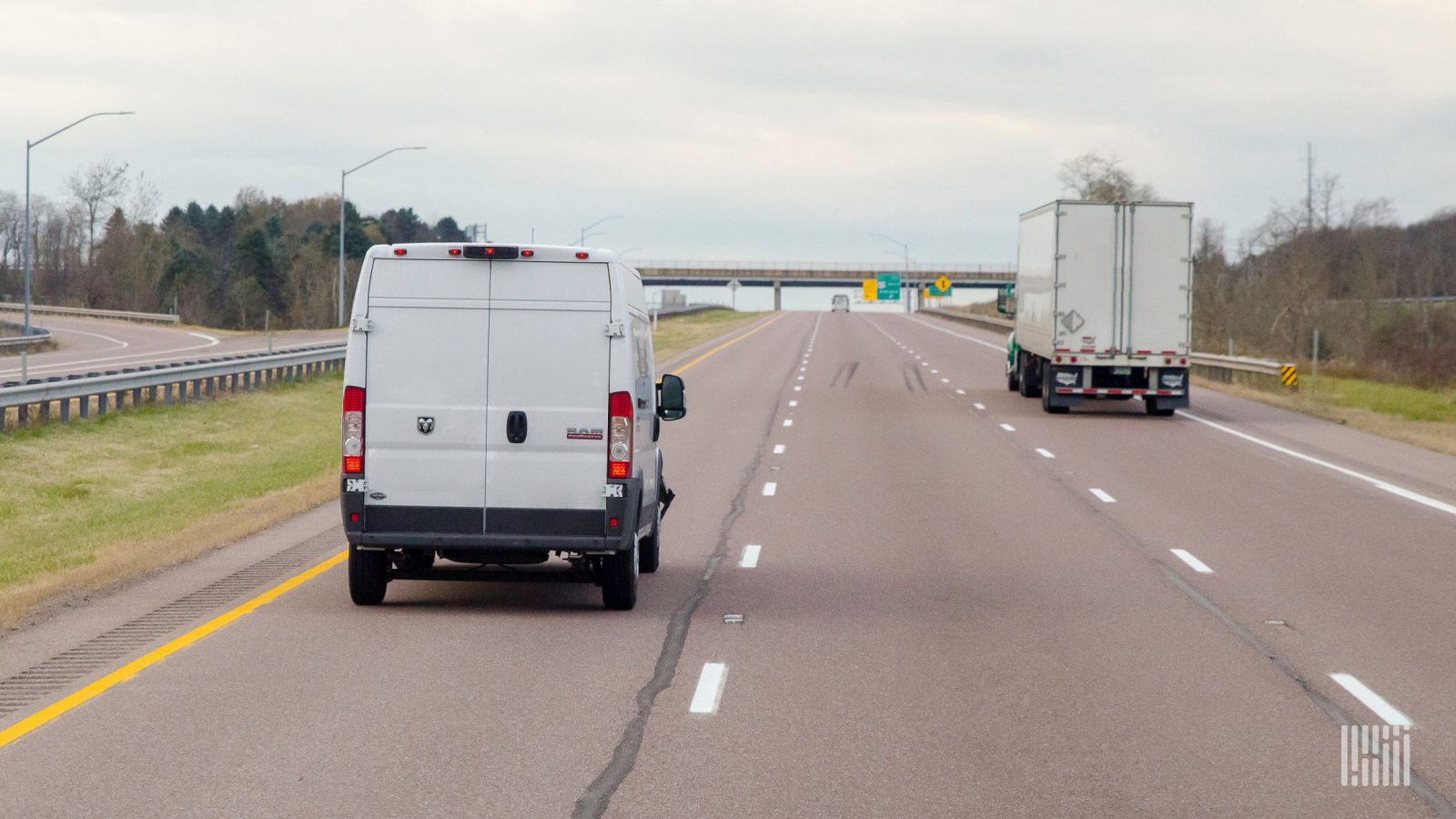
As e-commerce growth slows, last-mile delivery providers remain under pressure to deliver for shippers, even if they don’t know how much of their services will be required. (Photo: Jim / )
The challenges of the past few years have strained last-mile delivery networks. And just as they have started maturing with new entrants and efficiencies unlocked, e-commerce started slowing from its pandemic roll. Where exactly it stops, no one is quite sure, but last-mile providers don’t have time to wait. They must service the now and build for the future.
And a shortage of drivers is just one of the challenges facing the last mile.
Slowing e-commerce sales
Capacity demand slows, for some
“Drivers will remain difficult to hire and retain,” Sackos noted. “I do think overall that freight demand, or freight tonnage, will continue to be down year over year as COVID-weary consumers choose experiences and travel over things in 2022. … Last-mile delivery of food and smaller items will grow less rapidly in 2022, but the last-mile delivery of bulky will continue to grow as retailers try to apply lessons learned in small delivery to larger items.”
“Our Shipt Driven business is our fastest-growing product line and has grown by more than 100% over the past year alone, demonstrating the heightened need for quick and easy doorstep delivery,” Rina Hurst, chief business officer, told Modern Shipper. “Our business model also allows us to offer retailers something traditional parcel carriers can’t — faster speeds and high-quality, personalized service at an economical cost.”
Automating the middle mile
A lasting market change?
“For last mile, I think it’s cooled off a bit with a lot of shippers diversifying their carrier bases more before the last peak season after being burned by COVID,” he said.
With that said, Sokolovsky noted the middle mile is easier to enter for firms than the last mile, creating an interesting dynamic for shippers seeking solutions in both.
“The bar for service quality in the last mile, especially amongst regionals, is high,” he said. “Service quality has always been the easy way to convince a shipper to move away from sole sourcing with national carriers. The bar for middle mile is astonishingly low so even when we haven’t been the cheapest on rates, a lot of shippers have trusted our reputation for quality and went with us.”
Mixed bag on parcel volumes
UPS said that daily volume growth for small and midsized businesses (SMBs) made up 28.4% of total U.S. volume in Q1. Total average daily volume, though, was down 3% to 611,000 packages per day versus Q1 2021. Residential volumes declined 7.4%, but B2B volumes were up 3.6%.
As e-commerce has slowed, Sokolovsky said the market has adapted.
“We went from a super-strong carrier market throughout COVID to a strong shipper market in the last three months — supply outpaced demand,” he said. “Supply [drivers and carriers] that was /propped up on shaky financial footing will be pushed out of the market. Demand [on goods] has significantly eased from its COVID peaks. This will find its balance by the back end of this year.”
Shippers seek more options
“The concept of carrier diversification is everything and the ability to have interoperability … between modes is also very important,” he said. “We see more and more diversity not only in carriers but also in the drivers that handle [deliveries for us]. We have seen on-time rates improve and I think that has to do with redundancy (plenty of carriers in the market) that is favoring carriers that get deliveries done on time.”
“We were averaging about 90% on time pre-COVID, but we still haven’t recovered,” Jenny Bebout, global leader of last-mile solutions at project44, said, noting that on-time rates today are about 80%. There are many reasons, she said, including port congestion, supply chain bottlenecks and warehouse fulfillment issues that include a shortage of labor.
Sackos said brands and retailers continue to look for more last-mile delivery partners to broaden their carrier base, hoping to both secure capacity and flexibility. Bebout noted that since May 2019, the average project44 shipper has seen a 20% increase in the average number of carriers per customer, from 4.14 to 4.9.
An e-commerce update
E-commerce has a long way to go
“I would say our service demand is growing due to increases in fuel and delivery service costs,” he said. “As the BOPA model is based on delivering to commercial locations in which multiple packages can and are delivered at the same time, the fuel cost is split, making it more attractive.”
Nikitin said that while COVID accelerated e-commerce and the need for last-mile delivery, the transition is still ongoing.
“I believe we are very far from a balance point if you think about /brick-and-mortar retail sales distribution,” he said. “Shopping habits, like any others, take quite a while to shift, especially for a more /senior segment of shoppers. Yes, COVID took us maybe five years ahead of schedule in changing those habits. But the overall shift is not completed yet and will take another 10 years or so.”
Data suggests online sales still make up less than 20% of overall retail sales. According to the U.S. Department of Commerce, total e-commerce sales in 2021 were $870.8 billion, an increase of 14.2% over 2020 during the height of the pandemic, but still just 17.9% of total retail sales in 2021. That was up from 13.2% the year prior.
The future of the last mile
Where 2022 will land is anyone’s guess. Current expectations are that online commerce will continue to grow, albeit more in line with historical norms. Both Sokolovsky and Sackos noted consumers were shifting more spending to services rather than goods as COVID-related restrictions expired and the weather is turning warmer across the country.
“The goods economy will be softer as consumers get newly acclimated to the post-COVID world, but barring any further COVID disruption, we should start to find a new balance by the end of year,” Sokolovsky said.
Bebout said disruption in the market is holding back growth.
“I don’t expect things to improve anytime soon,” she said. “Demand and the overall economy may have reduced a little bit, but worker [shortages and other issues have not let up].”
For last-mile providers, Nikitin offered a positive outlook, including a record-breaking holiday season.
“While overall DTC (direct-to-consumer) volume may be softer than planned, I expect our [Via.Delivery] services to continue to thrive as we are not expecting carriers to simply drop their rates back to the days of the late 20-teens,” he said. “Carriers have spent huge capital on expanding their networks, and they still need to pay for these investments in as short a time frame as they can. On top of that, a labor shortage and inflation will not help either. But regardless of that softness, by the end of the year, we will be witnessing another holiday season online sales records.”